Road Map
Follow a structured learning path from basic mechanics to modern physics — each topic builds on the last, so you’re never lost. Our roadmap guides you step by step through every core concept, making sure you build real understanding before moving forward.
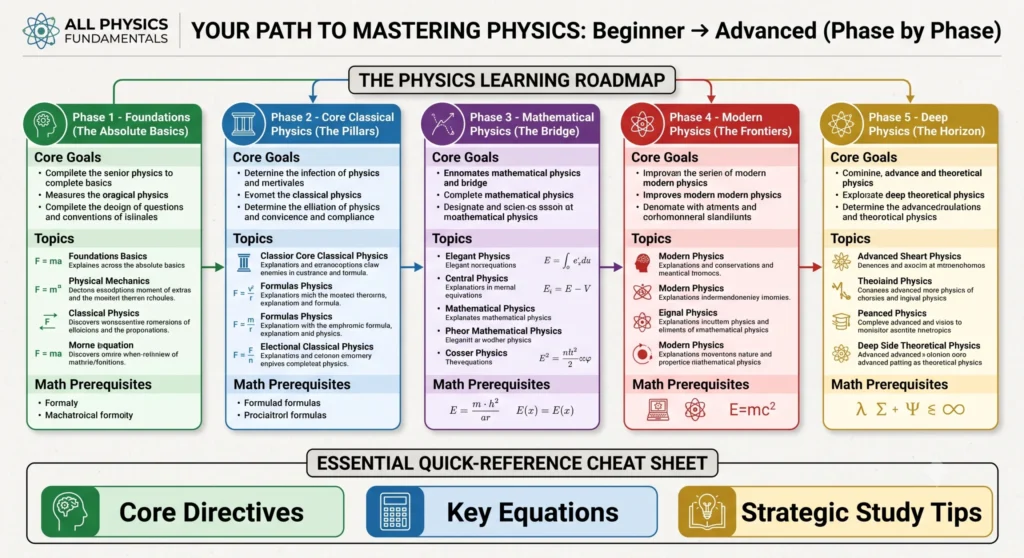
🌐 Comprehensive Physics Learning Roadmap
🟢 Phase 1: Foundations (The Absolute Basics)
Core Goal
Develop an intuitive, mechanical understanding of motion, forces, and energy in everyday life.
Core Topics
- Kinematics: Understanding position, velocity, and acceleration (v = u + at).
- Newton’s Laws of Motion: Explaining why objects move, accelerate, or stay at rest (F = ma).
- Work, Energy, & Power: Calculating work done, kinetic energy (KE = ½mv²), and gravitational potential energy (PE = mgh).
- Linear Momentum: Analyzing collisions and conservation laws (p = mv).
Mathematical Prerequisite
Basic algebra, arithmetic, and interpreting linear or quadratic graphs.
🎯 Phase Outcome
You can systematically analyze, diagram, and solve real-world mechanical motion problems using free-body diagrams.
🔵 Phase 2: Core Classical Physics (The Pillars of Reality)
Core Goal
Transition from basic particle motion to complex, continuous physical systems.
Core Topics
- Rotational Dynamics: Angular velocity, torque, and moment of inertia.
- Gravitation: Kepler’s laws and Newton’s Law of Universal Gravitation (F = Gm₁m₂/r²).
- Thermodynamics: Heat transfer, ideal gas behavior, and the laws of entropy.
- Oscillations & Wave Mechanics: Simple harmonic motion, wave equations, and sound propagation.
- Electromagnetism: Electric fields, Coulomb’s law, circuits (V = IR), and magnetic forces.
Mathematical Prerequisite
Basic trigonometry and a conceptual introduction to derivatives and integrals.
🎯 Phase Outcome
You understand the classical laws governing macro-scale real-world physics systems.
🟣 Phase 3: Mathematical Physics (Bridging Intuition & Rigor)
Core Goal
Move away from formula memorization and learn to derive the laws of nature from first principles.
Core Topics
- Vector Calculus: Gradient, divergence, curl, and line integrals.
- Differential Equations: Setting up and solving ordinary and partial differential equations for physical systems.
- Classical Field Theory: Formulating Maxwell’s Equations for electrodynamics.
Where This Applies
Deriving advanced wave equations, fluid dynamics, and foundational motion equations.
🎯 Phase Outcome
You stop viewing physics as separate formulas and begin viewing it as a unified language written in calculus.
🔴 Phase 4: Modern Physics (Beyond the Everyday Experience)
Core Goal
Explore reality at scales where everyday human intuition completely fails.
Core Topics
- Quantum Mechanics: The wave function (ψ), probability density, and the Heisenberg Uncertainty Principle (ΔxΔp ≥ ħ/2).
- Special Relativity: Time dilation, length contraction, and mass-energy equivalence (E = mc²).
- General Relativity: Spacetime curvature, gravitational time dilation, and the geometry of gravity.
🎯 Phase Outcome
You understand the quantum nature of atoms and the relativistic structure of space and time.
🟡 Phase 5: Deep Theoretical Physics (Unified Frameworks)
Core Goal
Discover how the fundamental forces and symmetries of the universe connect at the deepest level.
Core Topics
- Quantum Field Theory (QFT): Merging quantum mechanics with special relativity.
- The Standard Model: Classification of elementary particles (quarks, leptons, gauge bosons).
- Symmetry & Conservation: Noether’s Theorem linking symmetries directly to conservation laws.
- Cosmology: The early universe, inflationary theory, and the geometry of the cosmos.
🎯 Phase Outcome
You comprehend physics at the edge of modern human knowledge.
⚡ Interactive Physics Cheat Sheet
🧠 Core Directives
- Force: The agent that changes the state of motion.
- Energy: The currency of the universe; it can change form but is always conserved.
- Entropy: The measure of system disorder; it always increases in an isolated system.
- Fields: Continuous entities that mediate forces across space.
- Quantum Scale: Inherently probabilistic, not deterministic.
- Relativity Scale: Space and time are a dynamic, flexible fabric woven together.
📐 Foundational Equations
Kinematics
- v = u + at
- s = ut + ½at²
Dynamics
- F = ma
Energy & Momentum
- KE = ½mv²
- PE = mgh
- p = mv
Electrodynamics
- V = IR
🌍 Universal Forces & Frameworks
- Gravitational Force: Weakest force; acts over infinite distances between masses.
- Electromagnetic Force: Governs atomic structures, chemistry, and electricity.
- Strong Nuclear Force: Binds quarks together to form protons and neutrons inside nuclei.
- Weak Nuclear Force: Responsible for radioactive decay and initiating solar fusion.
📊 Strategic Study Loop
1. Master the Concept First
Focus deeply on the core physical meaning before touching equations.
2. Practice Iteratively
Solve 10–20 varied problem types per sub-topic.
3. Analyze Every Error
Isolate math mistakes from conceptual misunderstandings.
4. Utilize Dimensional Analysis
Always verify that the units on both sides of your equations balance before calculating the final answer.
Frequently Asked Questions
Get physics insights delivered weekly
Join students and educators receiving expert explanations, study tips, and platform updates every Thursday.
Join others. No spam.
allphysicsfundamentals
Making physics accessible, interactive, and genuinely understandable for students at every level.
Learn
- All Articles
- Classical Mechanics
- Thermodynamics
- Waves & Optics
- Electromagnetism
- Modern Physics