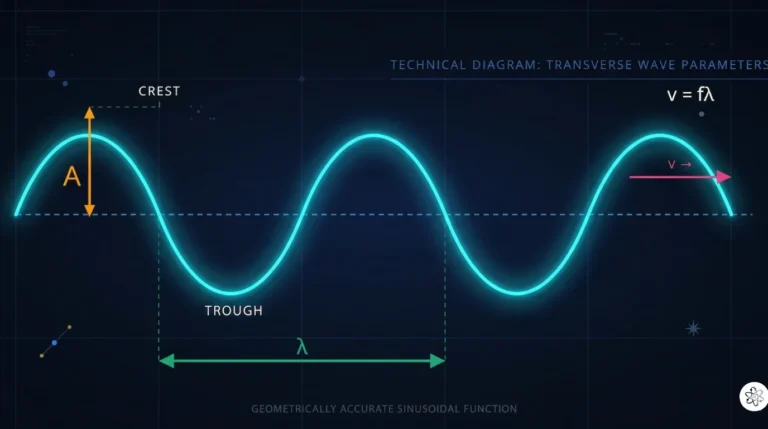
wave speed equals frequency times (v = fλ)wavelength educational source
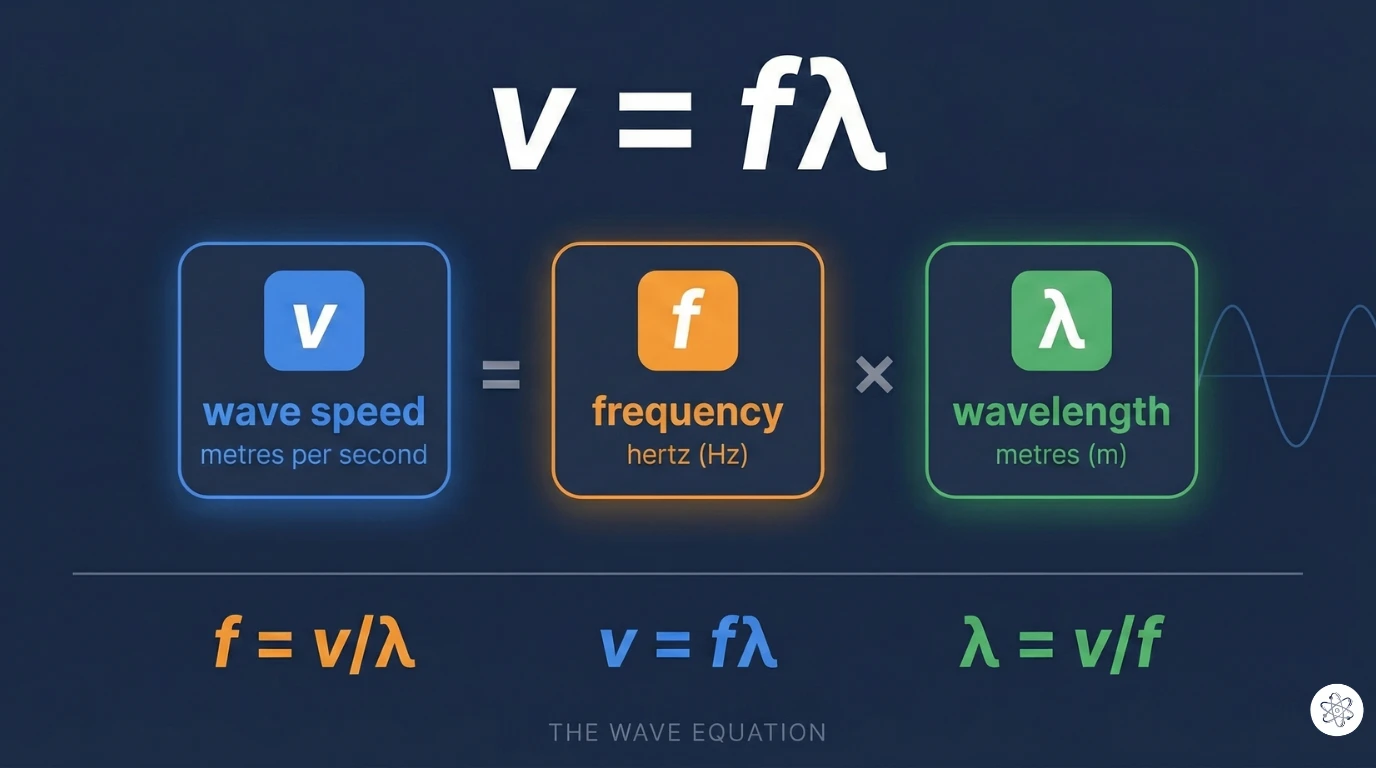
The speed of a wave can be found by multiplying its frequency by its wavelength (speed = wavelength x frequency).This equation that sits at the heart of everything waves do — whether it’s sound bouncing off walls, light streaming through a prism, or Wi-Fi signals reaching your phone across the room. That equation is v = fλ. Three letters. One relationship. And once you actually understand what it’s telling you, wave physics stops being confusing and starts making sense.
Let’s unpack it properly.
What Does v = fλ(lambda) Actually Mean?
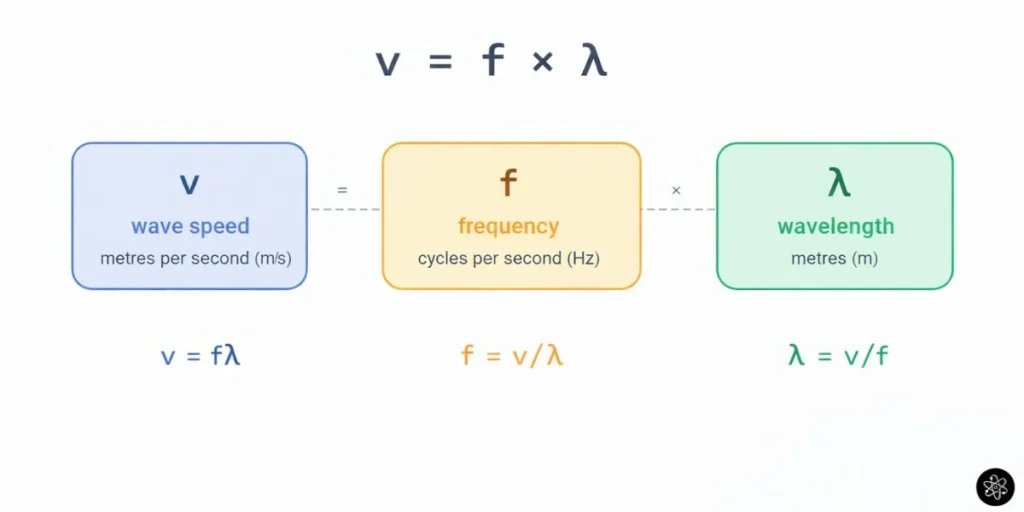
The wave equation connects three quantities: wave speed (v), frequency (f), and wavelength (λ, pronounced “lambda”). In plain English, it says the speed of a wave equals its frequency multiplied by its wavelength.
But don’t just memorize it. Think about why it works.
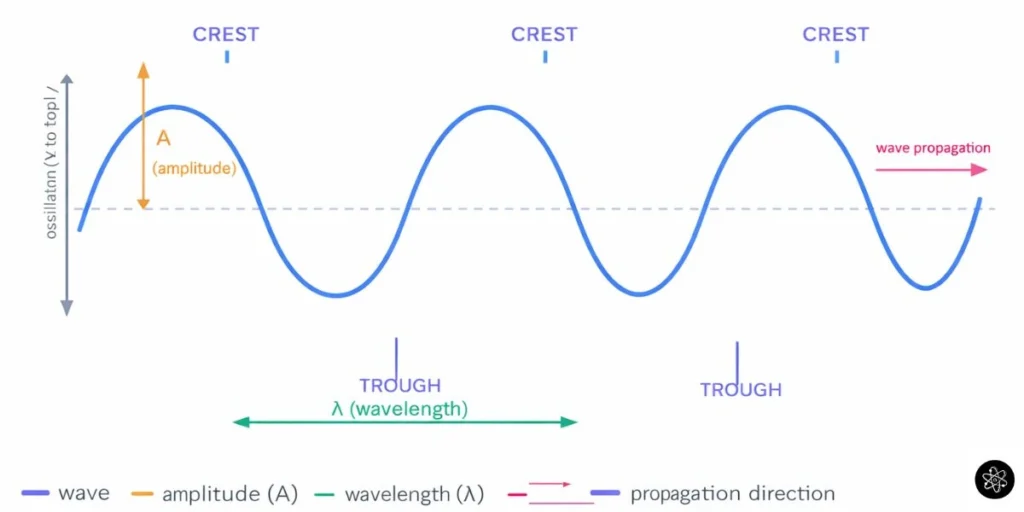
Frequency tells you how many complete wave cycles pass a fixed point every second. If f = 5 Hz, that means five full waves go by per second. Wavelength tells you how long each one of those waves is — the distance from one crest to the next, measured in meters.
So if five waves pass you every second, and each wave is 2 meters long, the wave front has traveled 5 × 2 = 10 meters in that second. That’s the speed. It’s not some abstract formula — it’s just counting how far the wave pattern moves in one second based on how many waves fit into that distance.
Frequency vs. Period — Two Sides of the Same Coin
You’ll often see another quantity thrown around alongside frequency: the period (T). Period is how long one complete cycle takes. If a wave oscillates at 100 Hz, each cycle takes 1/100 of a second, or 0.01 seconds. The relationship is dead simple:
½ m⟨v²⟩ = (3/2) k_B T
When do you use “period” instead of “frequency”? Mostly when you’re dealing with oscillating systems — pendulums, springs, LC circuits. Period feels more natural in those contexts because you’re watching one thing swing back and forth, and it’s easier to think “each swing takes 0.5 seconds” than “this swings at 2 Hz.” Same information, different framing.
Here’s the Part Most People Get Wrong
A lot of students — and even some people who should know better — think that changing the frequency of a wave changes its speed. It doesn’t. Not in the same medium, anyway.
Wave speed is determined by the medium the wave travels through. For sound in air at room temperature, the speed is about 343 m/s regardless of whether you’re playing a deep bass note or a high-pitched whistle. For light in a vacuum, every frequency — from radio waves to gamma rays — travels at exactly c = 3 × 10⁸ m/s.
So what happens when you crank up the frequency? The wavelength shrinks. It has to. Because v = fλ, and v isn’t changing, if f goes up, then λ must come down to keep the product constant. That’s why high-pitched sounds have short wavelengths and low-pitched sounds have long ones. Same speed, different packaging.
What actually controls wave speed?
For mechanical waves, speed depends on two properties of the medium — its stiffness (or elasticity) and its density (or inertia). Stiffer materials transmit waves faster. Denser materials slow them down. That’s why sound rips through steel at about 5,100 m/s but only manages 343 m/s in air. Steel is much stiffer relative to its density. Want to learn more about waves? Visit Wave Particle Duality.
For waves on a string, there’s a neat formula: v = √(T/μ), where T is the tension in the string and μ is its linear mass density (mass per unit length). Crank up the tension, the wave goes faster. Use a heavier string; it slows down. Guitar players know this intuitively — tighter strings produce higher-pitched notes, and thicker strings sound lower.
Visual Explanation of Wave Speed, Frequency & Wavelength: v = fλ
Medium (sets wave speed)
Wave speed (v)
3×10⁸ m/s
Frequency (f)
30 THz
Wavelength (λ)
10.0 μm
v = f × λ → 3×10⁸ = 30 × 1×10⁷
Finding wavelength from frequency
Concert pitch A is 440 Hz. Sound travels at 343 m/s in air. What’s the wavelength?
λ = v / f = 343 / 440 ≈ 0.78 m
So the wavelength of the note A above middle C is roughly 78 cm — about the length of your arm from shoulder to fingertip. That gives you an intuitive feel for it. Low bass notes, around 80 Hz, have wavelengths over 4 meters. That’s why bass sound is so hard to contain in a room — the waves are literally bigger than most walls are thick.
Finding frequency from wavelength
Green light has a wavelength of about 550 nm (that’s 5.5 × 10⁻⁷ m) in vacuum. What’s its frequency?
f = v / λ = (3 × 10⁸) / (5.5 × 10⁻⁷) ≈ 5.45 × 10¹⁴ Hz
That’s about 545 terahertz. Light oscillates absurdly fast — hundreds of trillions of times per second. Your eyes evolved to detect these frequencies, which is kind of mind-blowing when you put a number on it.
How Fast Do Waves Travel in Different Materials?
This is where it gets interesting. The same type of wave can travel at wildly different speeds depending on what it’s moving through.
| Wave Type | Medium | Speed |
|---|---|---|
| Sound | Air (20°C) | 343 m/s |
| Sound | Water | ~1,480 m/s |
| Sound | Steel | ~5,100 m/s |
| Light | Vacuum | 3 × 10⁸ m/s |
| Light | Glass | ~2 × 10⁸ m/s |
| Light | Water | ~2.25 × 10⁸ m/s |
Sound is roughly four times faster in water than in air. That surprised most people when they first learned it — water feels like it should slow things down, not speed them up. But water is much harder to compress than air, and that stiffness wins out over the extra density.
Light, on the other hand, actually slows down when it enters a denser medium like glass or water. And here’s where it gets really cool — different frequencies of light slow down by slightly different amounts in glass. That’s called dispersion, and it’s the reason a prism splits white light into a rainbow. Each color bends at a slightly different angle because each is traveling at a slightly different speed inside the glass.
The Electromagnetic Spectrum — Same Equation, Wildly Different Waves
Here’s something that still amazes me: radio waves, microwaves, visible light, X-rays, and gamma rays are all the same thing. They’re all electromagnetic waves. The only difference is frequency (and therefore wavelength). And they all obey v = fλ with v = c in vacuum.
Radio waves sit at the low-frequency end with wavelengths stretching from meters to kilometers. Visible light is a tiny sliver in the middle — frequencies around 430 to 750 THz, wavelengths between about 400 and 700 nanometers. X-rays and gamma rays occupy the high-frequency extreme, with wavelengths smaller than atoms.
The only thing that changes across this entire spectrum is the frequency. Speed is constant (in vacuum). And wavelength is just along for the ride, adjusting to keep v = fλ balanced. One equation, the whole spectrum. That’s elegant.
The Doppler Effect: What Happens When the Source Moves
You’ve heard this even if you didn’t know the name. An ambulance drives toward you with its siren on — the pitch sounds higher than normal. It passes you and drives away — the pitch drops. That shift in perceived frequency is the Doppler effect, and it’s a direct consequence of wave speed, frequency, and wavelength interacting with motion.
When the ambulance approaches, each successive wavefront is emitted from a position slightly closer to you than the last one. The wavefronts get bunched together in front of the vehicle — shorter wavelength, higher frequency. Behind the vehicle, the wavefronts are stretched apart — longer wavelength, lower frequency.
The wave speed through air doesn’t change — it’s still 343 m/s regardless of what the ambulance does. But the effective wavelength and frequency you perceive do change because of the relative motion.
The Doppler effect isn’t just about sirens
This same principle works for light. When astronomers look at distant galaxies and see their light shifted toward lower frequencies (toward the red end of the spectrum), that’s a Doppler-like redshift — evidence that those galaxies are moving away from us. This observation was one of the key pieces of evidence that the universe is expanding.
Police radar guns use it too. They bounce microwaves off your car, measure the frequency shift in the reflected signal, and calculate your speed from that. Medical ultrasound works the same way — bouncing sound waves off moving blood cells to measure blood flow velocity. All of it traces back to v = fλ and what happens when sources or observers are in motion.
Wave Energy: Where Frequency Really Flexes
Frequency doesn’t just affect wavelength. It directly affects how much energy a wave carries — and the relationship is different depending on the type of wave.
For electromagnetic waves (photons), the energy per photon is E = hf, where h is Planck’s constant (6.626 × 10⁻³⁴ J·s). Higher frequency means more energy per photon. That’s why ultraviolet light gives you sunburn, but radio waves don’t — UV photons carry enough energy to damage DNA. Radio photons don’t even come close.
For mechanical waves, energy depends on both frequency and amplitude: E is proportional to f²A². So doubling the frequency quadruples the energy. But doubling the amplitude also quadruples it. These are independent contributions, which explains something that might seem strange at first — a quiet, high-pitched sound and a loud, low-pitched sound can carry roughly the same amount of energy. Different combinations, same total.
Why Does Any of This Matter Outside a Classroom?
Because waves are everywhere, and v = fλ is the master key.
Telecom engineers use it to design antennas — the physical size of an antenna is closely tied to the wavelength it’s meant to receive. Acoustic engineers use it to design concert halls where sound doesn’t get muddy. Medical physicists use it to calibrate ultrasound machines and select the right X-ray frequencies for imaging. Seismologists use it to study earthquake waves traveling through Earth’s interior. Even the Wi-Fi router in your house operates at specific frequencies (2.4 GHz and 5 GHz) that correspond to specific wavelengths, and those wavelengths determine how well the signal passes through walls.
Every single one of those applications starts with v = fλ.
Frequently Asked Questions
What is the relationship between wave speed, frequency, and wavelength?
They’re connected by the equation v = fλ. Wave speed equals frequency times wavelength. The medium determines the speed, the source determines the frequency, and the wavelength adjusts automatically to satisfy the equation. This holds for every type of wave — sound, light, water, seismic, you name it.
Does changing the frequency of a wave change its speed?
No — at least not in the same medium. Speed is set by the medium’s physical properties, not by the wave’s frequency. When you increase the frequency, the wavelength decreases proportionally so that their product (the speed) stays constant. The one exception is dispersion, where different frequencies travel at slightly different speeds in certain materials like glass — but that’s a property of the material, not the frequency itself.
How do you calculate wavelength if you know frequency and speed?
Rearrange v = fλ to get λ = v / f. Divide the wave speed by the frequency. For sound in air, use v = 343 m/s. For light in a vacuum, use v = 3 × 10⁸ m/s. For example, a 680 Hz sound wave in air has a wavelength of 343 / 680 ≈ 0.50 m, or about 50 centimeters.
What is the unit of frequency?
Hertz (Hz). One hertz means one cycle per second. Larger units include kilohertz (kHz, thousands), megahertz (MHz, millions), gigahertz (GHz, billions), and terahertz (THz, trillions). AM radio broadcasts in the hundreds of kHz range. Your microwave oven runs at about 2.45 GHz. Visible light sits in the hundreds of THz range.
Why do high-frequency sounds have short wavelengths?
Because the wave speed in a given medium is constant. If the speed doesn’t change but the frequency goes up, the wavelength has to shrink to keep v = fλ balanced. More waves per second means each wave takes up less space. Think of it like cars on a highway — if more cars pass you per minute but they’re all going the same speed, they must be packed closer together.
The speed of a wave is equal to the frequency multiplied by… what?
Multiplied by wavelength, which is also known as lambda.
Wavelength times frequency equals the speed of light
That’s a fundamental relation in physics:
Here’s what each symbol means:
- ccc = speed of light (≈ 3.0×10⁸ m/s)
- λ\lambdaλ (lambda) = wavelength (meters)
- ν\nuν (nu) = frequency (hertz, Hz)
Frequently Asked Questions
Get physics insights delivered weekly
Join students and educators receiving expert explanations, study tips, and platform updates every Thursday.
Join others. No spam.

allphysicsfundamentals
Making physics accessible, interactive, and genuinely understandable for students at every level.
Learn
- All Articles
- Classical Mechanics
- Thermodynamics
- Waves & Optics
- Electromagnetism
- Modern Physics