Kinematics: Velocity, Acceleration, and Displacement Explained
What Is Kinematics?
Kinematics is the branch of physics that describes how things move. Not why they move — that’s dynamics and Newton’s laws. Just how. Where something is, how fast it’s going, how quickly its speed is changing, and how far it’s traveled. These four ideas — displacement, velocity, acceleration, and time — are the entire vocabulary of kinematics, and everything else follows from understanding them clearly.
If you’ve ever wondered why a ball thrown upward slows down before falling back, why a car takes longer to stop at high speed than low speed, or how a sprinter’s velocity changes during a race, those are kinematics questions. And the tools to answer them are simpler than most students expect.
Distance vs. Displacement: Not the Same Thing
This is where a lot of students trip up early on, so let’s get it straight before anything else.
Distance is a scalar quantity. It tells you the total length of the path traveled, with no regard for direction. If you walk 5 meters north and then 5 meters south, your total distance traveled is 10 meters.
Displacement is a vector quantity. It tells you the straight-line change in position from start to finish, including direction. In the same example, your displacement is zero because you ended up exactly where you started.
This distinction matters enormously in physics. Many real problems involve objects that change direction, and if you confuse distance with displacement, you’ll get the wrong answer every time. Displacement is written as delta x or s in most textbooks, and its SI unit is the meter (m).
Simulation
Speed vs. Velocity
The same distinction applies to speed and velocity.
Speed is a scalar. It tells you how fast something is moving with no information about direction. Your car’s speedometer shows speed.
Velocity is a vector. It tells you both how fast something is moving and in which direction. A car moving north at 60 km/h has a different velocity from a car moving south at 60 km/h, even though both have the same speed.
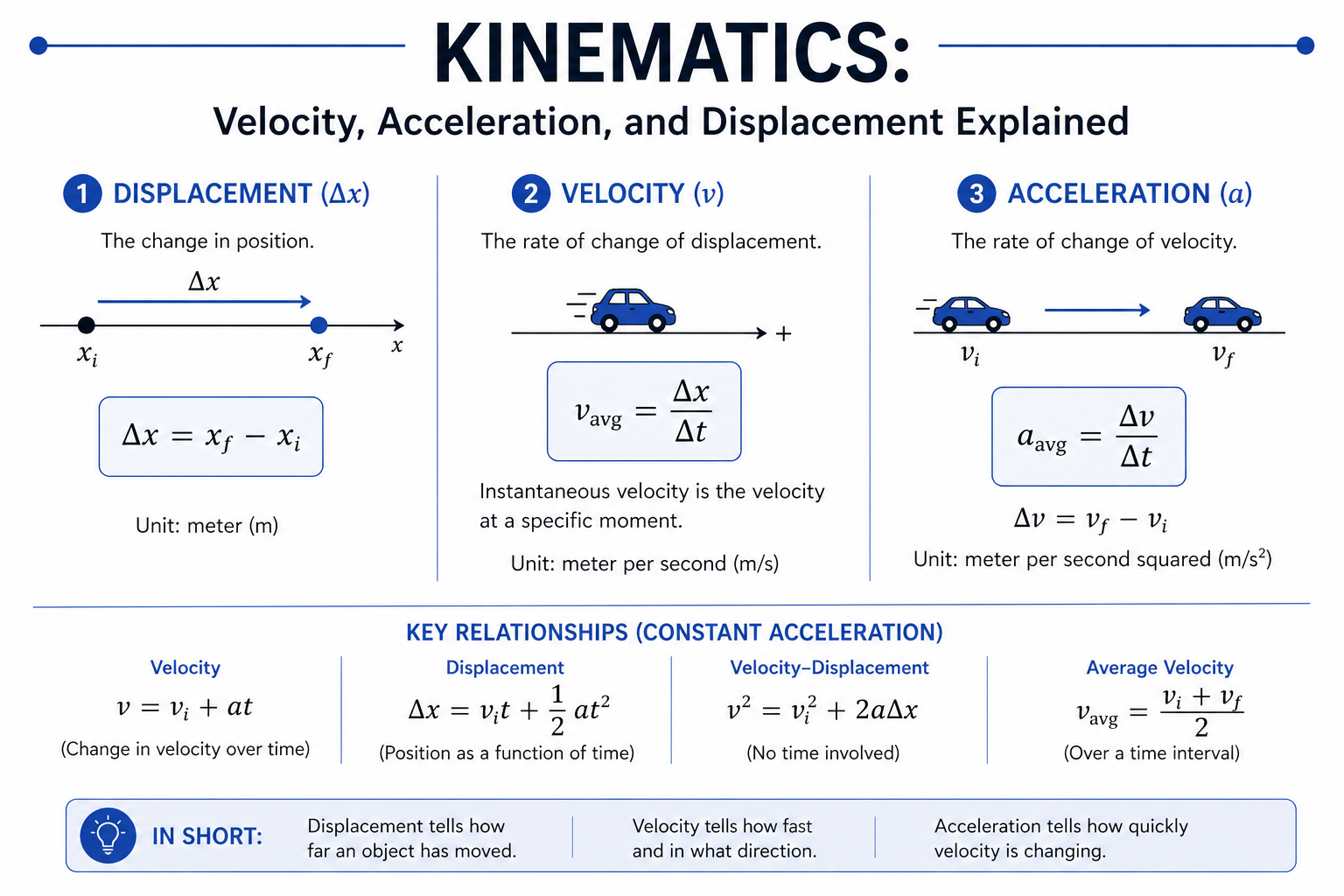
Average velocity is defined as displacement divided by time:
v average = delta x / t
Average speed is the total distance divided by the total time. For an object that changes direction, these two quantities will be different. For an object that moves in a straight line without changing direction, they will be the same.
Instantaneous velocity is the velocity at a specific moment in time, which you find by taking the derivative of position with respect to time in calculus, or by finding the slope of a position-time graph at that instant.
Acceleration: The Rate of Change of Velocity
Acceleration is the rate at which velocity changes with time. Its SI unit is meters per second squared (m/s2).
Average acceleration = change in velocity / time = (v final minus v initial) / t
Acceleration is also a vector quantity. This is important. An object can accelerate without speeding up. If you’re driving in a circle at constant speed, your direction is constantly changing, which means your velocity is constantly changing, which means you are accelerating even though your speed is constant. This is called centripetal acceleration.
An object decelerating, slowing down, has acceleration in the opposite direction to its velocity. When you brake a car, the car’s acceleration points backward while its velocity points forward. Students sometimes call this deceleration but in physics it’s just acceleration with a negative sign in the chosen direction.
Acceleration due to gravity near Earth’s surface is approximately 9.8 m/s2 directed downward. This value is often written as g and is one of the most important constants in mechanics. Every object in free fall, ignoring air resistance, accelerates downward at exactly this rate regardless of its mass. A feather and a hammer dropped simultaneously in a vacuum hit the ground at the same time, as famously demonstrated on the Moon during the Apollo 15 mission.
The SUVAT Equations
For motion with constant acceleration, there are five equations that connect the five kinematic variables: displacement (s), initial velocity (u), final velocity (v), acceleration (a), and time (t). These are called the SUVAT equations.
Each equation contains four of the five variables. So if you know any three of them, you can always find the other two.
v = u + at This connects velocity, initial velocity, acceleration, and time. No displacement.
s = ut + (1/2) x a x t2 This connects displacement, initial velocity, acceleration, and time. No final velocity.
v2 = u2 + 2as This connects final velocity, initial velocity, acceleration, and displacement. No time.
s = (u + v) / 2 x t This connects displacement, initial and final velocity, and time. No acceleration.
s = vt minus (1/2) x a x t2 This connects displacement, final velocity, acceleration, and time. No initial velocity.
These five equations are the workhorse of kinematics. Every problem involving constant acceleration can be solved using one or more of them. The key skill is identifying which three variables you know and selecting the equation that contains those three plus the one you want to find.
How to Solve a Kinematics Problem
The method is always the same regardless of how complicated the problem sounds.
Step 1: Write down what you know. List all the given values with their symbols: u, v, a, s, t.
Step 2: Identify what you need to find.
Step 3: Choose the SUVAT equation that contains your known variables and the unknown you want.
Step 4: Substitute and solve.
Step 5: Check the sign and units of your answer.
Let’s work through an example. A car starts from rest and accelerates uniformly at 3 m/s2. How far does it travel in 8 seconds?
Known: u = 0 (starts from rest), a = 3 m/s2, t = 8 s. Want: s.
Use s = ut + (1/2) x a x t2
s = 0 x 8 + (1/2) x 3 x 82
s = 0 + (1/2) x 3 x 64
s = 96 meters
Another example. A ball is thrown upward with initial velocity 20 m/s. How high does it go before stopping?
Known: u = 20 m/s, v = 0 (stops at top), a = minus 9.8 m/s2 (gravity acts downward). Want: s.
Use v2 = u2 + 2as
0 = 400 + 2 x (minus 9.8) x s
19.6s = 400
s = 20.4 meters
Graphs of Motion
Graphs are one of the most powerful tools in kinematics because they let you extract information visually without doing calculations.
Position-time graphs: The slope at any point gives the instantaneous velocity. A straight line means constant velocity. A curved line means changing velocity, i.e. acceleration. A horizontal line means the object is stationary.
Velocity-time graphs: The slope at any point gives the instantaneous acceleration. The area under the graph between two times gives the displacement during that interval. A straight line means constant acceleration. A horizontal line means constant velocity with zero acceleration.
Acceleration-time graphs: The area under the graph gives the change in velocity during that interval.
Being comfortable reading and interpreting these three types of graphs is just as important as being able to use the SUVAT equations, especially in exams where graphs are frequently used instead of numerical data.
Projectile Motion: Two-Dimensional Kinematics
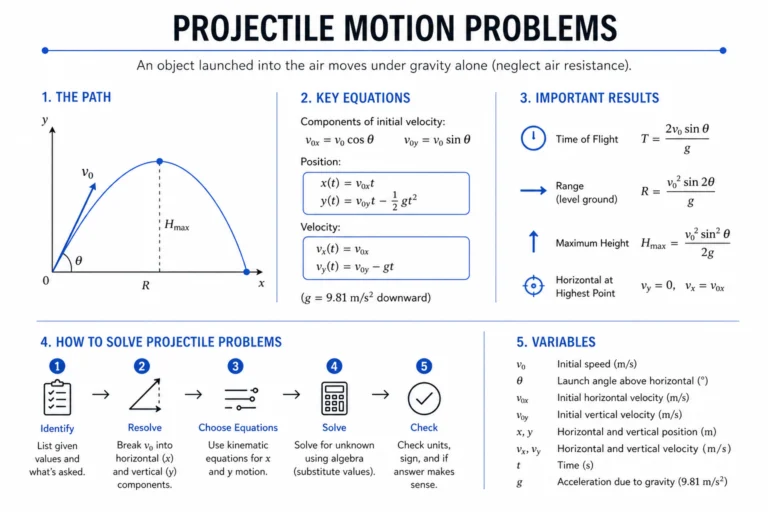
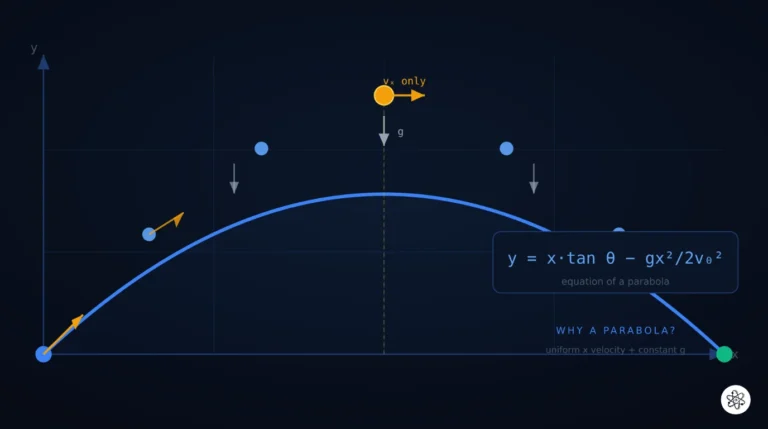
When an object moves through the air under gravity, with no other forces, it follows a curved path called a parabola. This is projectile motion, and it’s analyzed by treating the horizontal and vertical components of motion completely independently.
Horizontal direction: No acceleration (ignoring air resistance). Horizontal velocity stays constant throughout the flight.
Horizontal displacement = horizontal velocity x time
Vertical direction: Constant downward acceleration of g = 9.8 m/s2. The SUVAT equations apply in the vertical direction using this acceleration.
The key insight is that the time of flight is determined entirely by the vertical motion. The horizontal range is then found by multiplying the constant horizontal velocity by that time. The two components are linked only through time.
A ball thrown horizontally from a cliff with speed 15 m/s from a height of 45 m: time to fall = sqrt(2h/g) = sqrt(90/9.8) = 3.03 seconds. Horizontal range = 15 x 3.03 = 45.5 meters.
Relative Motion
All motion is measured relative to a reference frame, a chosen point or object that is treated as stationary. The velocity of an object depends on who is measuring it.
A passenger walking forward at 2 m/s on a train moving at 30 m/s appears to move at 32 m/s to someone standing beside the track. To a fellow passenger sitting still on the same train, the walking passenger moves at only 2 m/s.
Relative velocity = velocity of object minus velocity of observer
This concept becomes important in problems involving objects moving toward or away from each other, boats crossing rivers with currents, and aircraft dealing with wind.
Frequently Asked Questions
What is the difference between velocity and acceleration?
Velocity tells you how fast an object is moving and in which direction. Acceleration tells you how quickly that velocity is changing. An object can have high velocity with zero acceleration (constant speed in a straight line) or zero velocity with high acceleration (a ball at the top of its throw, momentarily stopped but still being pulled downward by gravity).
What does it mean when acceleration is negative?
It depends on how you’ve defined positive direction. If you define upward as positive, then gravitational acceleration is negative (minus 9.8 m/s2) because it acts downward. Negative acceleration doesn’t always mean slowing down. An object moving in the negative direction and speeding up has negative acceleration and is speeding up, not slowing down.
Can an object have zero velocity and nonzero acceleration?
Yes. A ball thrown straight up has zero velocity at its highest point but is still accelerating downward at 9.8 m/s2. This is one of the most commonly misunderstood points in introductory kinematics.
What is uniform acceleration?
Uniform acceleration means the acceleration is constant, neither changing in magnitude nor direction. The SUVAT equations only apply to uniform acceleration. For non-uniform acceleration you need calculus.
What is the difference between average and instantaneous velocity?
Average velocity is total displacement divided by total time. Instantaneous velocity is the velocity at one specific moment, found from the slope of the position-time graph at that instant or from calculus as the derivative of position with respect to time.
Frequently Asked Questions
Get physics insights delivered weekly
Join students and educators receiving expert explanations, study tips, and platform updates every Thursday.
Join others. No spam.

allphysicsfundamentals
Making physics accessible, interactive, and genuinely understandable for students at every level.
Learn
- All Articles
- Classical Mechanics
- Thermodynamics
- Waves & Optics
- Electromagnetism
- Modern Physics