Conservation of Momentum: The Rule Behind Every Collision, Explosion, and Rocket Launch
Two cars crash on a highway. A rifle kicks back when fired. A rocket blasts into orbit with no road underneath it. A pool player sinks the 8-ball off a combination shot. These look like completely unrelated events, but there’s one law governing all of them — the conservation of momentum.
It’s one of those physics principles that once you really get it, you start seeing everywhere. And unlike a lot of physics, it’s not an approximation or an idealization. Momentum conservation is exact. It comes from something deep about the structure of the universe itself.
What Is Momentum?
Momentum is mass times velocity. That’s it.
p = mv
A 1000 kg car moving at 20 m/s has a momentum of 20,000 kg·m/s. A 0.01 kg bullet moving at 800 m/s has a momentum of 8 kg·m/s. The car’s momentum is about 2,500 times larger, even though the bullet is moving 40 times faster. Mass matters just as much as speed.
But here’s what makes momentum different from, say, kinetic energy: momentum is a vector. It has direction. A ball moving to the right at 5 m/s and an identical ball moving to the left at 5 m/s have momenta that are equal in size but opposite in direction. Add them together, and you get zero. This sign business isn’t just bookkeeping — it’s the whole reason momentum conservation works the way it does.
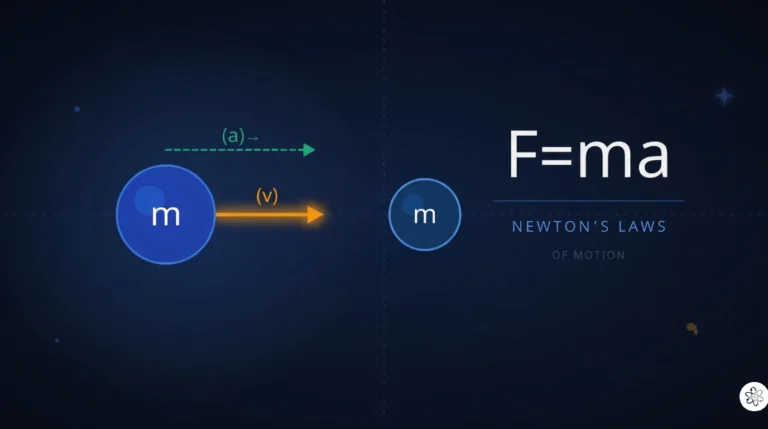
The SI unit is kg·m/s, which is the same as a newton-second (N·s). That’s not a coincidence — it connects directly to Newton’s second law. In its original form, Newton didn’t write F = ma. He wrote F = Δp/Δt — force is the rate of change of momentum. The F = ma version is just what you get when mass stays constant.
Conservation of Momentum: The Law
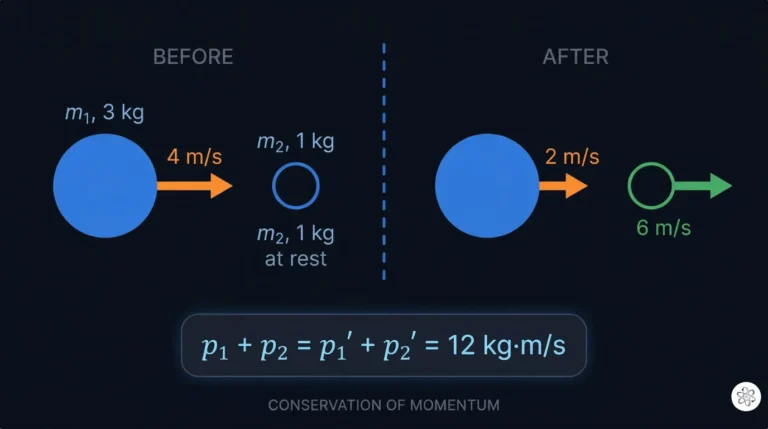
The conservation of momentum says: in an isolated system (one with no net external force), the total momentum before an event equals the total momentum after.
m₁v₁ + m₂v₂ = m₁v₁’ + m₂v₂’
Before the collision, after the collision, during an explosion, after a breakup — it doesn’t matter. Add up the momentum of everything in the system, and the number doesn’t change. Individual objects within the system trade momentum back and forth, but the total is locked.
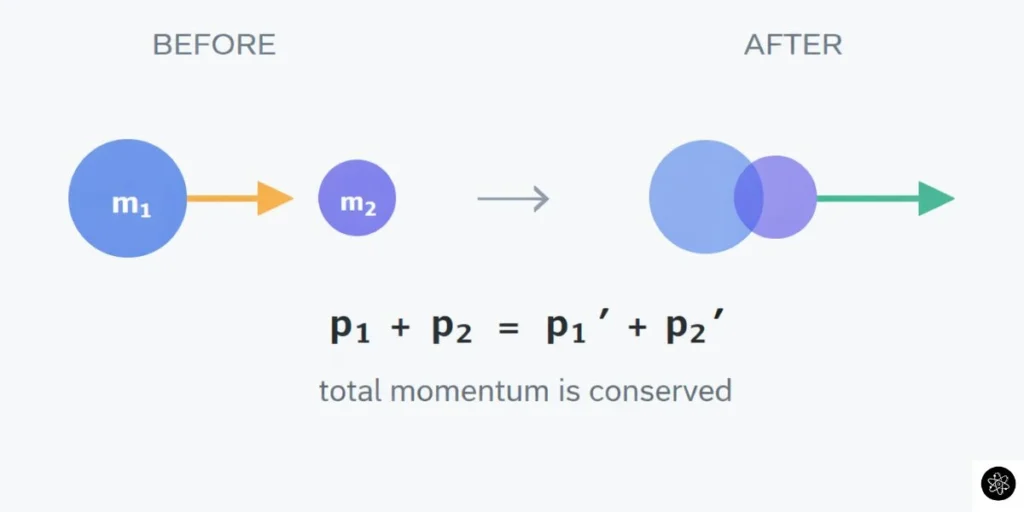
“Isolated system” sounds like a lab condition, but it works in practice because collision forces are massive compared to external forces like gravity or friction. When two cars slam together, the forces between them during the crash are tens of thousands of newtons acting for milliseconds. Gravity and road friction are tiny by comparison during that brief window. So for the duration of the collision, the two-car system is effectively isolated, and momentum is conserved to high accuracy.
Why Does Momentum Get Conserved? The Real Answer
There are two ways to understand this — one practical, one profound.
The practical reason comes from Newton’s third law. When ball A hits ball B, A pushes B to the right and B pushes A to the left with equal force. These forces act for the same duration (the collision time), so the impulse (force × time) delivered to each ball is equal and opposite. Equal and opposite impulse means equal and opposite momentum change. What one gains, the other loses. Total unchanged.
The profound reason was discovered by mathematician Emmy Noether in 1915. She proved that every symmetry of nature corresponds to a conservation law. Momentum conservation comes from translational symmetry — the fact that the laws of physics work the same way regardless of where you are in space. Move your experiment 10 meters to the left, and nothing changes about how physics works. That spatial uniformity mathematically requires momentum to be conserved. It’s not a rule we discovered empirically and hope it keeps working. It’s built into the geometry of space.
Three Types of Collisions
All collisions conserve momentum. What separates them is what happens to kinetic energy.
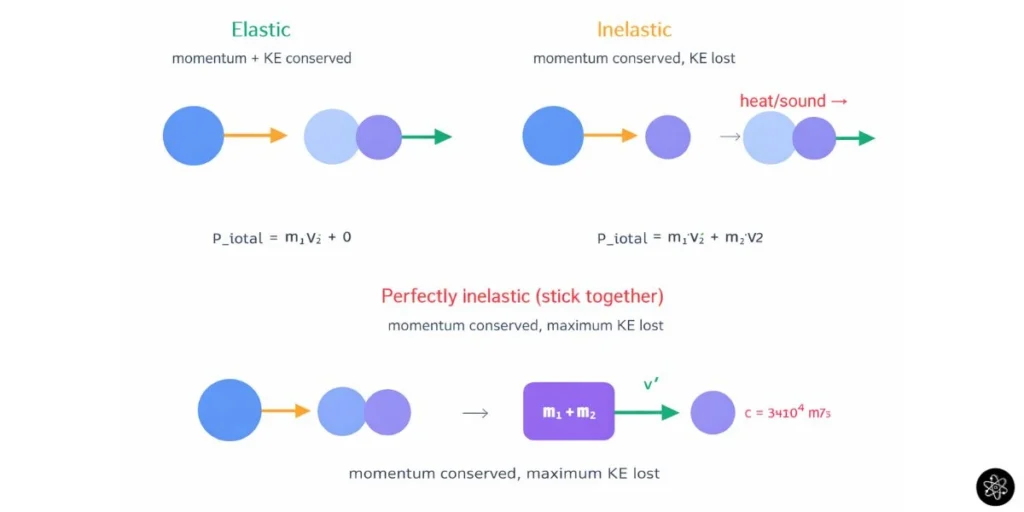
Elastic collisions — everything bounces
Both momentum and kinetic energy are conserved. The objects bounce off each other with no energy lost to heat, sound, or deformation. In reality, perfectly elastic collisions only happen at the atomic scale — gas molecules bouncing off each other, for example. Newton’s cradle on your desk is a close approximation, but even steel balls lose a tiny bit of energy each click.
For a head-on elastic collision where one object is initially at rest, there are clean formulas:
v₁’ = (m₁ − m₂)v₁ / (m₁ + m₂)
v₂’ = 2m₁v₁ / (m₁ + m₂)
If both masses are equal, the first object stops dead, and the second one takes off at the original speed. That’s exactly what you see in Newton’s cradle when one ball swings in and one ball flies out the other side.
Inelastic collisions — energy leaks out
Momentum is conserved, kinetic energy isn’t. Some kinetic energy converts to heat, sound, and permanent deformation. This is what happens in almost every real-world collision — car crashes, dropping a ball of clay, a football tackle. The collision is messier. Energy goes into crunching metal, making noise, and warming things up.
Perfectly inelastic — they stick together
The extreme case. Two objects collide and move as a single unit afterward. This is the maximum possible kinetic energy loss for a given momentum exchange. The math is the simplest of the three:
v’ = (m₁v₁ + m₂v₂) / (m₁ + m₂)
Just weighted average velocity. A 1500 kg car at 20 m/s hits a stationary 1000 kg car and they lock bumpers? Combined velocity = (1500 × 20) / 2500 = 12 m/s. The kinetic energy drops from 300,000 J to 180,000 J. That missing 120,000 J went into crumpling metal, shattering glass, and making a lot of noise.
Worked Example: The Recoil Problem
A 4 kg rifle fires a 0.008 kg bullet at 900 m/s. How fast does the rifle recoil?
Before firing, everything is at rest: total momentum = 0. After firing, momentum still equals 0:
0 = (0.008 × 900) + (4 × vrifle)
vrifle = −7.2 / 4 = −1.8 m/s
The negative sign tells you the rifle moves opposite to the bullet. The bullet is tiny but fast; the rifle is heavy but slow. Their momenta are equal in size, opposite in direction. Total momentum stays zero, exactly as it was before the trigger was pulled.
This is Newton’s third law and momentum conservation working hand in hand. The explosion inside the barrel pushes the bullet forward and the rifle backward with equal and opposite force for the same duration. Equal impulse, opposite directions.
Impulse: Why Airbags Save Your Life
Impulse is force multiplied by the time the force acts, and it equals the change in momentum:
J = FΔt = Δp
This equation is the reason crash safety engineering exists. In a collision, your body goes from moving to stopped — the change in momentum is fixed by your initial speed and mass. You can’t change that. But you can change how that momentum change is delivered.
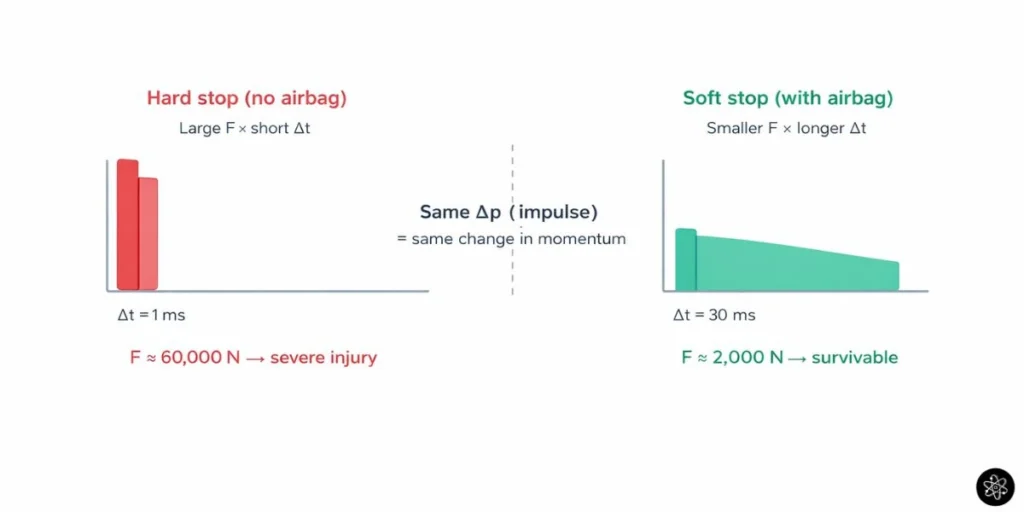
Hit a concrete wall bare-handed, and your hand stops in maybe 1 millisecond. The force is enormous — easily enough to break bones. Now put on a thick boxing glove and hit the same wall. Your hand stops over maybe 20 milliseconds. Same impulse (same momentum change), but spread over 20 times longer, so the force is 20 times smaller.
That’s exactly what an airbag does. Without one, your head hits the steering wheel and stops in about 1–2 ms. With an airbag, the stopping time stretches to about 30–40 ms. The force drops by a factor of roughly 20–30. That’s often the difference between fatal injury and walking away.
Crumple zones in cars work the same way — the front of the car is designed to collapse gradually, extending the stopping time for the passenger compartment. Helmets, padded floors in gymnasiums, the bending of your knees when you land from a jump — they’re all impulse management. Same momentum change, longer time, lower force.
Rockets: How Do You Push Off Nothing?
Rockets confuse people because there’s no ground to push against. In space, there’s literally nothing underneath you. So how do you accelerate?
Momentum conservation is the answer. A rocket carries propellant and throws it out the back at high speed. The exhaust gains momentum in one direction, so the rocket gains momentum in the other. Total system momentum stays constant, which was zero when the rocket was sitting on the pad.
The Tsiolkovsky rocket equation captures this precisely:
Δv = ve × ln(m₀ / mf)
Where ve is the exhaust velocity, m₀ is the total mass before the burn, and mf is the mass after fuel is spent. The logarithm is the killer — it means that to double your speed change, you need to square your fuel ratio, not just double it. That’s why rockets are 85-90% fuel by mass. Getting to low Earth orbit requires a Δv of about 9.4 km/s, which means a mass ratio of roughly 10:1. For every kilogram of payload, you need about 9 kilograms of propellant. Momentum conservation doesn’t just explain rocket science — it dictates every aspect of spacecraft design.
Momentum vs. Kinetic Energy — Don’t Mix Them Up
Students confuse these constantly. They’re related but fundamentally different.
Momentum (p = mv) is a vector — it has direction. Kinetic energy (KE = ½mv²) is a scalar — direction doesn’t matter. Momentum scales linearly with speed; kinetic energy scales with the square of speed. Double your speed and your momentum doubles, but your kinetic energy quadruples.
Here’s the really important difference: momentum is always conserved in collisions. Kinetic energy is only conserved in elastic collisions. In every inelastic collision, some kinetic energy disappears into heat, sound, and deformation — but momentum stays exactly the same.
And here’s a scenario that nails the difference: imagine two identical balls flying toward each other at the same speed. Total momentum? Zero — they cancel. Total kinetic energy? Very much not zero — both balls are moving, and KE is always positive. When they collide (inelastically), they can stop dead. Momentum was zero before, zero after — conserved. But all that kinetic energy had to go somewhere — heat, sound, deformation. Energy was conserved too (first law of thermodynamics), just not as kinetic energy.
Momentum in Two Dimensions
Real collisions don’t always happen head-on. Think of a billiard ball hitting another at an angle — the balls scatter in two different directions. Momentum conservation applies independently in each direction:
x-direction: m₁v₁ₓ + m₂v₂ₓ = m₁v₁ₓ’ + m₂v₂ₓ’
y-direction: m₁v₁ᵧ + m₂v₂ᵧ = m₁v₁ᵧ’ + m₂v₂ᵧ’
You solve two separate equations — one for x, one for y. This is how accident reconstruction experts figure out pre-crash speeds from post-crash evidence. And it’s how particle physicists at CERN track what happened inside a collision by measuring the momenta of everything that flew out. If the total measured momentum in any direction doesn’t add up, something escaped the detector — which is exactly how neutrinos and missing energy signatures are identified.
Real-World Applications
Conservation of momentum isn’t just exam material. It’s behind some of the most important technology and analysis methods in the world.
Automotive safety — every crash test is fundamentally a momentum problem. Crumple zones, airbags, seatbelt pretensioners, and energy-absorbing steering columns are all designed around the impulse-momentum theorem: extend the time, reduce the force.
Space exploration — every orbital maneuver, from station-keeping burns to gravity assists, is calculated using momentum conservation. The Voyager probes used momentum exchange with Jupiter and Saturn to reach speeds that no chemical rocket could achieve alone.
Forensics — crash investigators use skid marks, vehicle deformation, and final resting positions to reconstruct pre-impact speeds using conservation of momentum, often without any witness testimony.
Particle physics — at the Large Hadron Collider, detectors surround the collision point and measure every particle that flies out. If the total measured momentum doesn’t balance, something invisible escaped — this is how the existence of neutrinos was first inferred and how the Higgs boson was confirmed.
Sports — the “follow-through” in golf, tennis, and baseball isn’t just a coaching cliche. By maintaining contact longer between the club/racket/bat and the ball, you increase the impulse and transfer more momentum to the ball, making it go faster and farther.
Frequently Asked Questions
What is the law of conservation of momentum?
It states that the total momentum of an isolated system stays constant over time. No matter what happens inside the system — collisions, explosions, anything — the total momentum before equals the total momentum after. This works because internal forces always come in equal and opposite pairs (Newton’s third law).
Is momentum always conserved?
In an isolated system (no net external force), yes — always. In practice, most collisions happen fast enough that external forces like gravity and friction are negligible during the impact, so momentum is conserved to high accuracy. Over longer timescales, if external forces are significant, you need to account for them.
What’s the difference between elastic and inelastic collisions?
Both conserve momentum. Elastic collisions also conserve kinetic energy — the objects bounce apart with no energy lost. Inelastic collisions lose kinetic energy to heat, sound, or deformation. Perfectly inelastic collisions are the extreme — the objects stick together and kinetic energy loss is maximized.
How do airbags use the impulse-momentum theorem?
In a crash, your body’s change in momentum (stopping) is fixed. An airbag extends the stopping time from about 1-2 milliseconds (hitting a hard dashboard) to about 30-40 milliseconds. Since impulse = force × time, the same momentum change spread over a longer time means much less force — typically 20-30 times less.
How do rockets work in the vacuum of space?
A rocket ejects mass (exhaust) at high speed. The exhaust gains backward momentum, so the rocket gains equal forward momentum. Total system momentum stays zero (or whatever it was before). The rocket doesn’t need anything to push against — it pushes against its own exhaust. This is momentum conservation in action.
Do momentum is conserved in explosives?
Yes, momentum is conserved in explosions according to the Law of Conservation of Momentum: the total momentum before the explosion is equal to the total momentum after it, as long as no external forces act on the system. For example, if an object at rest explodes, its initial momentum is zero, and after the explosion the pieces move in different directions with momenta that cancel each other out, so the total remains zero even though a large amount of energy is released.
Frequently Asked Questions
Get physics insights delivered weekly
Join students and educators receiving expert explanations, study tips, and platform updates every Thursday.
Join others. No spam.

allphysicsfundamentals
Making physics accessible, interactive, and genuinely understandable for students at every level.
Learn
- All Articles
- Classical Mechanics
- Thermodynamics
- Waves & Optics
- Electromagnetism
- Modern Physics