Simple Harmonic Motion: Definition, Formulas, and Real-World Examples
Have you ever wondered why a playground swing takes the exact same amount of time to complete a full back-and-forth cycle, whether you are pumping high into the air or just gently swaying? Or why a plucked guitar string repeats its tight vibrations so perfectly to create a clean musical note?
This beautiful, predictable rhythm is driven by one of the most fundamental concepts in physics: Simple Harmonic Motion (SHM).
What is Simple Harmonic Motion?
At its core, Simple Harmonic Motion is a special type of repeating, back-and-forth movement (oscillation) around a central midpoint. In physics, we call this central midpoint the equilibrium position. Think of it as the “home base” where the object naturally rests when nothing is disturbing it.
What makes SHM unique—and different from just any random vibration—is a single strict rule: The force pulling the object back to home base gets stronger the farther the object moves away.
The Secret of the Restoring Force
This homecoming force is called the restoring force because its entire job is to restore the object back to equilibrium. It is governed by Hooke’s Law:
$$F = -kx$$
Let’s break down what this formula actually means without the confusing jargon:
- $F$ is the Restoring Force.
- $k$ is the Spring Constant (or stiffness). It measures how stubborn the system is. A stiff metal spring has a high $k$; a loose slinky has a low $k$.
- $x$ is the Displacement. This is simply the distance the object has traveled away from its home base.
- The Negative Sign ($-$) is the most critical part! It tells us that the force always fights against the direction of movement. If you pull a spring to the right ($+x$), the force pulls hard back to the left ($-F$).
The Master Blueprint of SHM: Key Terms
To master SHM, you only need to understand five core building blocks. Here is your quick-reference cheat sheet:
| Quantity & Symbol | What It Actually Means | Standard Unit |
| Amplitude ($A$) | The maximum distance the object can stretch or swing away from home base. The peak of the motion. | meters (m) |
| Period ($T$) | The total time it takes to complete exactly one full round-trip cycle (e.g., from far left, to far right, and back to far left). | seconds (s) |
| Frequency ($f$) | The number of full round-trip cycles the object can pull off in one single second. | Hertz (Hz) |
| Angular Frequency ($\omega$) | How fast the oscillation is happening in terms of rotation tracking (radians per second). | rad/s |
| Phase Constant ($\phi$) | A fancy term for “where the stopwatch started.” It tells us if we began tracking the object at its peak, at home base, or somewhere in between. | radians (rad) |
Visualizing Simple Harmonic Motion
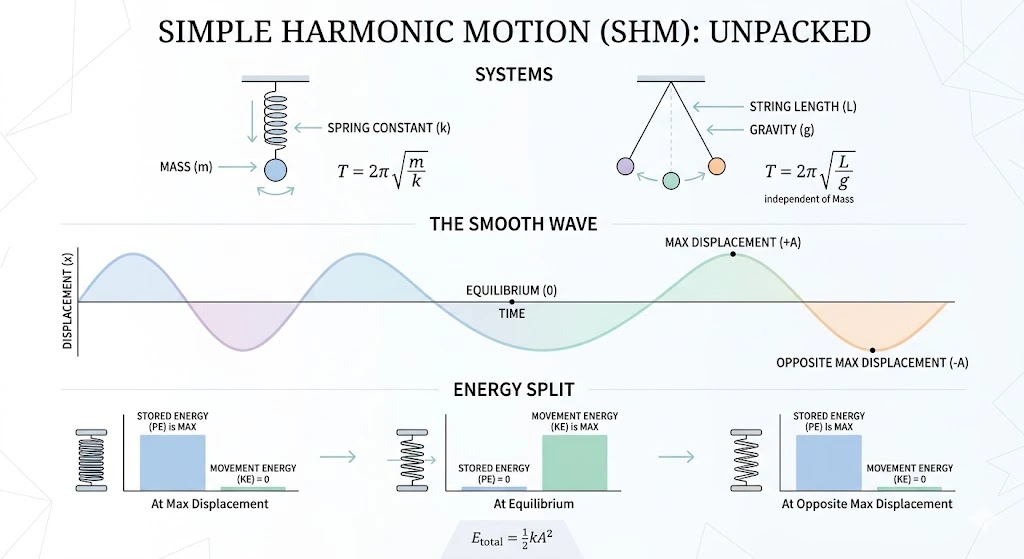
If you attach a pen to a bouncing mass-spring system and pull a long strip of paper underneath it at a steady speed, the pen will draw a perfect, smooth wave.
Below is a visual guide mapping how an object moves through one full period ($T$) of Simple Harmonic Motion:
Plaintext
Position
  ^
  |      (Peak)
 +A |       .---.                               .---.
    |      /     \                             /     \
  0 |-----/-------\-----------/-----------\---/-------\-----> Time (t)
    |    /         \         /             \ /
 -A |   '           '_______'               '
  |  (Equilibrium)    (Trough)
    +-----+-----------+-------+-----------+---+-------+----->
    t = 0        t = T/4   t = T/2     t = 3T/4  t = T
Deciphering the Graph:
- At $t = 0$ (Home Base): The object is at equilibrium ($x = 0$). It is moving at its absolute maximum speed because the restoring force hasn’t had the chance to slow it down yet.
- At $t = T/4$ (The Edge): The object reaches maximum positive displacement ($x = +A$). For a split second, it stops completely (Velocity = 0) as the restoring force snaps it back in the opposite direction.
- At $t = T/2$ (Back to Center): The object flies past the center line again, heading backward.
- At $t = 3T/4$ (The Opposite Edge): The object hits the opposite peak ($x = -A$) and prepares to bounce forward again.
The mathematical equation that perfectly tracks this curve over time is:
$$x(t) = A \cos(\omega t + \phi)$$
The Two Classic Examples (And Their Hidden Gaps)
Textbooks love to show formulas, but they rarely explain why they work the way they do. Let’s look at the two classic examples of SHM and uncover the details that usually get left out.
1. The Mass-Spring System
When you hang a weight on a spring and pull it down, it bounces up and down in SHM. The time it takes for one full bounce is found using this formula:
$$T = 2\pi \sqrt{\frac{m}{k}}$$
The Deep Insight: Notice that mass ($m$) is on the top of the fraction. A heavier mass has more inertia, meaning it is harder to speed up and slow down. Therefore, increasing the mass makes the system swing slower (longer period $T$). Conversely, a stiffer spring (larger $k$) pulls back with more violence, making the system cycle faster.
2. The Simple Pendulum
A simple pendulum consists of a mass (a bob) swinging back and forth on a string or rod. The formula for its period is:
$$T = 2\pi \sqrt{\frac{L}{g}}$$
Where $L$ is the length of the string and $g$ is the acceleration due to gravity (9.8 meters per second squared on Earth).
The Missing Loophole Explained: Notice that mass ($m$) does not exist in this formula! A 10-pound bowling ball and a tiny marble hanging from identical strings will swing back and forth in perfect unison. Why? Because gravity pulls harder on heavier objects, but heavier objects also require more force to move due to their mass. These two factors cancel out perfectly.
The “Small Angle” Warning: This pendulum formula is actually a shortcut! It only works flawlessly if the pendulum swings at a small angle (less than 15 degrees). If you pull a pendulum back way too high, the path becomes a deep, distorted geometric arc, Hooke’s Law breaks down, and the motion stops being truly “simple” harmonic.
Energy: The Ultimate Cosmic Tennis Match
Energy cannot be created or destroyed; it can only change forms. In SHM, energy acts like a tennis ball being hit back and forth between two players: Kinetic Energy (movement energy) and Potential Energy (stored energy).
Plaintext
   [ Extreme Left ]             [ Center Base ]             [ Extreme Right ]
      x = -A                        x = 0                        x = +A
   PE is Maximum                 PE = 0                       PE is Maximum
   KE = 0 (Stopped)              KE is Maximum (Fastest)      KE = 0 (Stopped)
At any single moment during the swing, if you add the current Kinetic Energy and Potential Energy together, you will always get the exact same total mechanical energy:
$$E_{\text{total}} = \frac{1}{2}kA^2$$
The Core SEO Takeaway: Total energy is strictly tied to the Amplitude ($A$) squared. If you pull a swing twice as far back from the center, you aren’t just doubling the energy—you are quadrupling ($2^2 = 4$) the total energy stored in the system!
Real-World Applications: More Than Just Springs
SHM isn’t just an abstract physics concept; it keeps our modern world functioning.
- Quartz Wristwatches: Inside a watch, a tiny quartz crystal is shocked with electricity, causing it to vibrate in steady SHM exactly 32,768 times per second. A microchip counts these ultra-stable cycles to tick forward exactly one second at a time.
- Car Shock Absorbers: When your car hits a pothole, the springs compress. Without help, the car would bounce up and down in SHM forever, making you motion sick. Shock absorbers introduce damping (friction) to absorb that energy and stop the oscillation safely.
- Musical Instruments: The strings of a violin or piano vibrate in a form of SHM. The frequency of the oscillation dictates the musical note you hear, while the amplitude dictates how loudly it rings out.
The Power of Resonance
What happens if you push someone on a playground swing at the exact perfect moment, over and over again? They fly higher and higher. This is called resonance.
When an outside force pushes a system at its natural frequency, the amplitude grows rapidly. While great for swings, resonance can be dangerous for engineering. In 1940, strong winds pushed the Tacoma Narrows Bridge at its natural frequency, causing the entire concrete bridge to twist and shake in violent oscillations until it completely collapsed.
Frequently Asked Questions
Why doesn’t the amplitude affect the time it takes to swing?
If you pull a swing farther back, it has a longer distance to travel. However, pulling it farther back also stores significantly more potential energy, which converts into much higher speeds. Because the object moves proportionally faster over the longer distance, the total time (Period) remains completely unchanged.
What is the difference between Period and Frequency?
They are perfect opposites (reciprocals) of each other. Period ($T$) is the number of seconds per single cycle. Frequency ($f$) is the number of cycles per single second. If a wave takes 2 seconds to complete one loop, its frequency is $1/2$ (0.5) Hz.
What happens to a pendulum if you take it to the Moon?
Because gravity on the Moon is much weaker than on Earth ($g$ goes down), the restoring force pulling the pendulum down becomes weaker. According to the pendulum formula, a smaller $g$ results in a larger period ($T$), meaning a clock relying on a pendulum would swing much slower on the Moon!
Frequently Asked Questions
Get physics insights delivered weekly
Join students and educators receiving expert explanations, study tips, and platform updates every Thursday.
Join others. No spam.

allphysicsfundamentals
Making physics accessible, interactive, and genuinely understandable for students at every level.