Projectile Motion: The Physics of Every Throw, Launch, and Arc
Galileo figured out the math in the early 1600s. Newton explained why it works a few decades later. And the equations haven’t changed since. If you can break a velocity into horizontal and vertical components and apply F = ma in each direction separately, you can predict exactly where any projectile will land.
The One Big Idea: Horizontal and Vertical Are Independent
This is the single most important concept in projectile motion, and everything else follows from it.
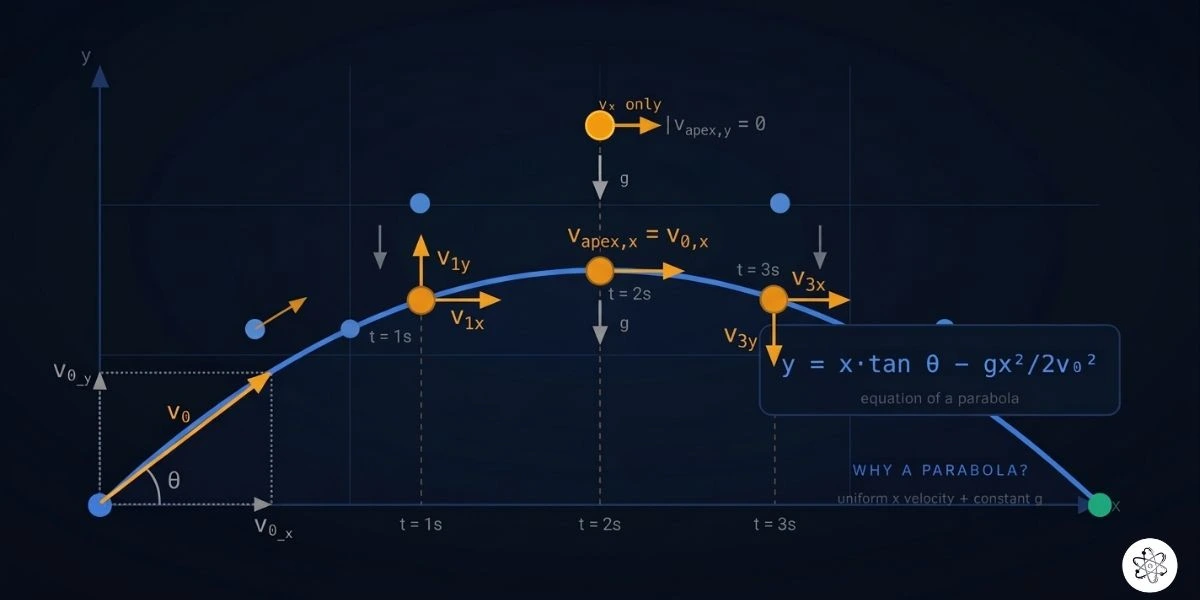
Gravity pulls straight down. It doesn’t care about horizontal motion. So the horizontal component of velocity stays constant the entire flight — no force is acting sideways. Meanwhile, the vertical component changes at a steady rate of 9.8 m/s² downward, because that’s what gravity does.
The two directions are completely independent. What happens vertically doesn’t affect what happens horizontally, and vice versa. A ball dropped from rest, and a ball fired horizontally from the same height hit the ground at the same time — the horizontal speed doesn’t help or hurt the vertical fall at all. This feels wrong the first time you hear it, but it’s been confirmed in countless experiments.
Setting Up the Equations
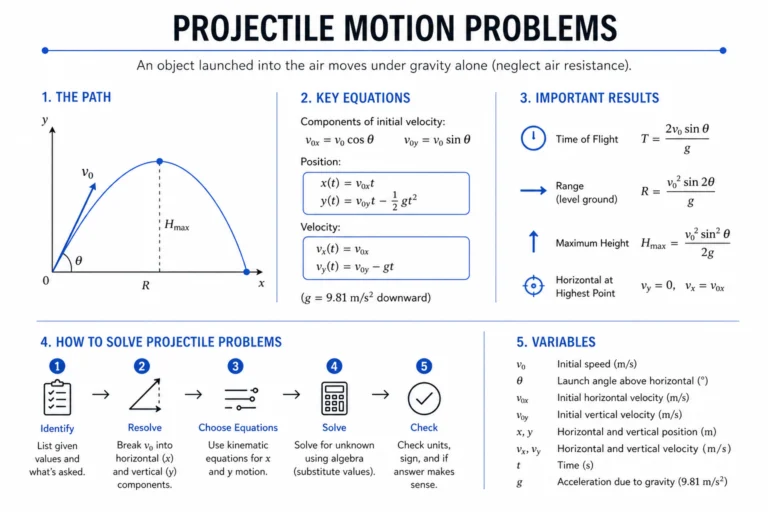
Launch an object at speed v₀ at angle θ above the horizontal. Split that initial velocity into components:
v₀ₓ = v₀ cos θ (horizontal) v₀ᵧ = v₀ sin θ (vertical)
Now apply kinematics to each direction independently.
Horizontal position:
x(t) = v₀ cos θ × t
No acceleration horizontally, so the position just increases linearly with time. Simple.
Vertical position:
y(t) = v₀ sin θ × t − ½gt²
This is the classic kinematic equation with constant acceleration g = 9.8 m/s² pulling downward. The first term pushes you up (if θ > 0), the second term pulls you down. Early in the flight, the first term wins. Later, the ½gt² term takes over and you come back down.
Horizontal velocity:
vₓ = v₀ cos θ (constant, forever)
Vertical velocity:
vᵧ = v₀ sin θ − gt (changes linearly with time)
At the peak of the trajectory, vᵧ = 0 — the object has stopped rising but hasn’t started falling yet. But it’s still moving horizontally at v₀ cos θ. This is Mistake #1 that students make: they think the velocity is zero at the top. It’s not. Only the vertical component is zero. The object is still cruising sideways.
The Four Formulas You Need
For a projectile launched from and landing at the same height (level ground), the equations simplify into four clean results.
Time to peak:
ttop = v₀ sin θ / g
Maximum height:
H = v₀² sin²θ / (2g)
Total flight time:
T = 2v₀ sin θ / g
Horizontal range:
R = v₀² sin(2θ) / g
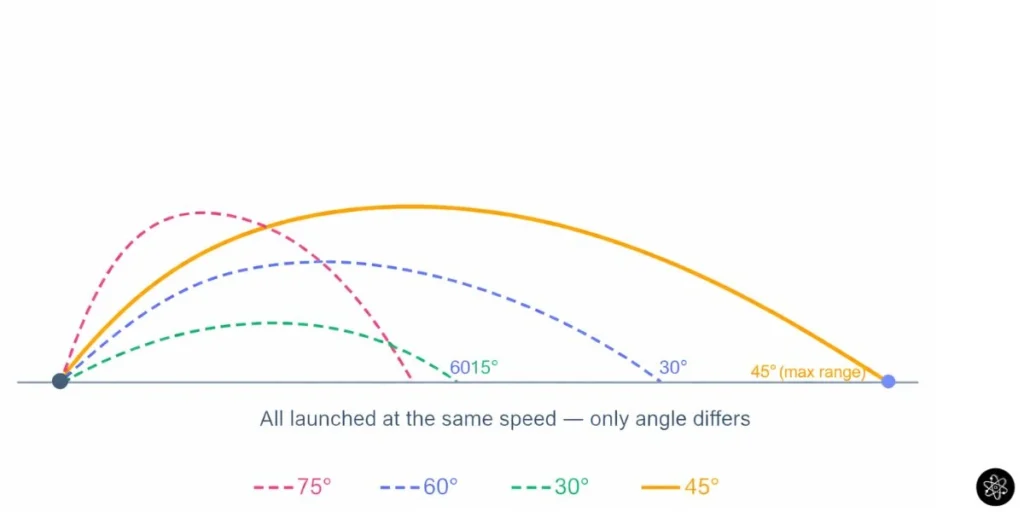
That range formula hides a gem. The sin(2θ) term is maximized when 2θ = 90°, which means θ = 45°. So for any given launch speed, a 45° angle gives the maximum range. And because sin(2θ) is symmetric around 90°, complementary angles give identical ranges — a 30° launch travels exactly as far as a 60° launch, though the 60° shot goes much higher and stays airborne much longer.
Worked Example: Ball Launched at 25 m/s at 40°
Let’s run through a complete problem step by step.
Given:
v₀ = 25 m/s, θ = 40°, g = 9.8 m/s²
Components:
v₀ₓ = 25 cos 40° = 25 × 0.766 ≈ 19.2 m/s
v₀ᵧ = 25 sin 40° = 25 × 0.643 ≈ 16.1 m/s
Time to peak:
ttop = 16.1 / 9.8 ≈ 1.64 s
Maximum height:
H = 16.1² / (2 × 9.8) = 259.2 / 19.6 ≈ 13.2 m
Total flight time:
T = 2 × 1.64 ≈ 3.28 s
Range:
R = 25² × sin(80°) / 9.8 = 625 × 0.985 / 9.8 ≈ 62.8 m
So the ball reaches about 13.2 m high, stays airborne for 3.28 seconds, and lands about 62.8 m away. At the peak, it’s still moving horizontally at 19.2 m/s.
The Energy Shortcut
You don’t always need kinematics. Conservation of energy gives you a faster route to some answers. Since there’s no friction (we’re ignoring air resistance), total mechanical energy is constant:
½mv² + mgy = ½mv₀²
This tells you the speed at any height without needing to track time or direction. Want to know how fast the ball is going at 10 m above launch? Plug in y = 10, solve for v. Done. No vector components needed.
At the peak (y = H), all the vertical kinetic energy has converted to potential energy, leaving only the horizontal kinetic energy: vtop = v₀ cos θ. Same answer the kinematics gives, but with less algebra.
Three Mistakes Almost Everyone Makes
“Velocity is zero at the top.” No. Only the vertical component is zero. The horizontal component v₀ cos θ never changes. The object is still moving sideways at the peak. The only exception is a perfectly vertical launch (θ = 90°), where there’s no horizontal component at all.
Using the range formula when heights don’t match. R = v₀² sin(2θ) / g only works when the projectile lands at the same height it was launched from. Throw a ball off a cliff? You can’t use this shortcut. You have to go back to the full kinematic equations and solve y(t) = −hcliff for the landing time, then plug that time into x(t).
Thinking gravity switches off at the peak. Gravity is 9.8 m/s² downward the entire flight — going up, at the peak, coming down. The acceleration never changes. At the peak, the object is momentarily not moving vertically, but it’s still accelerating downward at 9.8 m/s². That’s why it starts falling again immediately. Visit projectile motion problems for more common problems
What Happens When We Add Air Resistance?
Everything above assumes no air resistance. In reality, air drag makes the trajectory shorter, lower, and asymmetric — the descent is steeper than the ascent because drag opposes motion in both directions, and the object is moving faster early in the flight.
With drag, the optimal angle drops below 45° — for a baseball, it’s closer to 35°. The path is no longer a perfect parabola. The range formula doesn’t apply. And the math becomes much harder — usually requiring numerical simulation rather than clean algebra.
But for introductory physics, the drag-free model is astonishingly useful. It gets you within 10-15% of reality for many situations, and it teaches the fundamental principle that makes all of projectile motion work: horizontal and vertical are independent.
Real-World Applications
Sports science — the optimal launch angle for a basketball free throw is about 45-52°, depending on release height. Long jumpers leave the ground at about 20° because their horizontal speed matters more than height. Shot putters release at about 35-42° because the shot is released above ground level, which shifts the optimal angle downward.
Military ballistics — artillery calculations are essentially projectile motion problems (with drag and Coriolis corrections). The same physics that governs a thrown ball governs a howitzer shell.
Forensic science — crime scene investigators use projectile motion equations backward, working from impact sites and bullet holes to reconstruct trajectories and firing positions.
Civil engineering — water fountain arcs are designed using projectile motion to hit specific targets. Suspension bridge cables hang in catenary curves, which are closely related to parabolas.
Space launch — the initial ballistic phase of a rocket’s trajectory (after engine cutoff) is projectile motion. Orbital insertion calculations use the same kinematic framework, extended to account for Earth’s curvature.
Frequently Asked Questions
What is projectile motion?
The motion of an object launched into the air and subject only to gravity (ignoring air resistance). The key feature is that horizontal and vertical motions are independent — gravity only affects the vertical direction, so horizontal velocity stays constant. The resulting path is a parabola.
What angle gives maximum range?
On level ground, 45° gives the maximum horizontal range for a given launch speed. This comes from the range equation R = v₀² sin(2θ)/g — sin(2θ) is maximized when 2θ = 90°, so θ = 45°. Complementary angles (like 30° and 60°) produce equal ranges but very different trajectories.
Is velocity zero at the top of the trajectory?
No. Only the vertical component of velocity is zero at the peak. The horizontal component (v₀ cos θ) never changes throughout the entire flight. The object is still moving sideways at the top — it’s just not moving up or down at that instant.
Does mass affect projectile motion?
No (ignoring air resistance). Mass cancels out of all the equations — just like in free fall. A heavy ball and a light ball launched at the same speed and angle follow identical trajectories. In reality, heavier objects are less affected by air resistance relative to their weight, so they travel farther in the air — but the physics of ideal projectile motion is mass-independent.
Why is the path a parabola?
Because x grows linearly with time (x = v₀ₓ × t) while y grows quadratically (y = v₀ᵧt − ½gt²). Eliminate t between these two equations, and you get y as a quadratic function of x, which is the definition of a parabola. This was one of Galileo’s great insights.
Frequently Asked Questions
Get physics insights delivered weekly
Join students and educators receiving expert explanations, study tips, and platform updates every Thursday.
Join others. No spam.
allphysicsfundamentals
Making physics accessible, interactive, and genuinely understandable for students at every level.
Learn
- All Articles
- Classical Mechanics
- Thermodynamics
- Waves & Optics
- Electromagnetism
- Modern Physics