Transverse waves in physics How They Work, and Why They Matter
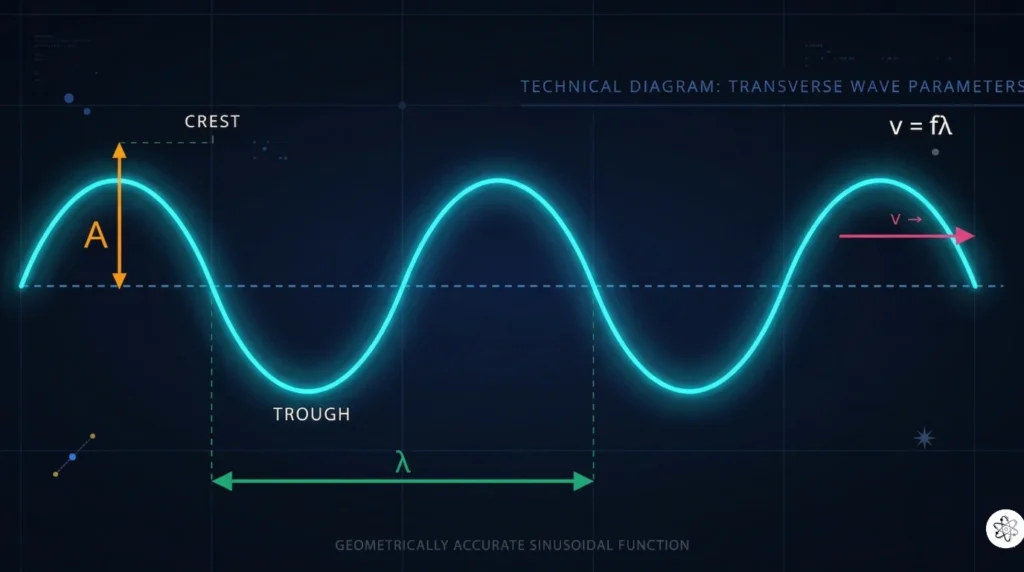
You’ve seen transverse waves your whole life without necessarily knowing the name. The ripple that spreads when you drop a stone in a pond. The vibration running along a guitar string after you pluck it. The light hitting your eyes right now as you read this. All transverse waves — and they all share one defining trait.
The medium (or field) oscillates perpendicular to the direction the wave travels. That’s the whole definition. The “trans” in transverse literally means “across.” The wave goes forward. The stuff doing the waving goes sideways. Once that clicks, the rest follows naturally.
What Makes a Wave “Transverse”?(Transverse wave defination)
Picture shaking one end of a rope up and down while a friend holds the other end. A wave pulse travels horizontally along the rope, but each little segment of rope only moves vertically — up and down. The direction of travel (horizontal) is perpendicular to the direction of oscillation (vertical). That’s the textbook definition of a transverse wave.
Compare that to a longitudinal wave, like sound in air. Air molecules compress and expand back and forth in the same direction the wave is traveling. Push-pull along the same axis. No perpendicular motion at all.
So the one question that separates the two types: does the medium move perpendicular to the wave’s travel, or parallel to it? Perpendicular = transverse. Parallel = longitudinal. That’s it.
The Five Properties You Need to Know about Transverse Waves
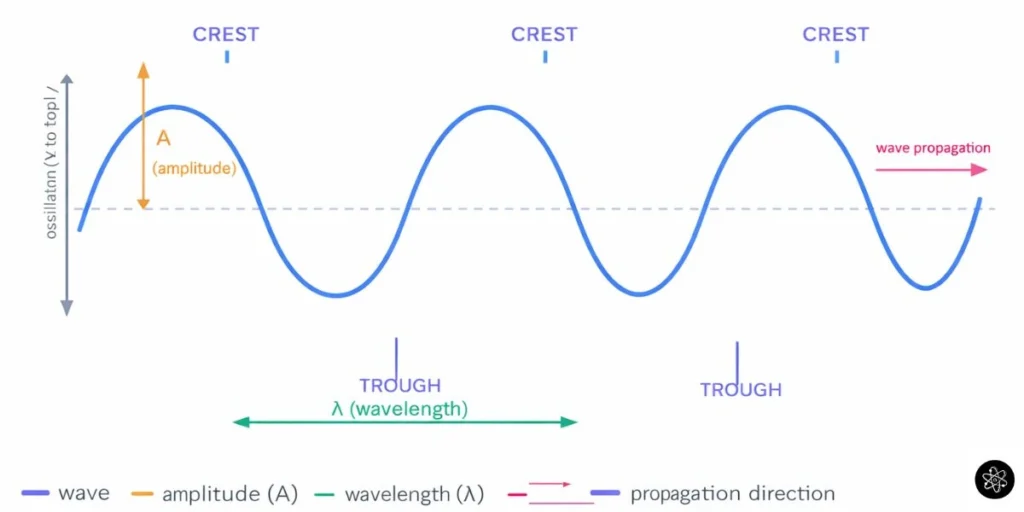
Every transverse wave — whether it’s light, a rope wave, or a seismic S-wave — is fully described by five measurable quantities.
Amplitude (A) is the maximum displacement from the equilibrium position. On a rope, it’s how far the rope swings above or below the resting line. Bigger amplitude means more energy — in fact, energy scales with the square of amplitude. Double the amplitude and you get four times the energy. That’s why a huge ocean wave is so much more destructive than a gentle ripple.
Wavelength (λ) is the distance between two consecutive identical points — crest to crest, trough to trough, or any two matching phase positions. Measured in meters. For visible light, wavelengths range from about 380 nm (violet) to 700 nm (red). For a guitar string, wavelengths are on the order of centimeters to meters.
Frequency (f) is how many complete cycles pass a fixed point per second. Measured in hertz (Hz). Concert A on a piano is 440 Hz — 440 complete vibrations every second. Red light oscillates at about 430 trillion Hz. The higher the frequency, the more energy per photon for electromagnetic waves.
Period (T) is the time for one full cycle. It’s just the reciprocal of frequency: T = 1/f. A wave at 500 Hz has a period of 0.002 seconds — two milliseconds per cycle.
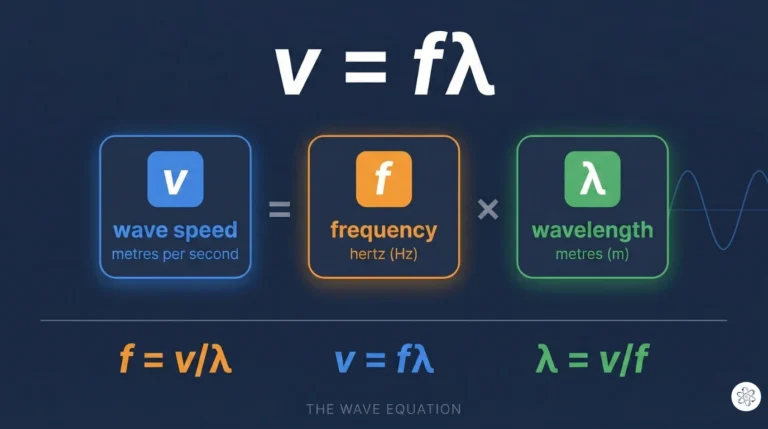
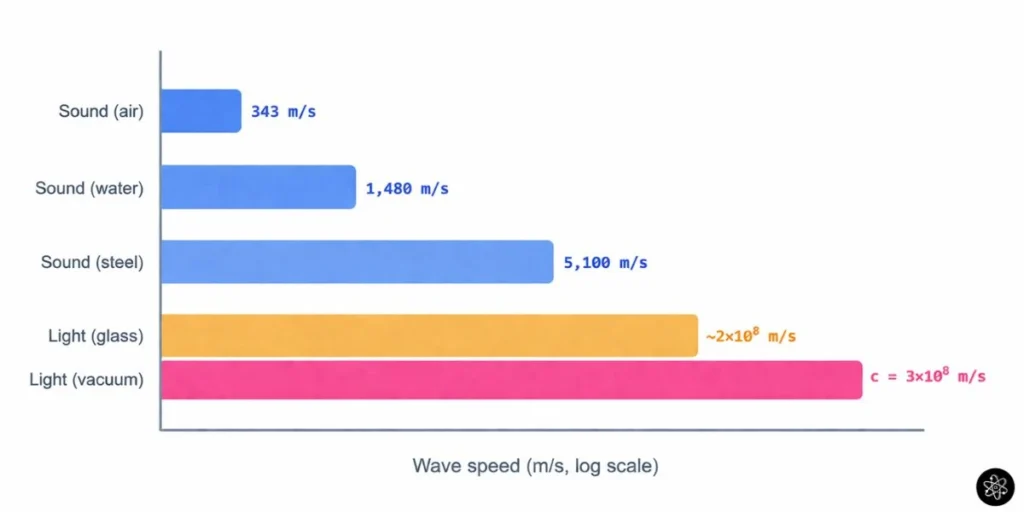
Wave speed (v) ties everything together with the wave equation: v = fλ. The speed depends on the medium, not the wave itself. All colors of light travel at c = 3 × 10⁸ m/s in vacuum. Sound in air moves at about 343 m/s regardless of pitch. The frequency and wavelength adjust to keep their product equal to the speed.
Waves on a String — The Clearest Example
If you want to see a transverse wave in its purest form, grab a rope. Flick one end sideways and watch the pulse travel. Each piece of rope moves up and down while the wave pattern slides horizontally. The medium doesn’t go anywhere — only the energy does.
For a string under tension, wave speed depends on two things:
v = √(T/μ)
Where T is the tension (how tightly you’re pulling the string) and μ is the linear mass density (mass per unit length). More tension = faster wave. Heavier string = slower wave.
This is exactly why guitar tuning works. Crank the tuning peg tighter and you increase T, which increases v. Since the string length (and therefore wavelength of the fundamental mode) stays roughly fixed, v = fλ tells you the frequency must go up. The note gets higher. Loosen the peg, tension drops, wave slows, pitch drops. It’s all one equation.
And the thick bass strings? They have higher μ (more mass per meter), so even at the same tension, the wave travels slower, producing lower frequencies. Physics and music are the same thing at this level.
Electromagnetic Waves — Light Is a Transverse Wave
This is probably the most important category of transverse waves. Radio waves, microwaves, infrared, visible light, ultraviolet, X-rays, gamma rays — they’re all the same thing. Electromagnetic waves. Transverse oscillations of electric and magnetic fields traveling through space.
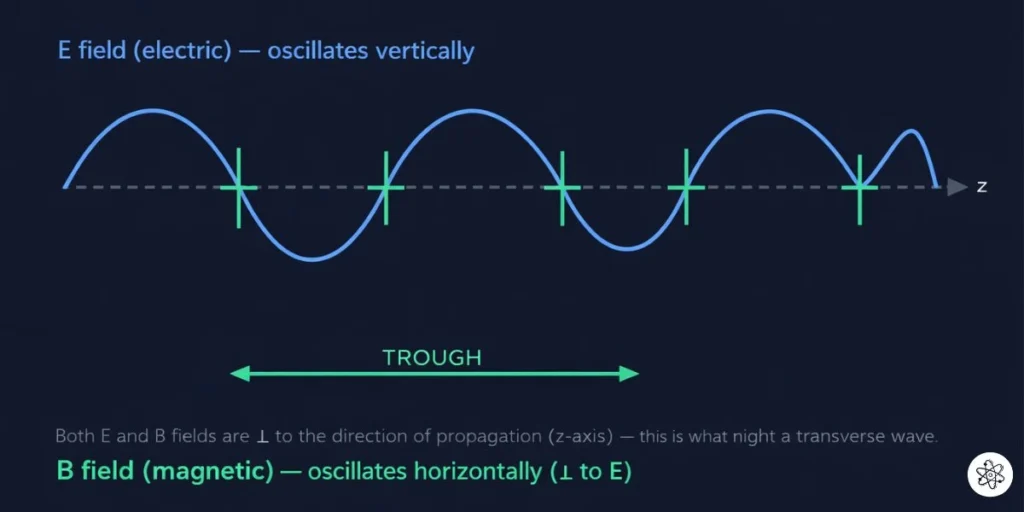
In an EM wave, the electric field wiggles in one direction (say, vertically), the magnetic field wiggles in a perpendicular direction (horizontally), and the wave itself travels in a third direction — perpendicular to both. Three mutually perpendicular axes. Everything is at right angles to everything else.
And unlike rope waves or water waves, EM waves don’t need a medium. They propagate through completely empty space. The electric field generates the magnetic field (Faraday’s law), which regenerates the electric field (Ampère-Maxwell law), which regenerates the magnetic field — and on and on, self-propagating at 3 × 10⁸ m/s. That’s one of the most stunning discoveries in all of physics.
Polarization — Proof That Light Is Transverse
If you ever needed proof that light is a transverse wave, polarization is it.
Unpolarized light vibrates in all directions perpendicular to its travel — up-down, left-right, diagonal, everything. A polarizing filter only lets through vibrations in one specific direction, blocking the rest. The result is polarized light — oscillating in a single plane.
This is physically impossible for a longitudinal wave. If something is oscillating back and forth along a single axis (like sound), you can’t “filter out” a perpendicular component because there is no perpendicular component. Polarization only makes sense when there’s perpendicular oscillation to filter — which only transverse waves have.
Polarizing sunglasses use this principle. Light reflecting off flat surfaces (roads, water, snow) becomes partially horizontally polarized. Your sunglasses have vertical-pass polarizing filters that block that horizontal glare, dramatically reducing brightness and improving contrast. LCD screens, 3D cinema glasses, camera filters, fiber-optic communications — all of them depend on polarization, and polarization only works because light is transverse.
Energy Moves, the Medium Doesn’t
This trips up a lot of students. When you watch a wave travel across water, it looks like the water is moving toward shore. It’s not. Individual water molecules bob up and down (roughly in small circles) but stay in roughly the same place. What travels is the pattern — and with it, the energy.
Same with a rope wave. You shake one end. The wave pulse zips to the other end. But no piece of rope actually traveled from your hand to the far end. Each segment just went up and came back down. The energy passed through without the medium tagging along.
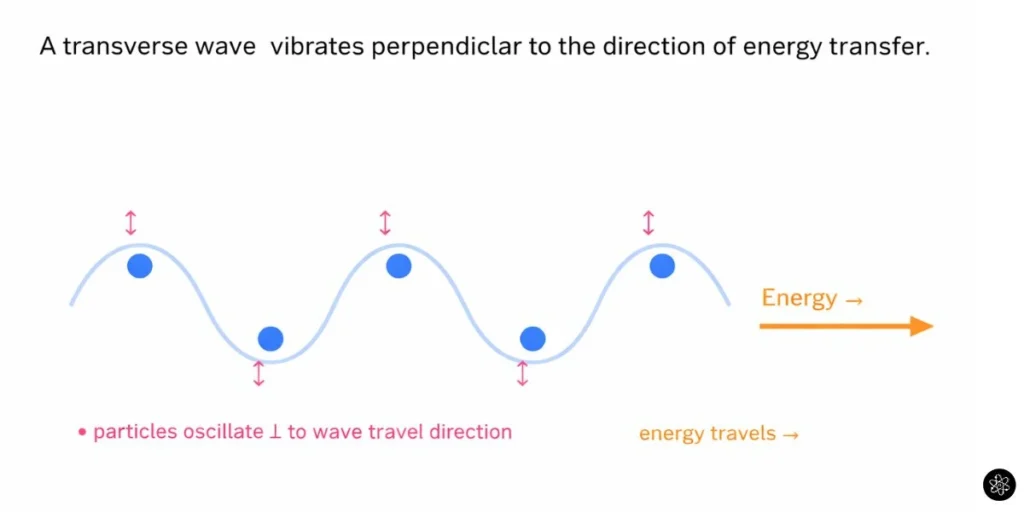
At any given moment, the energy in a transverse wave swaps between kinetic and potential forms. At the crest or trough (maximum displacement), the particle is momentarily stopped — all energy is potential. At the equilibrium crossing (zero displacement), the particle is moving fastest — all energy is kinetic. This constant exchange is the same mechanism as a mass oscillating on a spring.
Transverse vs. Longitudinal — The Full Comparison
| Feature | Transverse wave | Longitudinal wave |
|---|---|---|
| Oscillation direction | Perpendicular to travel | Parallel to travel |
| Can travel in vacuum? | Yes (EM waves) | No — needs a medium |
| Can be polarized? | Yes | No |
| Wave features | Crests and troughs | Compressions and rarefactions |
| Examples | Light, guitar strings, S-waves, water ripples | Sound, P-waves, ultrasound |
| Travels through liquids? | EM: yes. Mechanical: very limited | Yes |
Standing Waves — When Transverse Waves Bounce Back
Fix a rope at both ends and pluck it. The wave reflects off the fixed ends and interferes with itself. At certain frequencies, the overlapping waves create a pattern that appears to stand still — a standing wave. Some points (nodes) never move. Other points (antinodes) oscillate with maximum amplitude.
Standing waves are the reason musical instruments produce specific pitches. A guitar string fixed at both ends can only vibrate at frequencies where an integer number of half-wavelengths fits exactly between the endpoints. The lowest is the fundamental (first harmonic). Then the second harmonic has twice the frequency, the third has three times, and so on. These harmonics determine not just the pitch but the timbre — the tonal quality that makes a guitar sound different from a violin even when playing the same note.
Standing waves are the reason musical instruments produce specific pitches. A guitar string fixed at both ends can only vibrate at frequencies where an integer number of half-wavelengths fits exactly between the endpoints. The lowest is the fundamental (first harmonic). Then the second harmonic has twice the frequency, the third has three times, and so on. These harmonics determine not just the pitch but the timbre — the tonal quality that makes a guitar sound different from a violin even when playing the same note.
Real-World Transverse Wave Examples
Guitar strings and all stringed instruments — plucking creates a transverse standing wave. Tighter string = faster wave = higher pitch. Thicker string = slower wave = lower pitch. Frets shorten the vibrating length, changing the wavelength and therefore the frequency.
Water ripples — drop a pebble in a pond and ripples spread outward. Each water molecule moves up and down, not toward shore. The wave pattern carries energy outward while the water stays put.
Seismic S-waves — earthquakes produce both P-waves (longitudinal, faster) and S-waves (transverse, slower). S-waves can’t travel through liquids — which is how seismologists figured out that Earth’s outer core is liquid iron. S-waves from earthquakes on one side of Earth don’t arrive on the other side through the core. That shadow zone revealed the liquid layer.
The entire electromagnetic spectrum — from km-long radio waves to pm-scale gamma rays, all are transverse oscillations of electric and magnetic fields at c = 3 × 10⁸ m/s in vacuum.
The stadium wave (La Ola) — people stand up and sit down in sequence. Each person only moves vertically, but the wave pattern sweeps horizontally around the stadium. A perfect macroscopic transverse wave demonstration.
Visual Explanation of Transverse Waves
Worked Examples
Finding wave speed
A transverse wave has a frequency of 200 Hz and a wavelength of 0.5 m. What’s the speed?
v = fλ = 200 × 0.5 = 100 m/s
String wave speed from tension
A guitar string has 80 N of tension and a linear density of 0.005 kg/m. Wave speed?
v = √(T/μ) = √(80/0.005) = √16,000 ≈ 126.5 m/s
Energy and amplitude
If you triple the amplitude of a transverse wave (same frequency), by what factor does energy change?
Energy ∝ A². Tripling A gives 3² = 9 times the energy.
Frequently Asked Questions
What is a transverse wave?
A wave where the oscillation is perpendicular to the direction of travel. Shake a rope up and down — the wave goes sideways, the rope goes up and down. That perpendicular relationship is the defining feature. Light, guitar string vibrations, water ripples, and seismic S-waves are all transverse waves.
Is light a transverse wave?
Yes. Light is a transverse electromagnetic wave — the electric and magnetic fields oscillate perpendicular to the direction of propagation. The strongest evidence is polarization, which only works for transverse waves. Sound, by contrast, is longitudinal and can’t be polarized.
What’s the difference between transverse and longitudinal waves?
In transverse waves, oscillation is perpendicular to travel (crests and troughs). In longitudinal waves, oscillation is parallel to travel (compressions and rarefactions). Only transverse waves can be polarized. Sound is longitudinal; light is transverse. Mechanical transverse waves need a medium that supports shear forces — which is why they don’t travel through liquids.
Can transverse waves travel through a vacuum?
Electromagnetic transverse waves (light, radio, X-rays) absolutely can — they don’t need a medium at all. Mechanical transverse waves (rope, string, seismic S-waves) need a solid or semi-solid medium because they rely on shear restoring forces that fluids and vacuum can’t provide.
How did transverse waves prove Earth’s core is liquid?
Seismic S-waves (transverse) can’t travel through liquids. When an earthquake occurs, seismographs on the opposite side of the planet detect P-waves (longitudinal) but not S-waves. The “shadow zone” where S-waves disappear maps out a liquid layer inside Earth — the outer core. Transverse wave physics gave us a map of Earth’s interior from the surface.
Frequently Asked Questions
Get physics insights delivered weekly
Join students and educators receiving expert explanations, study tips, and platform updates every Thursday.
Join others. No spam.
allphysicsfundamentals
Making physics accessible, interactive, and genuinely understandable for students at every level.
Learn
- All Articles
- Classical Mechanics
- Thermodynamics
- Waves & Optics
- Electromagnetism
- Modern Physics