Current, Resistance, and Ohm’s Law: how many paths are there in a series circuit?
What Is Electric Current?
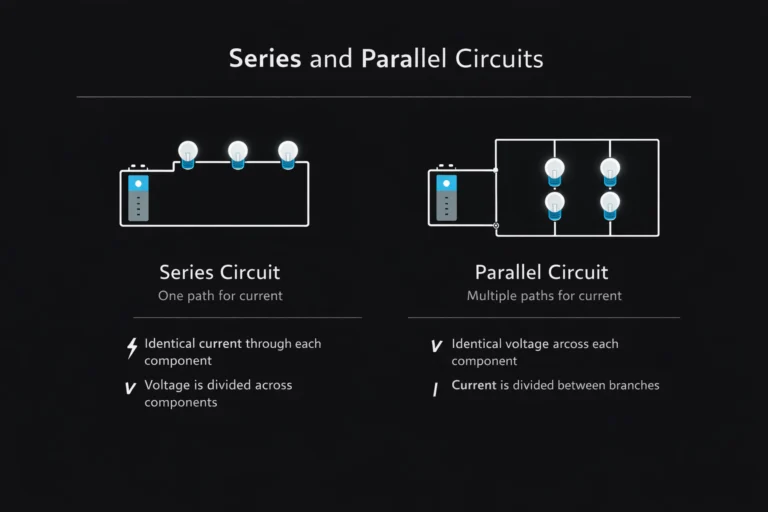
Voltage creates the push. Current is what actually flows. Electric current is the rate at which electric charge moves past a point in a conductor, and it is one of the most fundamental concepts in all of electromagnetism. Without current there are no circuits, no motors, no computers, and no electrical devices of any kind. Understanding what current is and how it behaves is the starting point for understanding all of electronics and electrical engineering. how many paths are there in a series circuit and in parallel circuit?
Series circuit → 1 path
Parallel circuit → multiple paths
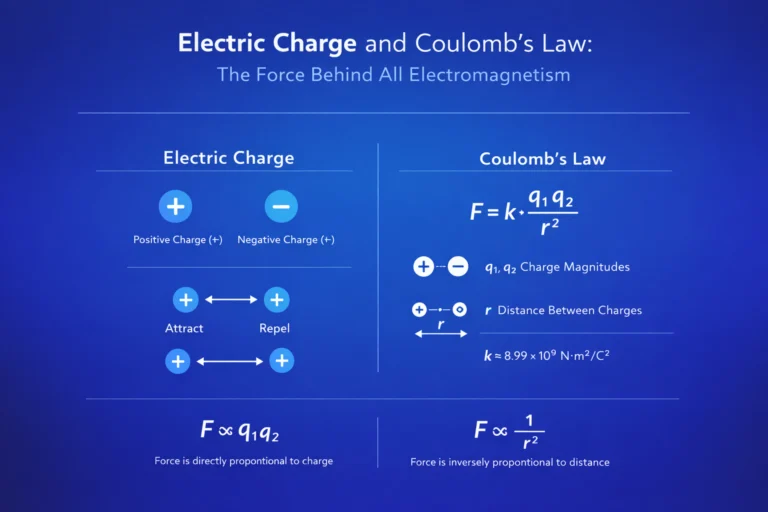
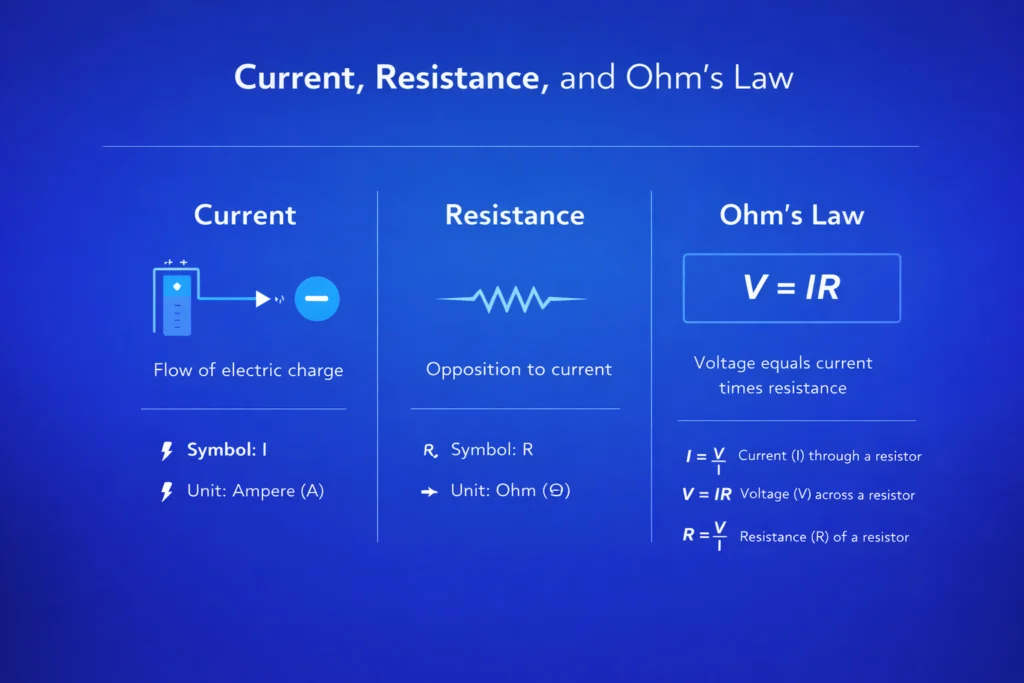
Current is measured in amperes (A), named after French physicist Andre-Marie Ampere who did pioneering work on electromagnetism in the early 19th century. One ampere equals one coulomb of charge passing a point per second:
I = Q / t
In metal wires, current is carried by electrons moving through the material. However, by historical convention going back to Benjamin Franklin, current direction is defined as the direction positive charges would flow, which is opposite to the actual direction electrons move. This is called conventional current. Do not let it confuse you. The physics works consistently either way as long as you stay with one convention throughout a problem.
There are two types of current. Direct current (DC) flows in one direction only and is what batteries produce. Alternating current (AC) reverses direction periodically, typically at 50 Hz in most of the world and 60 Hz in the United States, and is what comes from wall sockets. Most household appliances run on AC while most electronic devices internally use DC, which is why phone chargers and laptop adapters convert AC from the wall into DC for the device.
What Is Resistance?
Not all conductors carry current equally well. Some materials allow charge to flow freely while others fight against it. Resistance is the measure of how much a material opposes the flow of electric charge through it. The unit of resistance is the ohm, represented by the Greek letter omega, named after Georg Simon Ohm the German physicist who first described the mathematical relationship between voltage, current, and resistance.
Resistance arises at the atomic level. As electrons move through a conductor they constantly collide with the vibrating atoms of the material. Each collision slows the electrons down and transfers some of their energy to the atoms, making them vibrate faster. This increased atomic vibration is what we experience as heat. This is exactly how a toaster works, how an electric heater works, and how the filament in an old incandescent light bulb glows. The electrical energy carried by the current gets converted to thermal energy through resistance.
The resistance of a wire or conductor depends on three things.
First is length. A longer wire gives electrons more distance to travel and more chances to collide with atoms, so resistance increases with length.
Second is cross-sectional area. A thicker wire gives electrons more space to move through, so resistance decreases as the wire gets thicker.
Third is the resistivity of the material itself, which is an intrinsic property that varies enormously between different substances. Copper has very low resistivity of about 1.7 x 10^-8 ohm meters, which is why it is the standard choice for electrical wiring. Nichrome, a nickel-chromium alloy, has much higher resistivity, which is why it is used for heating elements in toasters and electric ovens. Rubber and glass have extremely high resistivity, making them excellent insulators.
Temperature also affects resistance. In most metals, resistance increases with temperature because hotter atoms vibrate more vigorously and collide with electrons more frequently. This is why the resistance of a light bulb filament when it is glowing hot is much higher than when it is cold.
Ohm’s Law
In 1827, Georg Simon Ohm published the result of years of careful experimental work on electrical circuits. He found a relationship so clean and so fundamental that it became the cornerstone of all circuit analysis. The relationship is simply this: for a conductor at constant temperature, the current flowing through it is directly proportional to the voltage applied across it. This is Ohm’s Law:
V = I x R
Voltage equals current times resistance. Three letters, one equation, and it describes the behavior of almost every resistor and conductor you will ever encounter. It tells you that for a given resistance, applying more voltage drives more current through the conductor. For a given voltage, increasing the resistance reduces the current that flows. The relationship is linear, meaning if you double the voltage you double the current, and if you double the resistance you halve the current.
The equation can be rearranged three ways depending on which quantity you need to find:
V = I x R to find voltage when you know current and resistance
I = V / R to find current when you know voltage and resistance
R = V / I to find resistance when you know voltage and current
Ohm himself faced serious resistance, no pun intended, from the scientific establishment when he first published his findings. Some critics dismissed his work as implausible. Within a few decades however his law was recognized as one of the most important results in physics and he was awarded the Copley Medal by the Royal Society of London.
Ohmic vs. Non-Ohmic Components
Ohm’s Law works perfectly for resistors, which are components specifically designed to have a constant resistance regardless of the voltage applied or the current flowing. These are called ohmic conductors and their current-voltage relationship is a perfectly straight line when plotted on a graph.
But not everything behaves this way. Diodes allow current to flow easily in one direction but block it in the other. Light emitting diodes (LEDs) only conduct above a certain threshold voltage. Transistors have resistance that depends on a control signal. The filament of a light bulb has resistance that changes dramatically with temperature. These are all non-ohmic devices and Ohm’s Law does not apply to them in a simple way. Understanding the difference between ohmic and non-ohmic behavior is important for anyone working with real electronic circuits.
Worked Example
A 12V battery is connected to a resistor of 4 ohms. What current flows through the circuit?
I = V / R = 12 / 4 = 3 A
Three amperes of current flows. Now if you double the resistance to 8 ohms, the current drops to 1.5 A. If you triple the resistance to 12 ohms, the current drops to 1 A. The relationship is perfectly linear for an ohmic resistor, exactly as Ohm’s Law predicts.
Now what if you connect two 4-ohm resistors in series, giving a total resistance of 8 ohms, to the same 12V battery? Current = 12 / 8 = 1.5 A. And what if those two resistors are in parallel instead, giving a total resistance of 2 ohms? Current = 12 / 2 = 6 A. The way components are connected matters enormously, which leads us to the topic of series and parallel circuits.
Electrical Power
When current flows through a resistance, electrical energy is converted to heat. The rate at which this conversion happens is called power, measured in watts (W). Power can be calculated three different ways depending on which quantities you know:
P = I x V
P = I2 x R
P = V2 / R
All three equations give the same result and are derived from each other using Ohm’s Law. A 60 watt light bulb running at 120V draws 0.5A of current and has a resistance of 240 ohms when hot.
Understanding power is also why electricity is transmitted across long distances at very high voltages. The power lost as heat in transmission wires equals I2 x R. If you can transmit the same amount of power at ten times the voltage, the current is ten times smaller, and the power lost in the wires drops by a factor of one hundred. This is the reason power lines operate at hundreds of thousands of volts and why transformers are used to step voltage up for transmission and back down for safe use in homes and businesses.
Frequently Asked Questions
What is Ohm’s Law in simple terms?
The current through a conductor is directly proportional to the voltage across it and inversely proportional to its resistance. Written as V = IR, it means more voltage drives more current while more resistance allows less current to flow.
What is the unit of resistance?
The ohm, named after Georg Simon Ohm. One ohm is defined as the resistance of a conductor through which one ampere flows when one volt is applied across it.
Why do wires have resistance?
Electrons moving through a conductor collide with vibrating atoms in the material, losing energy with each collision. Longer wires, thinner cross-sections, and higher temperatures all increase the number of collisions and therefore increase resistance.
What is the difference between AC and DC current?
Direct current (DC) flows in one direction only, like current from a battery. Alternating current (AC) reverses direction periodically, like current from a wall socket. Most household power grids use AC because it is more efficient to transmit over long distances.
Does Ohm’s Law always apply?
Only for ohmic conductors where resistance stays constant regardless of voltage or current. Non-ohmic devices like diodes, LEDs, and transistors do not follow a simple V = IR relationship because their resistance changes with operating conditions.
Frequently Asked Questions
Get physics insights delivered weekly
Join students and educators receiving expert explanations, study tips, and platform updates every Thursday.
Join others. No spam.

allphysicsfundamentals
Making physics accessible, interactive, and genuinely understandable for students at every level.