Electric Fields and Field Lines: How Charges Shape the Space Around Them
What Is an Electric Field?
Place a positive charge in empty space and bring a second positive charge nearby. They repel, but they never touch. How does one charge know the other is there? The answer is the electric field.
An electric field is a region in space where a charged particle experiences a force. Every charge creates a field that extends outward in all directions, and any other charged object entering that field feels a push or a pull. The field is the mechanism by which charges interact across empty space, a concept introduced by Michael Faraday in the 19th century that turned out to be one of the most powerful ideas in all of physics.
Defining Electric Field Strength
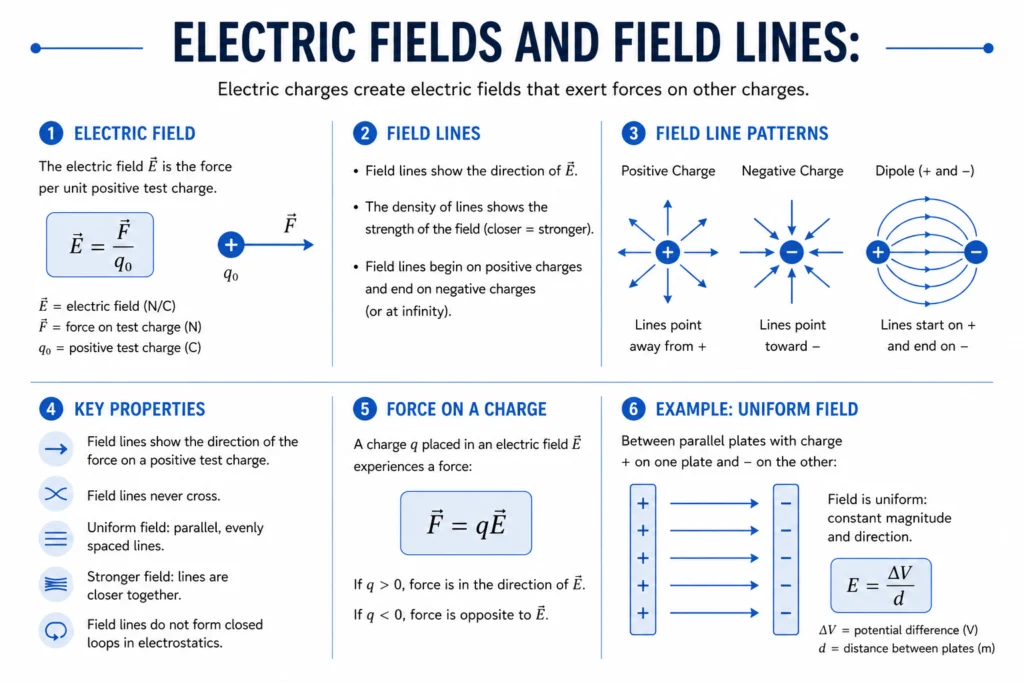
The electric field E at any point is defined as the force on a small positive test charge divided by that charge:
E = F / q
The unit is newtons per coulomb (N/C), equivalent to volts per meter (V/m). The field is a vector with both magnitude and direction. For a single point charge Q at distance r:
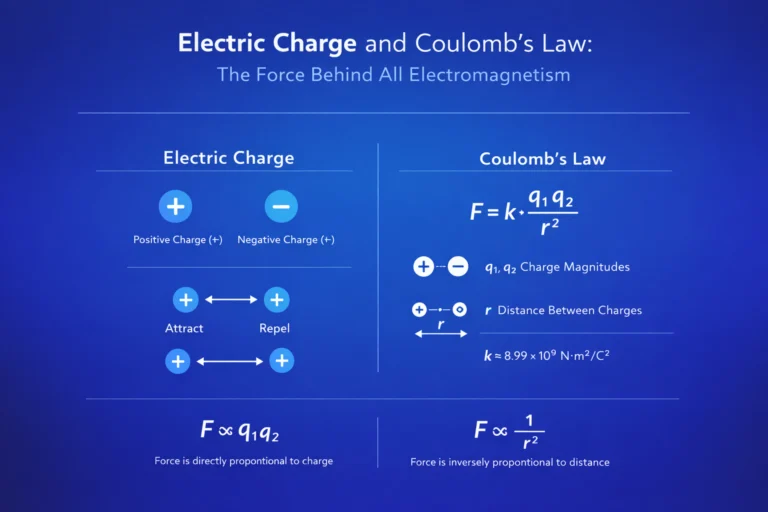
E = k x Q / r2
The same inverse-square relationship as Coulomb’s force. Double the distance and field strength drops to one-quarter.
Electric Field Lines: Mapping the Invisible
You cannot see an electric field but you can draw it using field lines. The rules for drawing them:
Field lines start on positive charges and end on negative charges.
The field direction at any point is tangent to the line at that point.
Where lines are close together the field is strong. Where they spread out it is weak.
Field lines never cross each other since that would imply two different field directions at one point, which is impossible.
For a single positive charge, field lines radiate outward in all directions. For a negative charge they point inward. For two opposite charges near each other, lines curve from positive to negative forming a dipole field.
Uniform Electric Fields
Between two large flat parallel plates, one positive and one negative, you get a uniform electric field. Field lines between the plates are parallel and evenly spaced, meaning field strength is constant everywhere between them. This parallel plate capacitor setup is the basis for how capacitors store energy in electronic circuits.
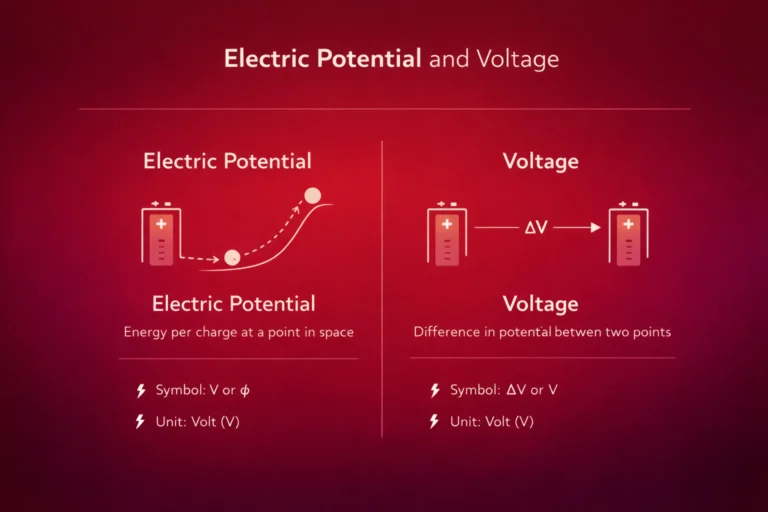
Field strength between parallel plates: E = V / d, where V is voltage across the plates and d is the separation between them.
Superposition of Fields
When multiple charges are present their fields add as vectors at every point in space. Calculate each charge’s contribution separately then add them together. Between two like charges, fields partially cancel along the connecting line creating a region of weak field right in the middle.
Why Electric Fields Matter
Maxwell showed that changing electric fields create magnetic fields and vice versa. Their interplay produces electromagnetic waves including light itself. Without the electric field concept there is no electromagnetic wave, no light physics, no radio. Electric fields also drive charged particles in accelerators, govern electron behavior in semiconductors, and are why atoms hold together at all.
Frequently Asked Questions
What is an electric field in simple terms?
The region of influence around a charged object where other charges feel a force. It is how charges interact across space without touching.
What do electric field lines show?
The direction of the field and its relative strength. They always point from positive to negative charges and never cross each other.
What is the unit of electric field?
Newtons per coulomb (N/C), equivalent to volts per meter (V/m).
Can electric fields exist in a vacuum?
Yes. Light itself is an oscillating electric and magnetic field traveling through empty space. No medium is required.
Frequently Asked Questions
Get physics insights delivered weekly
Join students and educators receiving expert explanations, study tips, and platform updates every Thursday.
Join others. No spam.

allphysicsfundamentals
Making physics accessible, interactive, and genuinely understandable for students at every level.