Electric Charge and Coulomb’s Law: The Force Behind All Electromagnetism
What Is Electric Charge and Coulomb’s Law
Everything around you is made of atoms, and every atom contains charged particles. There are two types of electric charge: positive and negative. Protons carry positive charge, electrons carry negative charge, and neutrons carry none. In most everyday objects the number of protons and electrons balance perfectly, so the net charge is zero. Disturb that balance and things get interesting fast.
The SI unit of charge is the coulomb (C). One electron carries a charge of 1.6 x 10^-19 C. That is an incredibly small number, which is why it takes trillions of electrons moving together to produce the currents we use every day.
Three Rules That Govern All Electric Charge
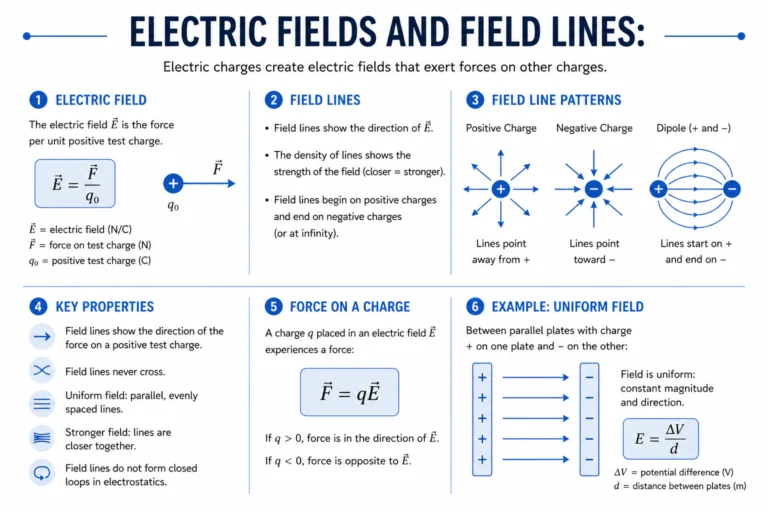
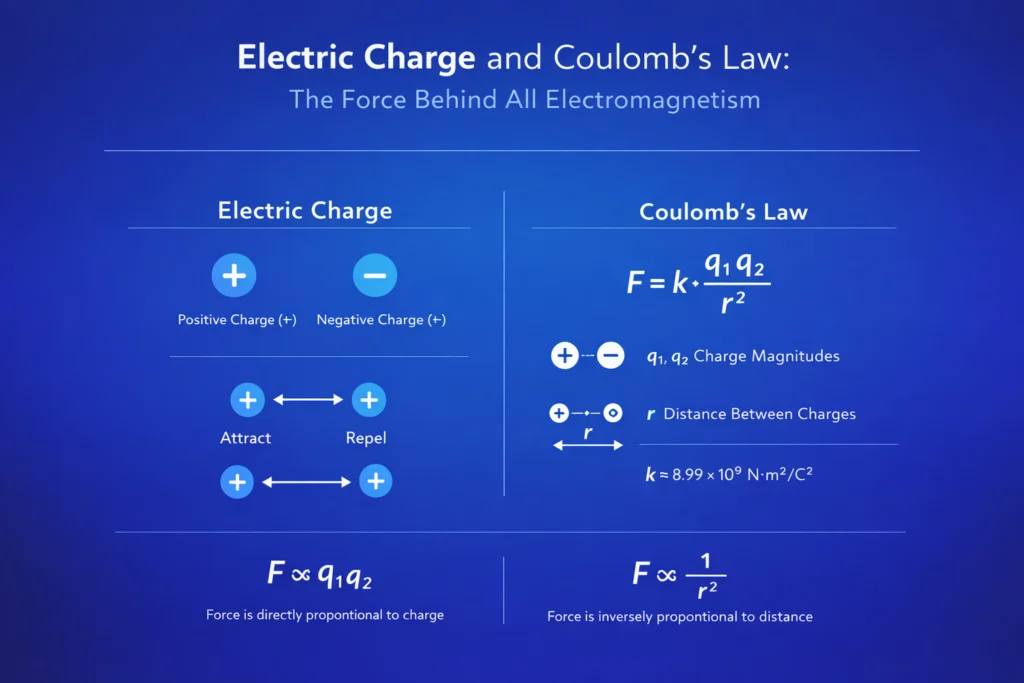
Like charges repel, opposite charges attract. Two positive charges push each other away. A positive and a negative charge pull toward each other. This is the fundamental rule behind every electrical interaction.
Charge is conserved. You can move charge around but you cannot create or destroy it. If a glass rod picks up positive charge by being rubbed with silk, the silk must gain an equal negative charge. Total charge of the system stays constant.
Charge is quantized. Charge always appears in whole-number multiples of the elementary charge (e = 1.6 x 10^-19 C). Nature only deals in discrete units, never fractional electrons.
Conductors vs. Insulators
In conductors like copper, electrons move freely throughout the material. Touch a metal rod with a charged object and charge spreads almost instantly. In insulators like rubber or glass, electrons are held tightly and charge stays put. That is why electrical cables are coated in rubber, to keep charge exactly where you want it.
Coulomb’s Law: Calculating the Electrostatic Force
In 1785, French physicist Charles-Augustin de Coulomb measured forces between charged spheres using a torsion balance and found a clean relationship. The force between two point charges is directly proportional to the product of their charges, and inversely proportional to the square of the distance between them.
F = k x (q1 x q2) / r2
Where F is the electrostatic force in newtons, q1 and q2 are the two charges in coulombs, r is the distance between them in meters, and k is Coulomb’s constant, 8.99 x 10^9 N.m2/C2. A positive result means repulsion and a negative result means attraction.
The Inverse-Square
The r2 in the denominator means force drops off fast. Double the distance and force drops to one-quarter. Triple it and force drops to one-ninth. This is the same inverse-square pattern Newton found with gravity, but electrostatic forces are roughly 10^36 times stronger. Gravity only dominates at large scales because most matter is electrically neutral overall.
Worked Example
Two charges, q1 = +3 x 10^-6 C and q2 = -2 x 10^-6 C, placed 0.1 m apart:
F = (8.99 x 10^9) x (3 x 10^-6 x 2 x 10^-6) / (0.1)2 = 5.39 N, attractive.
Coulomb’s Law vs. Newton’s Gravity
Coulomb’s Law depends on electric charge while Newton’s Gravity depends on mass. Coulomb’s Law can be attractive or repulsive while gravity is always attractive. Both follow the inverse-square law meaning force drops with the square of distance. Electrostatic force is roughly 10^36 times stronger than gravity at the same distance.
Frequently Asked Questions
What is electric charge in simple terms?
A fundamental property of matter that causes particles to experience a force near other charged particles. It comes in positive and negative types. Like charges repel, opposite charges attract.
What does Coulomb’s Law calculate?
The electrostatic force between two point charges. Larger charges and shorter distances produce stronger forces.
How is Coulomb’s Law similar to gravity?
Both are inverse-square laws. But gravity only attracts while electrostatic force can attract or repel, and is enormously stronger at the same distance.
What is Coulomb’s constant?
k = 8.99 x 10^9 N.m2/C2. It sets the scale of electrostatic force in SI units.
Frequently Asked Questions
Get physics insights delivered weekly
Join students and educators receiving expert explanations, study tips, and platform updates every Thursday.
Join others. No spam.

allphysicsfundamentals
Making physics accessible, interactive, and genuinely understandable for students at every level.