Power in Physics: Formula Meaning, Units, Examples & FAQ
Power in Physics — Formula, Units, Examples, and Real-Life Applications
Two cranes may lift the same steel beam to the same height. Both do exactly the same amount of work. Yet one finishes in 5 seconds while the other takes 20. Which machine is more powerful?
The answer reveals one of the most important ideas in physics:
It is not about how much work is done — it is about how fast the work is done.
That single idea explains:
- why sports cars accelerate harder,
- why rockets require enormous engines,
- why electric kettles boil water quickly,
- and why cities need gigantic power stations.
In physics, it measures the rate of energy transfer or the rate at which work is done. Whether you are analyzing engines, electrical circuits, athletes, elevators, or industrial machines, power tells you how quickly energy changes form.
What Is Power in Physics?
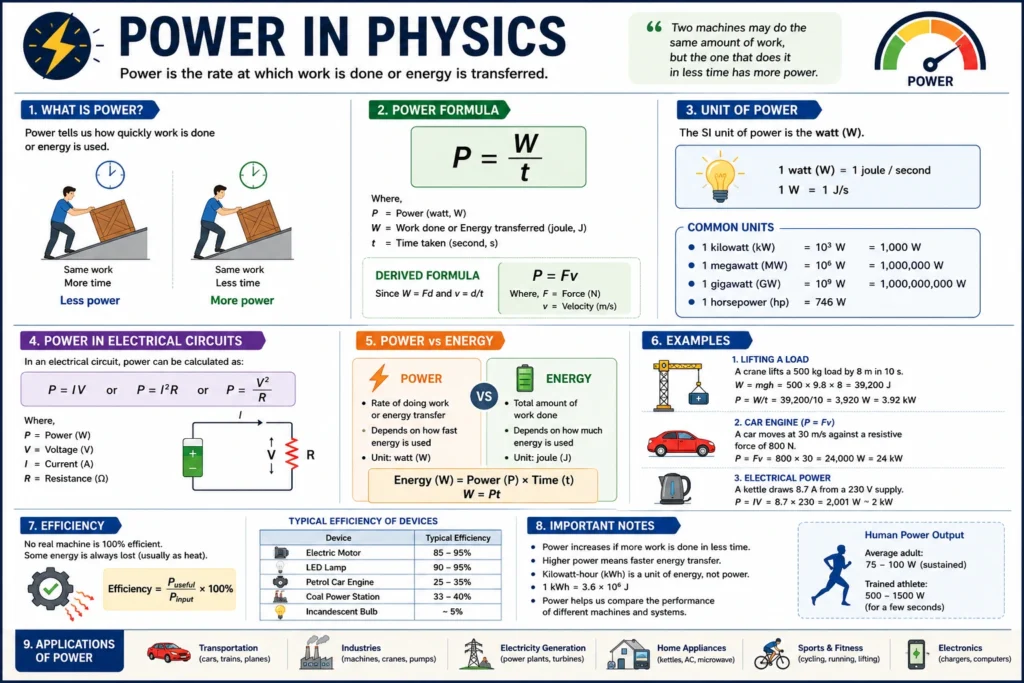
it is the rate at which work is done or energy is transferred.
The faster energy is transferred, the greater the power.
Formula
P=tW
Where:
- P = power (watts, W)
- W = work done or energy transferred (joules, J)
- t = time taken (seconds, s)
This equation shows that:
- doing the same work in less time means greater power,
- while taking longer means lower power.
SI Unit
The SI unit of power is the watt (W).
Definition of One Watt
1 W=1 J/s
One watt means:
one joule of energy transferred every second.
The unit is named after James Watt, whose improvements to steam engines helped launch the Industrial Revolution.
Understanding Power With a Simple Example
Imagine two students carrying identical boxes upstairs.
- Student A carries the box in 10 seconds
- Student B carries the same box in 5 seconds
Both students do the same work because:
- the mass,
- height,
- and gravitational force are identical.
But Student B transfers energy twice as fast.
Therefore:
- Student B produces twice the power.
That is the entire meaning of power in physics:
how quickly energy is used or transferred.
The Power Equation Explained
The standard equation is:
P=tW
From this relationship:
- It increases if work increases,
- It also increases if time decreases.
This makes power extremely important in:
- engines,
- machines,
- electronics,
- motors,
- athletics,
- and industrial systems.
Deriving Power From Force and Velocity
Since work is:
W=Fd
Substitute into the power equation:
P=tFd
Because:
v=td
We get:
P=Fv
This formula is incredibly important in mechanics and engineering.
It shows:
- high force at high speed requires enormous power.
That is why racing cars, trains, and aircraft engines need massive power outputs.
Units of Power
| Unit | Value | Common Use |
|---|---|---|
| Watt (W) | 1 J/s | Small electrical devices |
| Kilowatt (kW) | 1,000 W | Appliances, engines |
| Megawatt (MW) | 1,000,000 W | Power stations |
| Gigawatt (GW) | 1 billion W | National power grids |
| Horsepower (hp) | 746 W | Vehicle engines |
What Is Horsepower?
Horsepower was created to compare steam engines with horses.
Horsepower Conversion
1 hp=746 W
Modern car engines are still commonly rated in horsepower because the term became deeply associated with engine strength.
Worked Examples of Power
Example 1 — Lifting a Heavy Load
Step 1: Calculate Work Done
A crane lifts a 500 kg object vertically upward by 8 m in 10 s.
W=mghW=500×9.8×8 W=39,200 J
Step 2: Calculate P
P=1039200P=3920 W
Final Answer
P≈3.92 kW
Example 2 — Car Engine Power
A car travels at 30 m/s against a resistive force of 800 N.
Use:
P=FvP=800×30 P=24,000 W
Final Answer
P=24 kW
This is needed simply to maintain constant speed against friction and air resistance.
Example 3 — Electrical Power
A kettle uses:
- Voltage = 230 V
- Current = 8.7 A
Electrical power is:
P=IVP=230×8.7 P≈2000 W
So the kettle has a power rating of about:2 kW
That is why electric kettles heat water very quickly.
Electrical Power Formulas
In electrical circuits:
P=IV=I2R=RV2
Where:
- V = voltage,
- I = current,
- R = resistance.
These formulas are fundamental in:
- circuit analysis,
- electronics,
- electrical engineering,
- and power transmission.
Why High Voltage Power Lines Are Used
Power companies transmit electricity at extremely high voltages.
Why?
Because power loss in cables is:
Ploss=I2R
Reducing current dramatically reduces energy loss as heat.
That is why national grids use:
- 132 kV,
- 220 kV,
- or even 500 kV transmission systems.
Power vs Energy — What’s the Difference?
Students often confuse these terms.
| Power | Energy |
|---|---|
| Rate of energy transfer | Total amount of energy |
| Measured in watts (W) | Measured in joules (J) |
| “How fast?” | “How much?” |
Key Relationship
W=Pt
Energy equals power multiplied by time.
What Is a Kilowatt-Hour?
A kilowatt-hour (kWh) is a unit of energy, not power.
Formula
1 kWh=3.6×10⁶ J
Electricity companies charge customers based on:
- total energy consumed,
- not instantaneous power.
Efficiency and Power
No machine converts all input power into useful output.
Some energy is always wasted:
- usually as heat,
- sound,
- or friction.
Efficiency Formula
Efficiency=PinputPuseful×100%
Typical Efficiency Values
| Device | Typical Efficiency |
|---|---|
| Electric motor | 85–95% |
| LED lamp | 90–95% |
| Petrol engine | 25–35% |
| Coal power station | 33–40% |
| Incandescent bulb | ~5% |
This explains why modern LED bulbs save so much electricity compared to old filament bulbs.
Human Power Output
Humans are surprisingly weak compared to machines.
Typical sustained human output:
- 75–100 W
Elite athletes can briefly generate:
- 1000+ W
Professional cyclists can sustain:
- around 400–450 W for long periods.
That is still less than one horsepower.
Real-Life Applications of Power
it is everywhere in daily life.
Transportation
- Car engines
- Electric vehicles
- Aircraft turbines
- Trains
Home Appliances
- Microwaves
- Air conditioners
- Kettles
- Washing machines
Sports Science
- Sprint analysis
- Cycling performance
- Weightlifting
Industry
- Cranes
- Pumps
- Generators
- Manufacturing robots
Electricity Generation
Solar farms
Hydroelectric dams
Nuclear plants
Wind turbines
Frequently Asked Questions
What is power in physics?
It is the rate at which work is done or energy is transferred.
What is the formula for power?
P=tW
What is the SI unit of power?
The SI unit is the watt (W).
What is the difference between power and energy?
Energy is the total amount transferred.
it is how quickly the transfer happens.
Is kWh a unit of power?
No. It is a unit of energy.
Why is power important?
it determines:
- engine performance,
- electrical consumption,
- machine capability,
- and energy transfer speed.
Frequently Asked Questions
Get physics insights delivered weekly
Join students and educators receiving expert explanations, study tips, and platform updates every Thursday.
Join others. No spam.

allphysicsfundamentals
Making physics accessible, interactive, and genuinely understandable for students at every level.