Why is My Soda Warm? A Simple Guide to How Heat Moves (Conduction, Convection, Radiation)
Have you ever wondered why an ice cube melts in your hand, or how the sun heats the Earth through millions of miles of empty space? It’s not magic—it’s physics. Specifically, it’s thermodynamics.
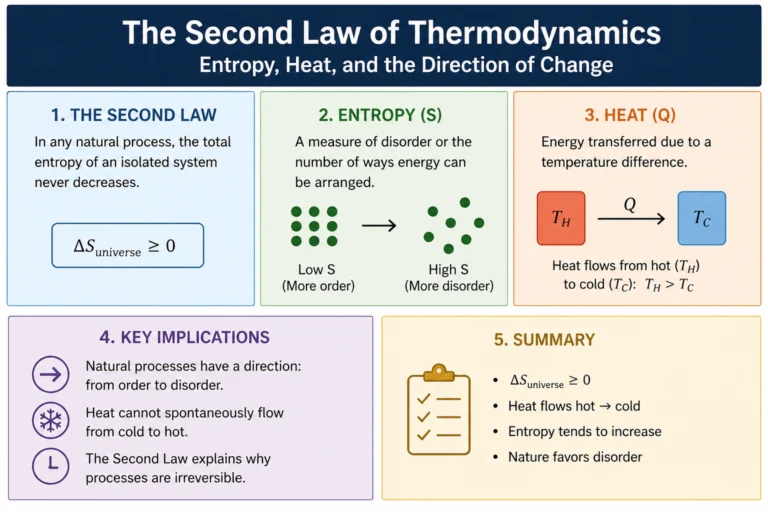
Heat never stays still. It is always on the move, flowing spontaneously from warmer objects (your hand) to colder ones (the ice cube). It continues this journey until everything reaches the same temperature.
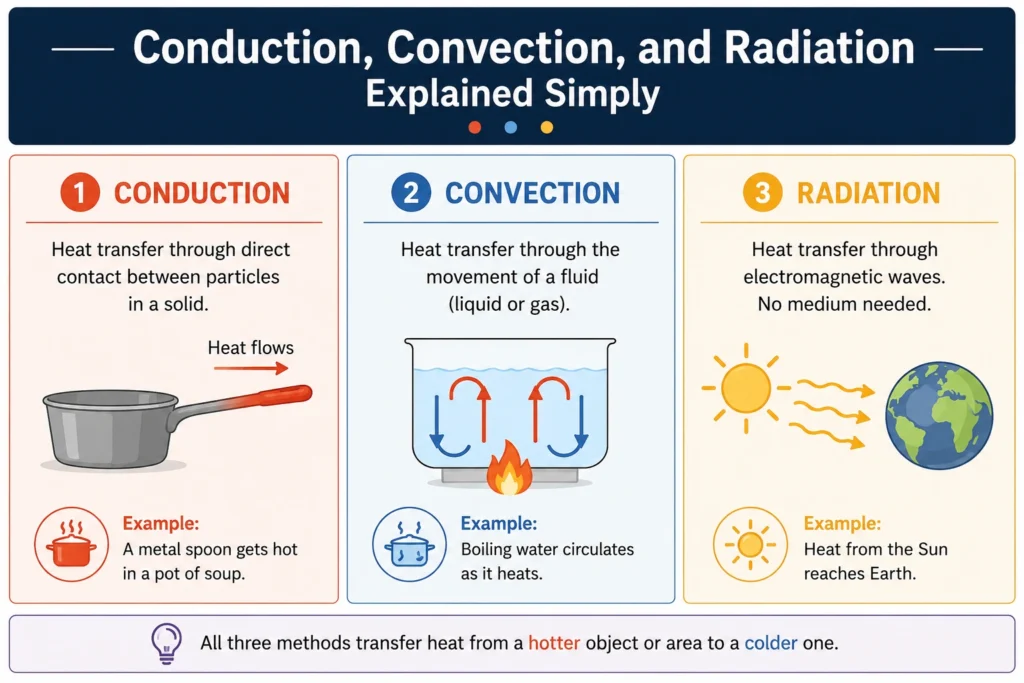
There are exactly three main ways heat can travel: Conduction, Convection, and Radiation. Understanding these three mechanisms isn’t just for textbooks; it explains everything from why you use a thermos to how weather patterns are formed.
1. Conduction: Heat by Touching
It is heat transfer through direct contact. Imagine you are in a crowded hallway. If someone at one end starts pushing, that energy is transferred person-to-person down the line, even though the people themselves don’t move across the hall.
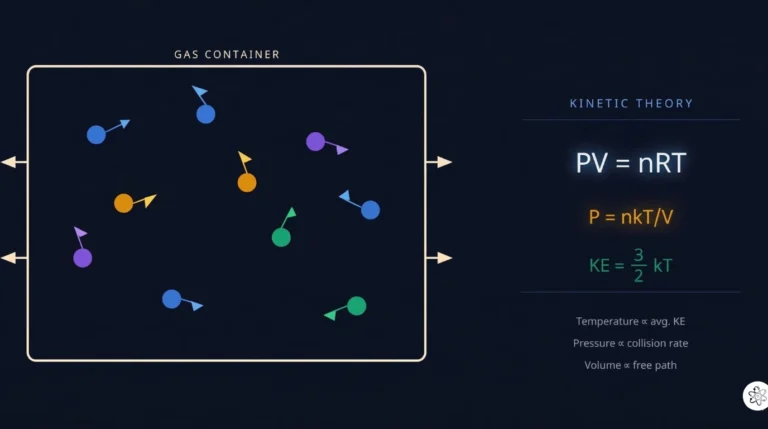
At the microscopic level, it works the same way. When an object heats up, its molecules start vibrating faster. These fast molecules collide with their slower (cooler) neighbors, passing kinetic energy along.
A Simple Rule: The greater the temperature difference, the faster the heat moves. Also, materials make a big difference:
Conductors vs. Insulators
| Type of Material | Description | Common Examples |
| Thermal Conductors | Materials that allow heat to flow through them easily. Metals are excellent conductors because they have “free electrons” that can carry energy quickly. | Silver, Copper, Aluminum, Steel |
| Thermal Insulators | Materials that block or slow down the flow of heat. | Still air, Wood, Glass, Fiberglass insulation, Styrofoam |
Real-World Example: This is why a metal spoon gets hot quickly when left in hot soup (conduction), and why we wear wool sweaters (wool traps still air, which is an excellent insulator, preventing your body heat from escaping).
2. Convection: Heat by Moving Currents
Convection is heat transfer that happens only in fluids (which means liquids or gases, like air or water).
It is “person-to-person,” but Convection is the whole crowd moving at once. It works because of a simple rule: Hot fluids rise, and cold fluids sink.
When a fluid heats up, its molecules move faster and spread out. This makes the hot fluid less dense (lighter). Gravity pulls the denser, cooler fluid down, pushing the warmer fluid up. This creates a continuous loop called a convection current.
Two Types of Convection:
- Natural (Free) Convection: This happens on its own due to temperature differences.
- Example: Hot air rising above a radiator in your room, or sea breezes (during the day, the land heats up faster than the sea, causing hot air over the land to rise and cool air from the ocean to move in).
- Forced Convection: This is when we use a machine (like a fan or pump) to speed up the process.
- Example: A fan-assisted oven, which uses a fan to circulate hot air evenly, cooking food much faster than natural convection alone.
3. Radiation: Heat by Invisible Waves
This is where the rules change completely. Conduction and Convection both require matter (solids, liquids, or gases) to move heat. Radiation requires no medium at all. It can travel through the perfect vacuum of space.
Radiation is the transfer of heat by electromagnetic waves, specifically infrared waves (which are invisible to human eyes, but we feel them as warmth).
Every single object in the universe, as long as it is warmer than absolute zero, is constantly emitting thermal radiation.
Interactive Heat Transfer Simulator
Toggle mechanisms and adjust fire intensity to observe the physics of heat movement.
Active Mechanisms
Loading active physics data…
A Matter of Surface and Temperature
How much radiation an object emits depends on two main things:
- Temperature: The hotter an object gets, the amount of radiation it emits increases dramatically.
- Surface Color and Texture:
- Dark and Matte (Rough) Surfaces: They are excellent absorbers and emitters of heat. If you wear a black shirt on a sunny day, it absorbs the sun's radiation quickly and makes you feel hot. It also releases heat efficiently.
- Light and Shiny (Reflective) Surfaces: They are poor absorbers and poor emitters. They reflect most of the radiation that hits them. This is why space suits are shiny silver: to reflect intense solar radiation in space and keep the astronaut safe.
Real-World Example: The Sun heats the Earth entirely by radiation. We can feel this warmth, even across 93 million miles of empty space.
Summary: The Battle for Your Thermos
To see all three processes in action, just look at how we stop heat transfer. A high-quality thermos flask (vacuum flask) is designed specifically to block all three mechanisms:
- The Vacuum: There is a double wall inside the thermos with a vacuum (no air) between them. Because there is no matter, heat cannot escape by conduction or convection.
- The Silver Coating: The inner glass walls are coated in silver (reflective coating). This prevents heat from escaping by radiation (the silver surface reflects the thermal waves back inside).
- The Insulating Cap: The cap is usually made of cork or plastic (good insulators), blocking the only direct exit point for heat via conduction.
By conquering all three methods, your thermos keeps your soup hot or your soda cold all day long.
Frequently Asked Questions (FAQs)
What are the 3 main types of heat transfer?
Heat moves in three specific ways: conduction (heat traveling through direct physical contact), convection (heat carried by moving currents in liquids or gases), and radiation (heat traveling as invisible electromagnetic waves without needing any physical matter).
What is the difference between conduction and convection?
The main difference is how the heat travels. Conduction requires solid objects to touch each other, passing heat molecule by molecule (like a hot pan on a stove). Convection only happens in fluids (liquids and gases), where the heat moves because the hot fluid actually physically rises and cold fluid sinks (like boiling water).
Can heat travel through a vacuum?
Yes, but only through radiation. Conduction and convection both require physical matter (atoms and molecules) to carry the heat. Because a vacuum has no matter in it, heat can only cross it using electromagnetic waves. This is exactly how the Sun's heat reaches Earth across millions of miles of empty space.
Why do we wear dark colors in the winter and light colors in the summer?
This has to do with radiation. Dark, matte colors are excellent at absorbing heat from the sun, which helps keep you warm in the winter. Light, shiny colors are poor absorbers and instead reflect the sun's radiation away from your body, keeping you cooler in the summer.
How does a thermos know to keep hot things hot and cold things cold?
A thermos doesn't actually "know" the temperature; it simply traps heat from moving in or out. It uses a vacuum gap between its walls to completely block conduction and convection. It also uses a shiny, silver-like inner coating to reflect radiation. By stopping all three methods of heat transfer, your hot soup stays hot, and your cold soda stays cold.
What makes a material a good insulator?
A good thermal insulator is a material that resists the flow of heat. Materials like wood, plastic, glass, and especially "still air" are great insulators because their molecules do not easily pass kinetic energy to one another. This is why winter coats are thick and puffy—they trap a layer of still air against your body to stop your body heat from escaping!
Frequently Asked Questions
Get physics insights delivered weekly
Join students and educators receiving expert explanations, study tips, and platform updates every Thursday.
Join others. No spam.

allphysicsfundamentals
Making physics accessible, interactive, and genuinely understandable for students at every level.