Stress, Strain, & Young’s Modulus: Explained
The Ultimate Guide to Stress, Strain, and Young’s Modulus
Imagine pulling a thick rubber band versus a thin steel wire. Why does the rubber stretch easily while the steel barely budges? Why do massive concrete pillars hold up bridges without snapping?
The answers lie in three foundational concepts of physics and engineering: Stress, Strain, and Young’s Modulus. Whether you are studying for a 10th-grade physics exam or curious about how safe buildings are designed, this guide breaks it down simply without the confusing jargon.
What is Stress? (The Internal Pressure)
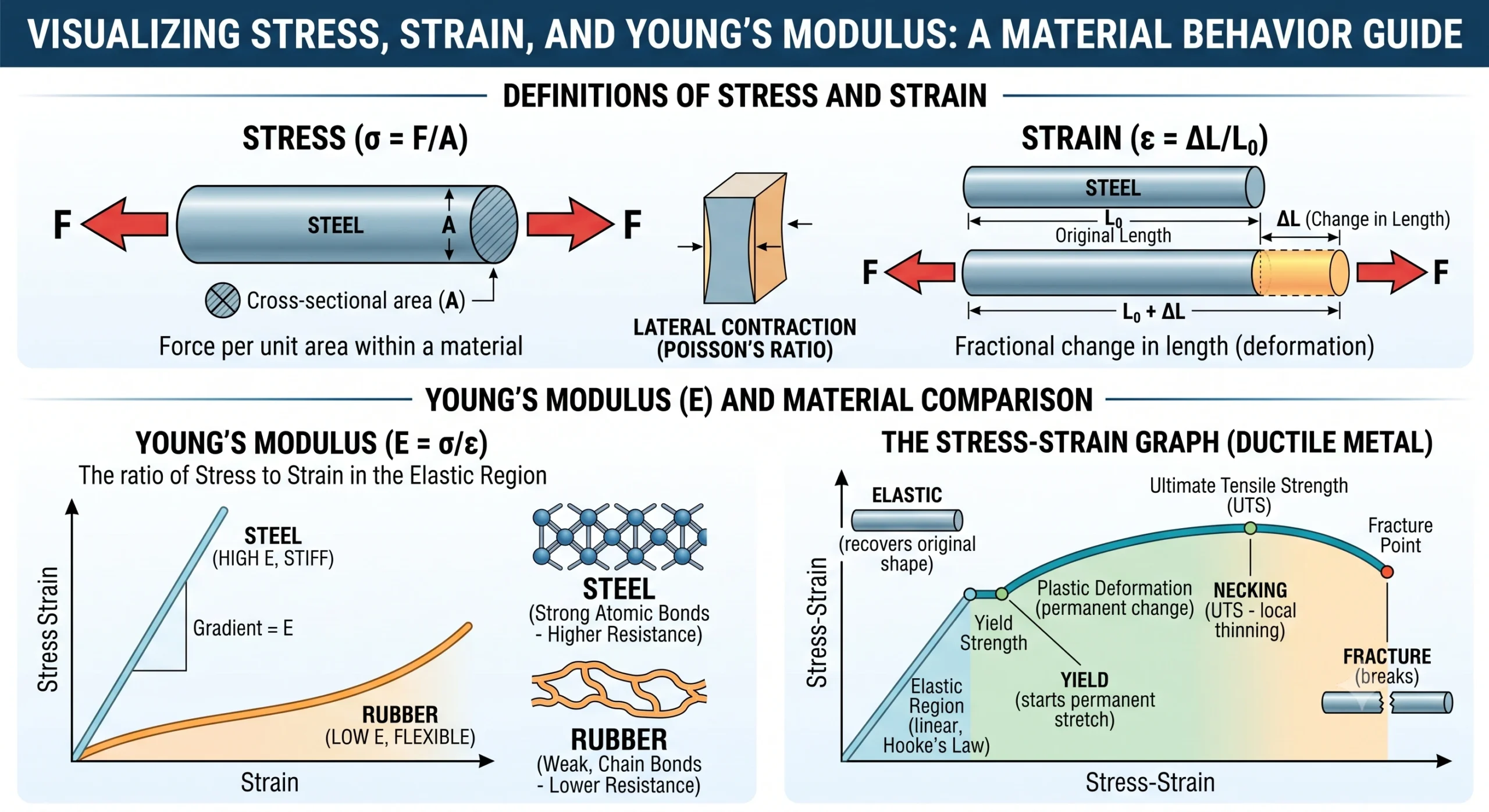
When you apply an external force (like pulling or pushing) to an object, the atoms inside fight back to hold the object together. It is the measure of this internal stretching or compressing force distributed across the material’s cross-sectional area.
Think of it as “force intensity.” A heavy load on a thick pillar creates less stress than the same load on a thin toothpick.
Formula
σ = F / A
- sigma (Sigma): It is measured in Pascals (Pa) or Newtons per square meter (Nm^2).
- F: Applied Force, measured in Newtons (N).
- A: Cross-sectional Area, measured in square meters (m^2).
💡 Keep in Mind: it depends only on the force and the thickness (area) of the material, not its length! A short wire and a long wire of the same thickness will experience the exact same stress if pulled with the same force.
What is Strain? (The Deformation)
When stress is applied, the material changes shape. It measures how much an object stretches or compresses compared to its original length. It tells us the percentage change in size.
Formula
ε = ΔL / L₀
- ε (Epsilon): Strain (This has no units because it is a ratio of two lengths!)
- ΔL: Change in length (extension or compression), measured in meters (m).
- L₀: Original length of the object, measured in meters (m).
💡 Keep in Mind: It is often written as a percentage. For example, if a 1 m rope stretches by 0.01 m, its strain is 0.01, which means it stretched by 1%.
What is Young’s Modulus? (The Material Stiffness)
If you apply the same stress to steel and rubber, the rubber stretches a lot more. Young’s Modulus E is a number that tells us exactly how stiff a material is. It calculates the ratio of stress to strain within the material’s elastic limit.
Formula
E = σ / ε = (F × L₀) / (A × ΔL)
Because strain has no units, it uses the same units as stress: Pascals (Pa). Because engineering materials are incredibly stiff, we usually measure them in Giga-Pascals (GPa), where 1 GPa = 1,000,000,000 Pa.
Stiffness of Common Materials
| Material | Young’s Modulus (E) | What it Means |
| Diamond | ≈1000 GPa | Extremely stiff; nearly impossible to stretch. |
| Steel | ≈200 GPa | Very stiff; used for building skyscrapers. |
| Aluminum | ≈70GPa | Moderately stiff; lightweight for airplanes. |
| Bone | ≈20 GPa | Stiff enough to support human weight safely. |
| Rubber | ≈0.01 – 0.1 GPa | Highly flexible; stretches easily with minimal force. |
Visualizing Material Limits: The Stress-Strain Graph
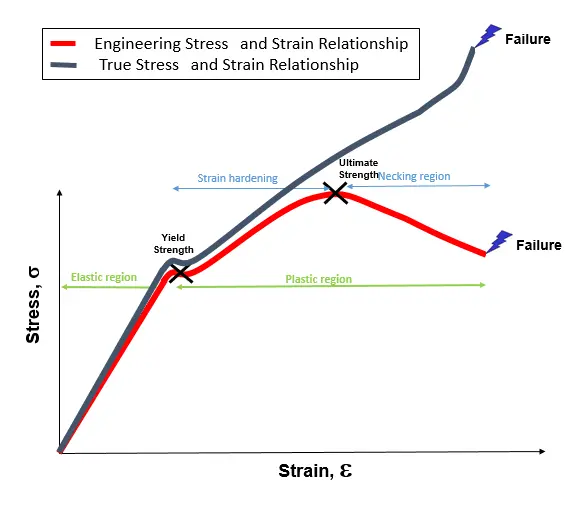
If you take a metal wire and pull it until it snaps, it goes through different stages. Engineers map this journey on a Graph.
Key Milestones on the Graph
- Linear Elastic Region (Hooke’s Law): The straight-line path at the beginning. In this region, stress is perfectly proportional to strain. If you let go of the material, it snaps right back to its original shape like a rubber band. The steepness (gradient) of this slope equals the Young’s Modulus.
- Elastic Limit: The absolute maximum stress a material can take while still being able to return to its original shape.
- Yield Point: If you stretch the material past its elastic limit, it hits the yield point. Here, the atomic bonds permanently slide past each other. The material enters the Plastic Region, meaning it will stay permanently bent or stretched even if you release the force.
- Ultimate Tensile Strength (UTS): The peak of the curve. This is the absolute maximum stress the material can handle. At this point, the material begins “necking”—thinning out locally at its weakest spot.
- Fracture / Breaking Point: The final point on the graph where the material completely snaps apart.
Material Classifications: Ductile vs. Brittle
Not all materials behave the same way on the graph:
- Ductile Materials (Steel, Copper, Aluminum): These have a large plastic region. They bend, stretch, and deform significantly before they finally break. This makes them safe for construction because they give plenty of visual warning before failing.
- Brittle Materials (Glass, Ceramics, Cast Iron): These materials have almost zero plastic region. They follow a straight elastic line and then snap suddenly with zero warning when they hit their limit.
Visual Explanation
Controls & Inputs
Calculated Live Data
Physical Deformation (Poisson’s Effect)
Live Stress-Strain Plot
4 Clear Worked Examples
Let’s look at how to use these formulas step-by-step using a simple, structured method.
Example 1: Finding the Extension of a Steel Wire
Problem:A steel wire (E = 200 GPa) is 2.0 m long with a cross-sectional area of 1.5 × 10^-6 m². A 600 N weight is hung from it. Calculate how much it extends.
- Given Variables:
- L₀ = 2.0 m
- A = 1.5 × 10^-6 m²
- F = 600 N
- E = 200 GPa = 200 × 10^9 Pa
1.Calculate the Stress:
2.Calculate the Strain:
ε = σ / E = (4.0 × 10^8) / (200 × 10^9) = 2.0 × 10^-3
3.Calculate the Final Extension:
Example 2: Finding Young's Modulus from an Experiment
Problem: A lab wire with a diameter of 0.8 mm (radius 0.4 mm = 0.4 × 10^-3 m) and a length of 1.5 m stretches by 2.1 mm under a load of 180 N. Find the Young's Modulus.
- Given Variables:
- L₀ = 1.5 m
- ΔL = 2.1 mm = 2.1 × 10^-3 m
- F = 180 N
- r = 0.4 × 10^-3 m
1.Calculate Circular Cross-Section Area:
2.Calculate Stress and Strain:
sigma = 180 / (5.027 × 10^-7) = 3.581 × 10^8 Pa
3.Calculate Young's Modulus:
Example 3: The Stress on a Human Bone
Problem: A runner's shin bone has a cross-sectional area of 4.5 cm² = 4.5 × 10^-4 m². During a hard step, it experiences a compressive force of 2700 N.
- Given Variables:
- A = 4.5 × 10⁻⁴ m²
- F = 2700 N
- Calculation:σ = F / A = 2700 / (4.5 × 10⁻⁴) = 6,000,000 Pa = 6.0 MPa
💡 Fun Fact: A human bone's ultimate crushing limit is about 170 MPa. This means the runner has a safety factor of nearly 28 times before the bone risks breaking!
Example 4: Strain on a Stretching Rubber Band
Problem: A rubber band with a starting length of 8 cm is pulled until it stretches to 14 cm. Find the strain value and express it as a percentage.
- Given Variables:
- L₀ = 8 cm = 0.08 m
- Final Length = 14 cm = 0.14 m
1.Find the Change in Length:
ΔL = 14 cm - 8 cm = 6 cm = 0.06 m
2.Calculate Strain:
ε = ΔL / L₀ = 0.06 / 0.08 = 0.75
To make it a percentage: 0.75 × 100 = 75% .
Understanding The Real-World Engineering Gaps
To truly understand how materials function in the real world, we have to look at how they react in three dimensions.
1. Poisson's Ratio (The Lateral Squeeze)
When you grab a piece of chewing gum and pull it lengthwise, it doesn't just get longer—it also gets thinner in the middle.
This sideways change is called Lateral Strain, and the ratio between the sideways narrowing and length stretching is known as Poisson's Ratio.
nu = -(lateral strain) / (longitudinal strain)
- Rubber (v ≈ 0.5): Completely incompressible. What it gains in length, it perfectly sacrifices in width.
- Cork (ν ≈ 0): Unique because it does not expand or narrow when compressed. This is exactly why a cork can easily be pushed straight into a wine bottle neck without jamming against the sides!
2. Confusing Words: Stiffness vs. Strength vs. Toughness
In everyday life, we swap these words around carelessly. In physics, they mean completely distinct properties:
- Stiffness (Young's Modulus): How hard is it to stretch elastically? (High stiffness = steep slope on the graph).
- Strength (UTS): How much total weight can it handle before it snaps or deforms permanently?
- Toughness: How much absolute impact energy can it absorb before structural fracture? This is measured as the entire area under the stress-strain curve. High toughness requires a balance of both strength and ductility.
⚡ Quick Exam Summary Cheat Sheet
Graph Slope: The gradient of the straight elastic section directly equals Young's Modulus ($E$).
Stress=Force / Area: Tells you the internal force intensity. Unit is Pascals (Pa).
Strain=Change in Length / Original Length: Fractional change in length. It has no units..
Young's Modulus = Stress / Strain: Measures stiffness. Large values mean the material resists stretching heavily.
Elastic vs Plastic: Elastic means it springs back cleanly; Plastic means it has stretched permanently out of shape.
Frequently Asked Questions (FAQs)
Q1: What is the main difference between stress and strain?
A: Stress is the internal resistance force per unit area acting inside a material (σ = F/A), whereas strain is the physical deformation or fractional change in length caused by that stress (ε = ΔL/L₀). Think of stress as the "cause" (internal pressure) and strain as the "effect" (stretching or squishing).
Q2: Why does strain have no units?
Strain is calculated by dividing the change in length by the original length ΔL / L₀. Because you are dividing a length in meters by another length in meters, the units cancel each other out completely, leaving a dimensionless ratio or percentage.
Q3: What does a high Young's Modulus value mean?
A high Young's Modulus means a material is very stiff and highly resistant to elastic deformation. For example, steel has a high Young's Modulus ≈ 200 GPa, meaning it requires a massive amount of force to stretch even a tiny amount.
Q4: What is the difference between elastic and plastic deformation?
Elastic deformation is temporary; when you remove the applied force, the material returns perfectly to its original shape. Plastic deformation is permanent; once a material is stretched past its elastic limit, its atomic structure shifts, and it will remain permanently warped or stretched even after the force is removed.
Q5: What is Poisson’s Ratio in simple terms?
Poisson's Ratio measures the thinning effect of a material. When you stretch an object lengthwise, it naturally contracts and gets thinner widthwise. Poisson's Ratio compares how much it thins out compared to how much it stretches.
Q6: Under what structural category do stress and strain fall?
Stress and strain fall under the category of Solid Mechanics (or Mechanics of Materials), which is a branch of classical mechanics. In school physics syllabus, it is typically taught under the chapter "Mechanical Properties of Solids" or "Properties of Matter."
Frequently Asked Questions
Get physics insights delivered weekly
Join students and educators receiving expert explanations, study tips, and platform updates every Thursday.
Join others. No spam.

Making physics accessible, interactive, and genuinely understandable for students at every level.