Electric Potential and Voltage: What They Are and Why They Matter
From Force to Energy
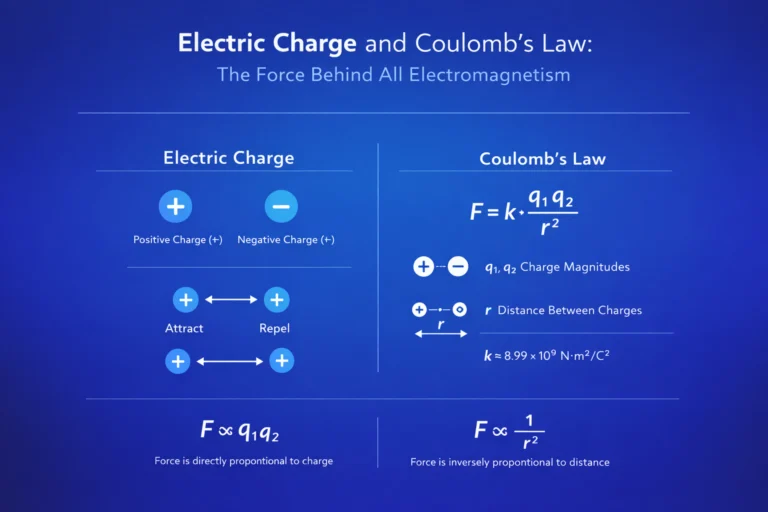
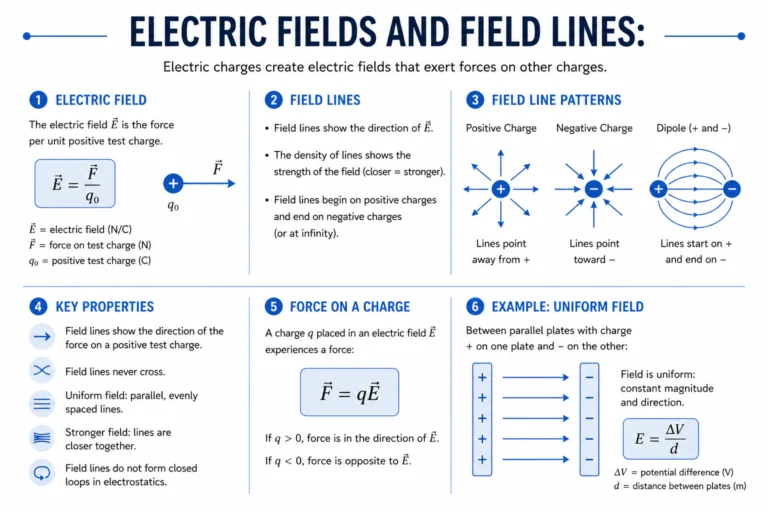
Coulomb’s Law gives you force. The electric field gives you force per unit charge at every point in space. But force alone is only part of the story. Physics also needs to account for energy, and that is where electric potential comes in. Without understanding electric potential, you cannot really understand how circuits work, why batteries have voltage ratings, or how energy moves through electrical systems.
Think of gravity as an analogy. When you lift a ball above the ground, you give it gravitational potential energy. The higher you lift it, the more energy you store. Drop it and that stored energy converts to kinetic energy as the ball falls. Electric charge works in exactly the same way. Push a positive charge against an electric field, against the direction it naturally wants to move, and you store energy in the system. Release it and the charge accelerates, converting that stored energy into motion. Electric potential is simply the energy version of the electric field concept. Instead of force per unit charge, it is energy per unit charge.
What Is Electric Potential?
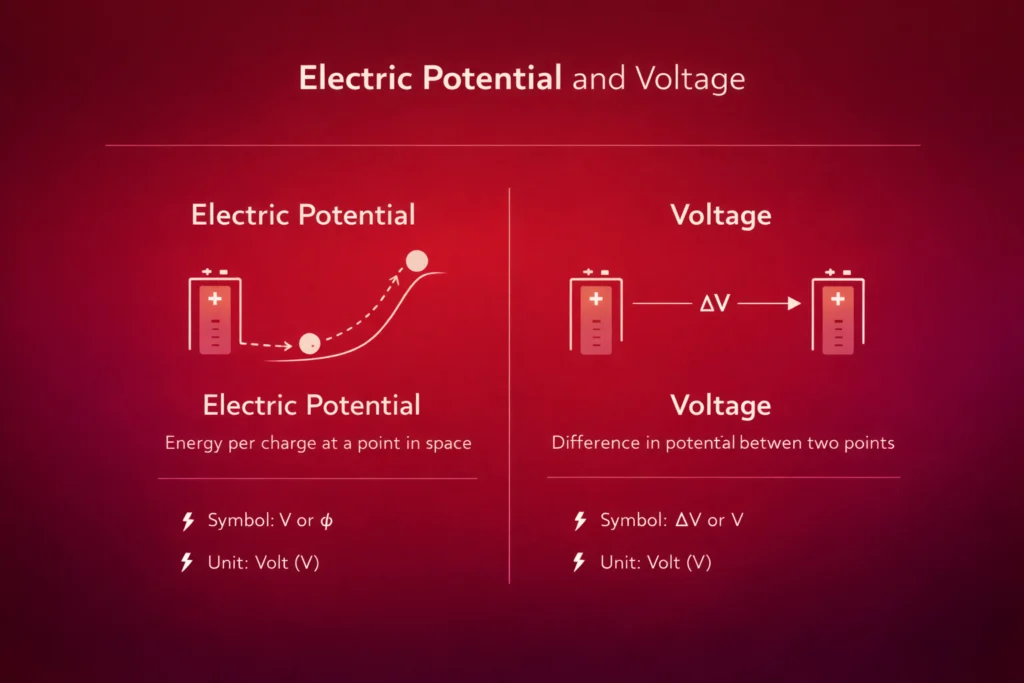
Electric potential V at a point in space is defined as the electric potential energy per unit charge at that point:
V = U / q
Where U is the potential energy in joules and q is the charge in coulombs. The unit of electric potential is the volt (V), named after Alessandro Volta, the Italian physicist who invented the first electrochemical battery. One volt equals one joule per coulomb (1 V = 1 J/C).
For a single point charge Q, the electric potential at a distance r is given by:
V = k x Q / r
Where k is Coulomb’s constant (8.99 x 10^9 N.m2/C2). Notice that this drops off as 1/r, not 1/r2 like the electric field strength does. This means potential falls off more slowly with distance than the field itself. A positive charge creates positive potential in the space around it while a negative charge creates negative potential.
It is also worth noting that electric potential is a scalar quantity, meaning it is just a number at each point in space with no direction. This makes it mathematically easier to work with than the electric field, which is a vector and has both magnitude and direction at every point.
Voltage: The Difference That Drives Current
In practice, absolute potential values are rarely what you care about. What actually matters in physics and engineering is the difference in potential between two points, which is called voltage or potential difference:
Voltage = V_A minus V_B
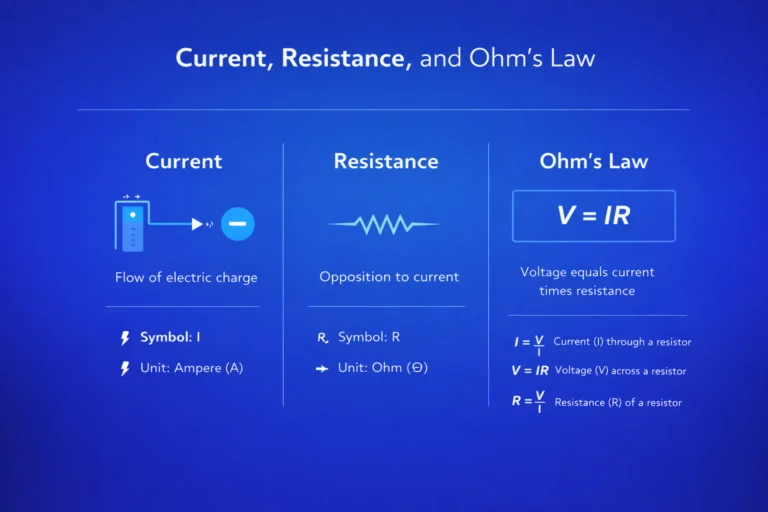
Voltage is what drives current through a circuit. A battery does not create charge from nothing. What it does is maintain a potential difference between its two terminals using a chemical reaction. The positive terminal is at higher potential and the negative terminal is at lower potential. Positive charges, or more accurately conventional current, flow from high potential to low potential, just like water flows naturally downhill. The bigger the voltage, the harder the push and the more current flows for a given resistance.
That is why your phone charger has a specific voltage rating, typically 5V or 9V or 20V depending on the device. And it is also why touching a high voltage power line is immediately lethal, while a static shock from a doorknob, which might involve thousands of volts, causes only a brief sting. The doorknob shock involves very little total charge and therefore very little total energy. Both the voltage and the total energy stored in the system matter for understanding the danger.
Equipotential Surfaces
Just as you can draw electric field lines to visualize an electric field, you can draw equipotential surfaces to visualize electric potential. An equipotential surface is a surface where the electric potential is exactly the same at every point on it. Moving a charge along an equipotential surface requires no work at all, because the potential does not change and therefore no energy is transferred.
Equipotential surfaces are always perpendicular to electric field lines. This makes sense because if you move along an equipotential, potential does not change, which means the field does no work on you, which means the field must be pointing perpendicular to your motion.
For a single positive point charge, the equipotential surfaces are concentric spheres centered on the charge. The closer the sphere to the charge, the higher the potential on it. For two parallel plates with opposite charges, the equipotential surfaces are flat planes running parallel to the plates and evenly spaced between them.
A conductor in electrostatic equilibrium is entirely at the same potential. Its entire surface is one equipotential. This is why charge distributes itself on the outer surface of a conductor rather than throughout the interior. It is also why the electric field inside a hollow conductor is exactly zero. This is the famous Faraday cage effect, which is used in electronics shielding, in MRI machines, and even in the metal walls of your microwave oven to keep radiation inside.
Electric Field and Potential: Two Sides of the Same Coin
Electric field and electric potential are not independent of each other. They are two different ways of describing the exact same physical situation. The electric field at any point points in the direction of decreasing potential, and its magnitude equals the rate at which potential decreases with distance:
E = minus dV/dx (in one dimension)
For the uniform field between two parallel plates this simplifies to:
E = V / d
Where V is the voltage across the plates and d is their separation. This relationship is deeply useful in practice. Often it is much easier to calculate the potential at various points first, since potential is a scalar and scalars add simply, and then derive the electric field from the potential rather than calculating the field directly from the charge distribution.
The Electron Volt: A More Convenient Energy Unit
The joule is the standard SI unit of energy but at the atomic scale it is inconveniently large. A single electron accelerated through one volt of potential difference gains only 1.6 x 10^-19 joules of energy, which is a tiny and awkward number to work with. Physicists therefore use a smaller unit called the electron volt (eV).
One electron volt is the energy gained by an electron when it moves through a potential difference of exactly one volt:
1 eV = 1.6 x 10^-19 J
The energy required to ionize a hydrogen atom, stripping its single electron completely away, is 13.6 eV. X-rays have photon energies in the kiloelectron volt range (keV). The Large Hadron Collider at CERN accelerates protons to energies of several trillion electron volts (TeV), making it the highest energy particle accelerator ever built.
Why Electric Potential Is So Important
Electric potential is one of those concepts that connects almost everything in electromagnetism together. It connects force to energy, it explains how batteries and circuits work, it tells you why conductors behave the way they do, and it links directly to the electric field through a simple mathematical relationship. Once you are comfortable with electric potential, concepts like capacitance, electric current, and electromagnetic induction all become much easier to understand because they all ultimately depend on potential differences driving charge from one place to another.
Frequently Asked Questions
What is the difference between electric potential and voltage?
Electric potential is the potential energy per unit charge at a specific point in space. Voltage, also called potential difference, is the difference in electric potential between two different points. In circuits it is always the voltage difference between two points that drives current to flow, not the absolute potential at any single point.
What is the unit of electric potential?
The volt (V), equal to one joule per coulomb. It is named after Alessandro Volta, the Italian physicist who invented the electrochemical battery in 1800.
Why does current flow from high to low potential?
Positive charges naturally move from regions of high potential to regions of low potential, in the same way that objects fall from high gravitational potential to low gravitational potential. This convention defines the direction of conventional current in all electrical circuits.
What is an equipotential surface?
A surface in space where the electric potential has the same value at every point. No work is required to move a charge along an equipotential surface. These surfaces are always perpendicular to the electric field lines passing through the same region.
What is the electron volt and why is it used?
The electron volt (eV) is a unit of energy equal to 1.6 x 10^-19 joules. It is used in atomic and particle physics because the joule is far too large a unit for describing energies at the atomic scale. One eV is the energy gained by a single electron accelerating through a potential difference of one volt.
Frequently Asked Questions
Get physics insights delivered weekly
Join students and educators receiving expert explanations, study tips, and platform updates every Thursday.
Join others. No spam.

allphysicsfundamentals
Making physics accessible, interactive, and genuinely understandable for students at every level.