The Work-Energy Theorem Explained: A Simple Guide for Physics Students
Imagine you are pushing a heavy shopping cart down the grocery store aisle. The harder you push, the faster it goes. But if you stop pushing and drag your feet, friction takes over, and the cart slows down.
Without even realizing it, you are demonstrating one of the most powerful rules in physics: The Work-Energy Theorem.
Instead of trying to calculate exactly how fast the cart is moving at every single fraction of a second, the Work-Energy Theorem gives us a brilliant shortcut. It connects the work you do to the cart’s speed in one simple equation.
Let’s break down exactly what this theorem is, how to use it, and why it makes solving physics problems so much easier.
What is the Work-Energy Theorem?
In physics, work is what happens when a force moves an object over a distance. Kinetic energy (KE) is the energy of motion—anything that is moving has kinetic energy.
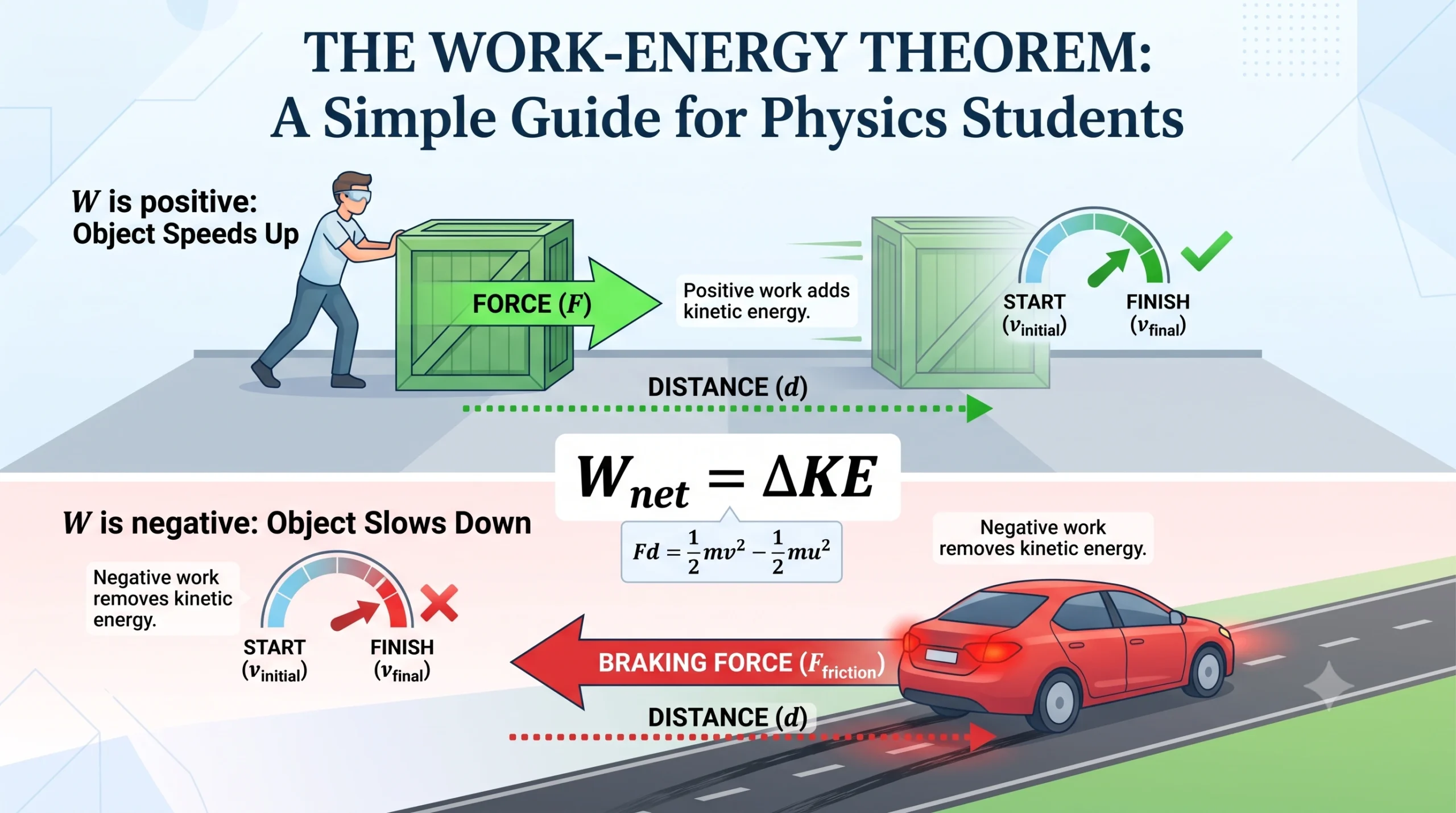
The Work-Energy Theorem simply states: The total (net) work done on an object is exactly equal to its change in kinetic energy.
Here is the formula:
Wnet = ΔKE = ½ mv² − ½ mu²
What the letters mean:
W_net= The total net work done by all forces (measured in Joules, J)ΔKE= The change in kinetic energy (Joules, J)m= The mass of the object (kg)v= The final speed (m/s)u= The initial speed (m/s)
The Golden Rule of the Theorem:
If the net work is zero, the kinetic energy doesn’t change. The object keeps moving at the exact same speed.
If the net work is positive, you are adding energy. The object speeds up.
If the net work is negative (like friction or hitting the brakes), you are removing energy. The object slows down.
How to Calculate “Net Work”
In the real world, there is rarely just one force acting on an object. When a car drives, the engine pushes it forward, but air resistance and road friction push it backward.
To find the Net Work (W_net), you have to look at all the forces:
- Forces helping the motion (Positive Work): Like a car engine pushing forward. These add kinetic energy.
- Forces fighting the motion (Negative Work): Like friction or air drag. These steal kinetic energy away and turn it into heat.
- Forces doing nothing (Zero Work): Any force that pushes perfectly sideways to the direction of motion (like gravity on a flat road) does zero work because it isn’t helping or stopping the object’s forward movement.
3 Steps to Solve Work-Energy Problems
Whenever you face a problem asking for speed, distance, or force, follow this simple framework:
- Calculate the Work: Multiply the net force by the distance the object moved. (
W = F × d). Remember to make it negative if the force is slowing the object down! - Set up the Theorem: Write down
W_net = ½mv² - ½mu². - Plug and Chug: Plug in the numbers you know and use basic algebra to solve for the missing piece.
Real-World Example: Braking Distance
Let’s look at one of the most important real-world applications of this theorem: how long it takes a car to stop.
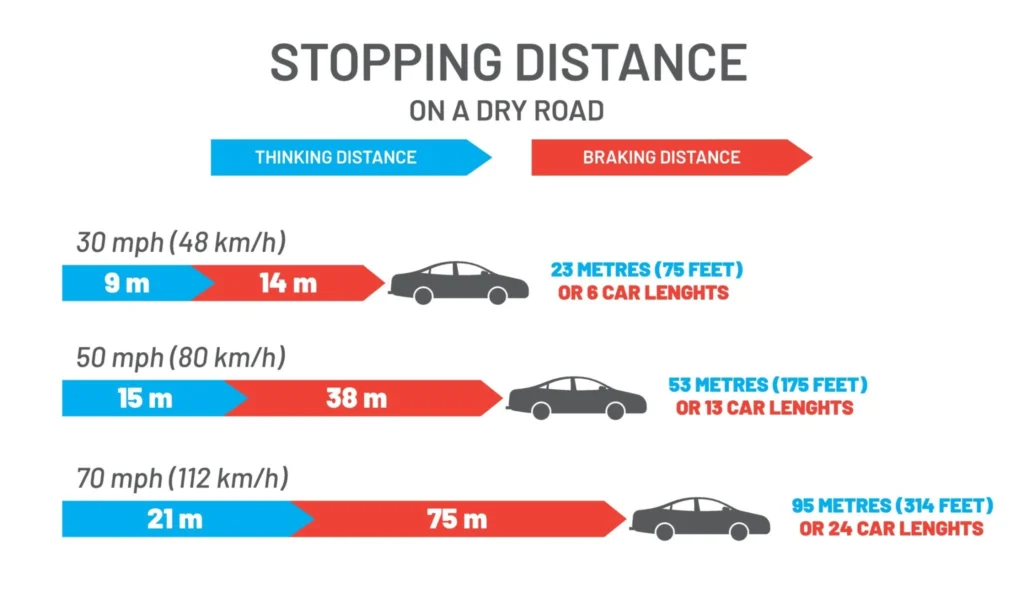
The Problem: A 1,000 kg car is traveling at 30 m/s (about 67 mph). The driver slams on the brakes, applying a braking force of 9,000 N. How far will the car skid before it completely stops?
The Solution:
- Step 1: The braking force fights the motion, so it does negative work. The work done is
-9000 × d(wheredis the distance). - Step 2: The car stops, so its final speed (
v) is 0. Its initial speed (u) was 30 m/s. - Step 3: Set them equal:
-9000 × d = 0 - ½(1000)(30)²
-9000 × d = -450,000
d = 50 meters
Mind-blowing fact: Because velocity is squared (v²) in the kinetic energy formula, if you double your speed on the highway, your car requires four times the distance to stop. This is why speed limits in school zones are so low!
Why Not Just Use F = ma?
You might be wondering: “Wait, can’t I just use Newton’s Second Law (F = ma) and my kinematic equations to solve these?”
Technically, yes. The Work-Energy Theorem is actually derived directly from F = ma.
However, the Work-Energy Theorem is a massive shortcut. Using Newton’s laws requires you to know exactly how much time a trip took and assumes the force stays perfectly constant. In real life (like a roller coaster dipping and curving, or a spring bouncing), forces change constantly. The Work-Energy Theorem lets you completely ignore how the object got from Point A to Point B. As long as you know the starting energy, the ending energy, and the total work done, you can instantly solve the problem.
Frequently Asked Questions (FAQs)
What is the simplest way to explain the Work-Energy Theorem?
The Work-Energy Theorem states that the total (net) work done on an object is equal to its change in kinetic energy (the energy of motion). If you do positive work on an object, you add energy, making it speed up. If a force like friction does negative work, it removes energy, making the object slow down.
What is the formula for the Work-Energy Theorem?
The standard formula is:
Plaintext
W_net = ΔKE = ½mv² - ½mu²
Where:
W_net= Net work done on the object (in Joules, J)ΔKE= Change in kinetic energy (in Joules, J)m= Mass of the object (in kilograms, kg)v= Final speed (in meters per second, m/s)u= Initial speed (in meters per second, m/s)
Why does doubling a car’s speed quadruple its stopping distance?
Because velocity is squared (v²) in the kinetic energy formula:
Plaintext
KE = ½mv²
When you double your speed (2²), your car has four times as much kinetic energy. Since the car’s brakes apply a steady force over a distance (W = F × d), the brakes must cover four times the distance to remove all that extra kinetic energy and bring the car to a complete stop.
Why should I use the Work-Energy Theorem instead of Newton’s Second Law?
While both methods are mathematically correct, the Work-Energy Theorem is a major shortcut. Using Newton’s Second Law requires you to know exactly how much time the motion took:
Plaintext
F = ma
The Work-Energy Theorem allows you to completely ignore time and skip complicated motion equations. As long as you know the starting speed, ending speed, and total distance, you can solve the problem in a single step.
Does the Work-Energy Theorem still apply if friction is present?
Yes. Unlike the Conservation of Mechanical Energy (which only works when there is no friction), the Work-Energy Theorem accounts for all forces. You simply include the negative work done by friction when calculating the total net work (W_net).
Frequently Asked Questions
Get physics insights delivered weekly
Join students and educators receiving expert explanations, study tips, and platform updates every Thursday.
Join others. No spam.
allphysicsfundamentals
Making physics accessible, interactive, and genuinely understandable for students at every level.