Newton’s Laws of Motion Explained With Real Examples
You’ve probably heard some version of Newton’s laws since middle school. A body at rest stays at rest. F equals ma. Action, reaction. But here’s the thing — most people memorize these statements without really getting what they mean. And that’s a problem, because these three laws aren’t just exam material. They’re the operating system behind every physical thing you interact with, from your morning commute to the International Space Station.
Isaac Newton laid these out back in 1687 in his book Principia Mathematica. Over 300 years later, they still hold up for pretty much everything you’ll encounter in daily life. They only start to break at extremes — near the speed of light (Einstein’s territory) or at subatomic scales (quantum mechanics). For everything else? Newton’s laws of motion are the rulebook.
Let’s actually break them down — not as textbook definitions you’ll forget next week, but as ideas you can carry around with you.
The First Law — Why Things Don’t Just Stop on Their Own
Newton’s first law says that an object at rest stays at rest, and an object in motion keeps moving at the same speed and in the same direction — unless something forces it to change. This is the law of inertia.
Now, that sounds obvious until you really think about it. Push a book across a table, and it stops. Kick a ball across grass, and it eventually rolls to a halt. So doesn’t everything just… stop naturally?
No. And this is where most people get tripped up. The book stops because friction is pushing against it the entire time. The ball stops because friction and air resistance are draining its energy. If you took away all those forces — picture a hockey puck on perfectly frictionless ice stretching out forever — that puck would never slow down. Not after a minute, not after a century. It’d glide at the same speed in the same direction until something acted on it.
What is inertia, exactly?
Inertia is just the tendency of an object to keep doing whatever it’s already doing. Sitting still? It wants to keep sitting still. Moving at 60 km/h to the north? It wants to keep moving at 60 km/h to the north. It’s not a force. It’s a property. And mass is how we measure it — more mass means more inertia. That’s why pushing a shopping cart is easy, but pushing a loaded truck is a different story entirely.
A mistake almost everyone makes
People tend to think that if something is moving, there must be a force pushing it forward right now. This is Aristotle-era thinking. A hockey puck sliding on ice doesn’t have a forward force acting on it — it’s just coasting on its own inertia. No force is needed to maintain constant velocity. Forces are only needed to change velocity.
Think about riding in a car on a straight highway at a constant speed. You don’t feel anything pushing you. That’s the first law in action. Now, hit the brakes suddenly — you lurch forward. Your body was trying to keep moving (inertia), and the seatbelt applied a force to change that. That’s why seatbelts exist.
Newton’s Second Law: F = ma and Why It Matters More Than You Think
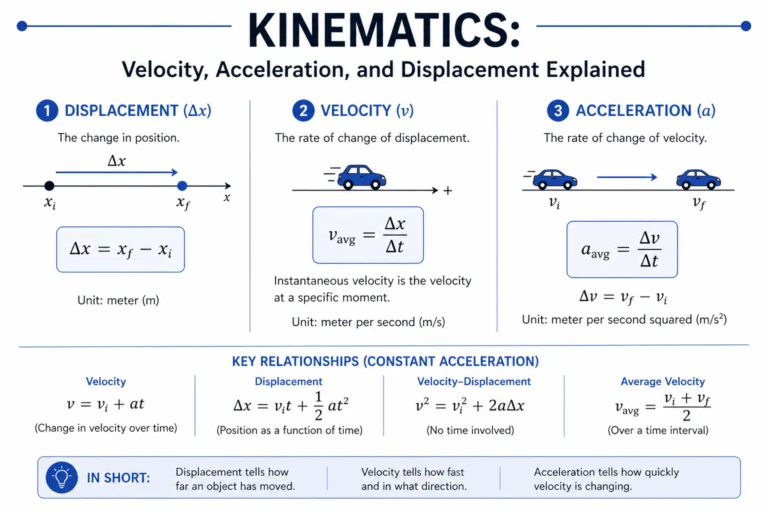
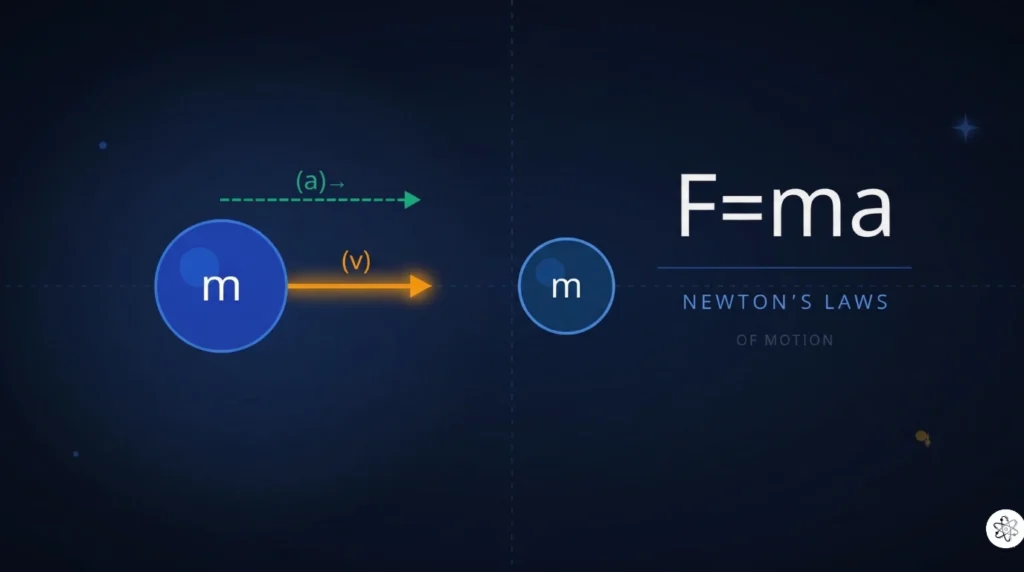
If the first law tells you when motion changes, the second law tells you how much it changes. The net force on an object equals its mass times its acceleration. That’s the famous F = ma equation, and it’s arguably the single most useful equation in all of introductory physics.
Here’s what it’s really saying: force doesn’t create speed. Force creates acceleration — a change in speed. Push a box with a constant force, and it doesn’t just travel at some constant speed. It speeds up continuously. The harder you push, the faster it accelerates. And the heavier the box, the slower it accelerates for the same push.
Breaking down the equation
Let’s get concrete. Say you’re pushing a 10 kg box across a smooth floor with a net force of 20 N (newtons). The acceleration is 20 ÷ 10 = 2 m/s². That means every second, the box’s speed increases by 2 meters per second. After 5 seconds of pushing, it’s traveling at 10 m/s.
Now double the mass to 20 kg, but keep the same 20 N force. The acceleration drops to 1 m/s². Same force, half the acceleration. That’s the inverse relationship between mass and acceleration — and it’s why a compact car zooms off the line while a loaded freight truck barely crawls at the same engine output.
What’s a newton, anyway?
Force is measured in newtons (N). One newton is the force you need to accelerate a 1 kg mass at 1 m/s². A typical apple weighs about 1 N thanks to gravity — which is a nice coincidence, given Newton’s famous apple story. Whether that story actually happened is debatable, but the unit is named after him regardless.
How the first and second laws connect
Here’s something most textbooks mention in passing but don’t emphasize enough: the first law is actually a special case of the second law. When the net force is zero (Fnet = 0), acceleration is zero, so velocity stays constant. That’s it. The first law doesn’t introduce new physics. It establishes the baseline — that constant velocity (including being at rest) is the natural state, and you need force to deviate from it.
The Third Law — Forces Always Travel in Pairs
Newton’s third law gets quoted all the time: for every action, there is an equal and opposite reaction. And it gets misunderstood almost as often.
The confusion usually goes like this: “If every force has an equal and opposite reaction, why doesn’t everything just cancel out? Why does anything move at all?” Good question. The answer is that the two forces in a third-law pair act on different objects. They never cancel because they’re not on the same body.
When you push against a wall, the wall pushes back on you with the same force. Your push is on the wall. The wall’s push is on you. Two different objects, two different free-body diagrams. Nothing cancels.
The book-on-table trap
This is a classic exam trick, so pay attention. A book sits on a table. Gravity pulls it down. The table pushes it up with a normal force. These two forces are equal and opposite. But they’re NOT a Newton’s third-law pair — because they both act on the same object (the book).
The actual third-law partner of gravity pulling the book down (Earth pulling the book) is the book pulling Earth upward. Yes, the book exerts a gravitational pull on the entire planet. It’s tiny, obviously. But it’s real. And the third-law partner of the table’s upward push on the book is the book pushing down on the table.
Third-law pairs always share two traits: they involve two different objects, and they involve the same type of force.
Free-Body Diagrams: The Tool That Makes It All Click
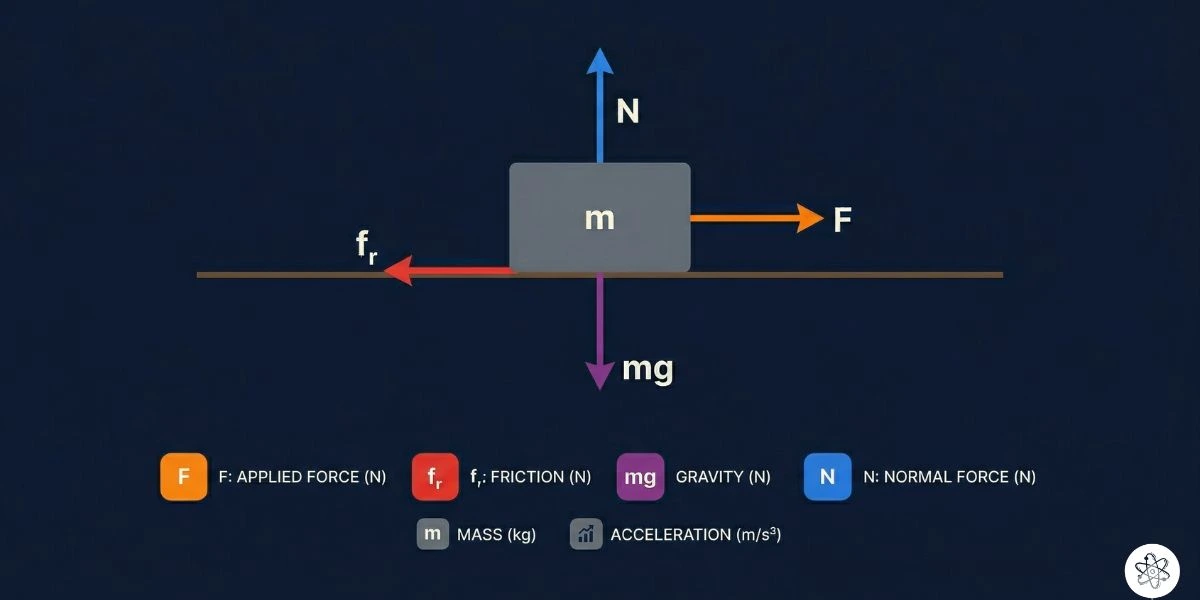
If there’s one skill that separates students who struggle with physics from those who breeze through it, it’s the ability to draw a correct free-body diagram (FBD). It’s the bridge between understanding the laws conceptually and actually solving problems.
A free-body diagram is dead simple in concept. Pick one object. Draw every external force acting on that object — gravity, friction, normal force, tension, applied push, whatever. Don’t include forces the object exerts on other things. Don’t include internal forces. Just what the universe does to your chosen object.
Once you have a correct FBD, the rest is plug-and-chug. Add up forces in the x-direction, set them equal to max. Add up forces in the y-direction, set them equal to may. Solve. That’s the recipe for nearly every problem you’ll face in introductory mechanics — from blocks on ramps to satellites in orbit.
What Newton’s Laws Lead To: Momentum and Energy
Newton’s laws aren’t three isolated ideas. They build on each other and lead to some of the deepest principles in physics.
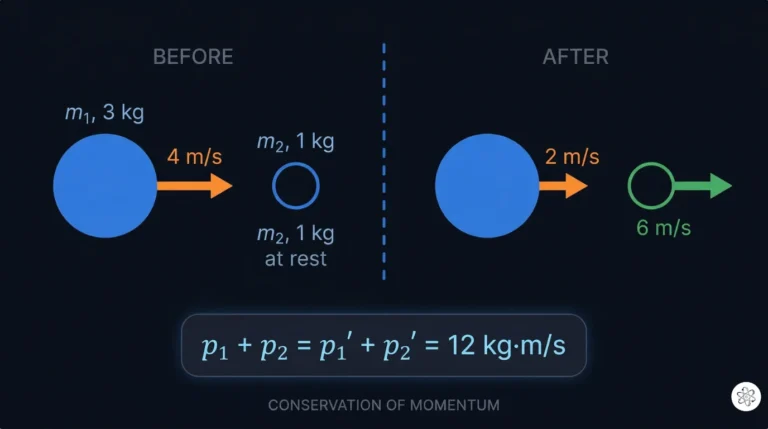
Take the third law. Apply it across every particle in a closed system, and you get conservation of momentum — the total momentum of an isolated system never changes. This is why rockets work in the vacuum of space. The rocket pushes exhaust gas backward, and the gas pushes the rocket forward. Momentum is conserved.
Combine the second law with the concept of work (force applied over a distance), and you arrive at the work-energy theorem and eventually conservation of energy. Energy isn’t created or destroyed, it just transforms. Kinetic becomes potential, becomes thermal, and back again. These conservation laws are probably the most powerful tools in all of physics, and they flow directly from Newton’s original three laws.
Quick Reference: All Three Laws at a Glance
| Law | What it Says | The Big Idea |
|---|---|---|
| First (Inertia) | An object won’t change its motion unless a net force acts on it | Objects resist changes — mass measures how much |
| Second (F = ma) | Net force equals mass times acceleration | Force causes acceleration, not constant speed |
| Third (Action-Reaction) | Every force has an equal and opposite partner on a different object | Forces always come in pairs on different bodies |
Where Do These Laws Actually Get Used?
Everywhere. And I don’t mean that as a vague statement — I mean literally every branch of engineering and applied physics starts with Newton’s laws. Structural engineers use them to calculate loads on bridges. Automotive engineers use them in crash-test simulations. Aerospace engineers use them to plot spacecraft trajectories. Sports biomechanics researchers use them to analyze a sprinter’s stride or a pitcher’s throw.
Even fields that seem unrelated circle back. Fluid mechanics? Built on Newton’s second law applied to tiny parcels of fluid. Orbital mechanics? Newton’s laws plus his law of gravitation. Robotics? Every joint, motor, and actuator is designed around F = ma.
When Do Newton’s Laws Stop Working?
There are two scenarios where you need to swap out Newton’s framework for something more advanced. First, when objects move at speeds approaching the speed of light, about 300,000 km/s. At those speeds, Einstein’s special relativity takes over, and mass, time, and length all start behaving in non-intuitive ways.
Second, at the scale of atoms and subatomic particles, quantum mechanics governs behavior. Particles don’t have precise positions and velocities the way Newton assumed — they exist in probability clouds and follow wave equations instead.
But for anything between those two extremes — which covers basically every human-scale experience you’ll ever have — Newton’s laws aren’t rough estimates. They’re accurate. Full stop.
Frequently Asked Questions
What are Newton’s three laws of motion in simple terms?
First law: objects keep doing what they’re doing (resting or moving) unless a force changes that. Second law: the net force on an object equals its mass times its acceleration (F = ma). Third law: When you push something, it pushes back on you just as hard.
Can you give a real-life example of Newton’s first law?
When a car brakes suddenly, your body keeps moving forward because of inertia. Your seatbelt applies the force that slows you down along with the car. Without the seatbelt, your body would continue at the car’s original speed — straight into the dashboard.
Why is F = ma so important in physics?
Because it connects three quantities — force, mass, and acceleration — in a way that lets you predict how any object will move under any set of forces. If you know the forces and the mass, you can calculate the acceleration, and from there reconstruct the entire trajectory. That’s the foundation of nearly all classical mechanics problems.
Do Newton’s third law forces cancel each other out?
No. The two forces in a third-law pair act on different objects, so they can’t cancel. Your push on a wall and the wall’s push on you are separate forces affecting separate things. Forces only cancel when they act on the same object in opposite directions.
Who came up with Newton’s laws of motion?
Sir Isaac Newton published them in 1687 in his Principia Mathematica. But he built on work by Galileo Galilei, who first established key ideas about inertia and the behavior of falling objects. Newton took those insights
Frequently Asked Questions
Get physics insights delivered weekly
Join students and educators receiving expert explanations, study tips, and platform updates every Thursday.
Join others. No spam.
allphysicsfundamentals
Making physics accessible, interactive, and genuinely understandable for students at every level.
Learn
- All Articles
- Classical Mechanics
- Thermodynamics
- Waves & Optics
- Electromagnetism
- Modern Physics