Circular Motion: Speed, Acceleration, and the Forces That Keep Objects Turning
The Counterintuitive Truth About Circular Motion
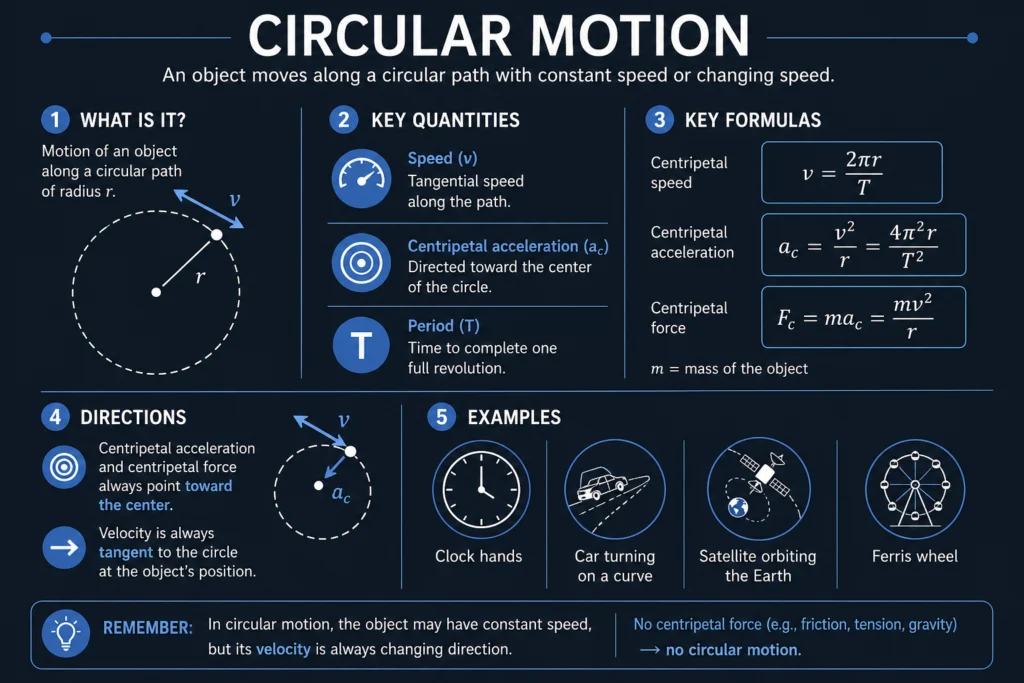
Here’s something that trips up almost every physics student the first time they encounter it. An object moving in a perfect circle at perfectly constant speed is still accelerating. Not sometimes. Always. Even if the speed never changes by a single meter per second, the object is constantly accelerating.
This sounds wrong. Acceleration means changing velocity, and if speed is constant, hasn’t velocity stayed the same? The answer is no, because velocity is a vector. It has both magnitude and direction. An object moving in a circle is constantly changing direction, which means its velocity vector is constantly changing, which means it is constantly accelerating.
This is the central insight of circular motion, and everything else flows from it.
Key Quantities in Circular Motion
Before getting into the physics, you need to be comfortable with a few quantities that describe circular motion.
Period (T) is the time taken to complete one full revolution. Measured in seconds.
Frequency (f) is the number of complete revolutions per second. Measured in hertz (Hz). Frequency and period are reciprocals of each other: f = 1/T.
Angular velocity (omega) measures how quickly the angle is changing, in radians per second. One full revolution is 2 pi radians, so omega = 2 pi / T = 2 pi x f.
Linear speed (v) is the speed of the object along the circular path. For a circle of radius r: v = omega x r = 2 pi x r / T.
These four quantities are all related. If you know any one of them and the radius, you can find all the others.
Simulation of Circular motion
Centripetal Acceleration
The acceleration of an object moving in a circle always points toward the center of the circle. This is called centripetal acceleration, from the Latin meaning center-seeking. The magnitude of centripetal acceleration is:
a = v2 / r = omega2 x r
Where v is the linear speed and r is the radius of the circular path. A few things to notice here. The acceleration increases with the square of the speed, so doubling the speed quadruples the centripetal acceleration. The acceleration decreases with larger radius, so tighter circles require more acceleration than gentler ones at the same speed. This is why sharp bends on roads are more dangerous at high speed than gradual curves.
The direction of centripetal acceleration is always toward the center of the circle. It's always perpendicular to the velocity of the object. This is what makes circular motion possible: the acceleration changes the direction of velocity without changing its magnitude, keeping the object on its circular path.
Centripetal Force
By Newton's second law, acceleration requires a net force. The force that produces centripetal acceleration is called centripetal force, and it always points toward the center of the circle:
F = m x a = m x v2 / r = m x omega2 x r
Centripetal force is not a new type of force. It's a label for whatever force happens to be pointing toward the center of the circle in a given situation. The actual physical force providing it depends on the situation.
For a ball on a string swinging in a horizontal circle, the centripetal force is the tension in the string.
For a car going around a bend, the centripetal force is the friction between the tires and the road, pointing toward the center of the curve.
For the Moon orbiting Earth, the centripetal force is gravity, always pulling the Moon toward Earth's center.
For a roller coaster at the top of a loop, the centripetal force is the combination of gravity and the normal force from the track.
For an electron orbiting a nucleus in the Bohr model, the centripetal force is the electrostatic attraction between the electron and the proton.
The key question in any circular motion problem is always: what physical force is providing the centripetal acceleration? Identify that and you've identified the equation you need.
What Happens If the Centripetal Force Disappears?
If the force providing centripetal acceleration suddenly vanishes, the object does not fly outward. It continues in a straight line tangent to the circle at the point where the force disappeared. This is Newton's first law: an object in motion continues in a straight line unless acted on by a force.
Swing a ball on a string in a circle and then let go. The ball doesn't shoot outward away from you. It flies off in whatever direction it was moving at the moment you released it, which is tangent to the circle. This is how a hammer thrower in athletics releases the hammer to send it flying across the field.
The common misconception of a centrifugal force, the idea that something pushes an object outward in circular motion, is just the feeling you get from being in a rotating reference frame. From outside the circle, there is no outward force. There is only the inward centripetal force and the tendency of objects to move in straight lines when that force is absent.
Vertical Circles
Circular motion in a vertical plane is more complex than horizontal circular motion because gravity acts throughout and changes the net force at different points on the circle.
At the top of a vertical circle, both the centripetal force requirement and gravity point downward toward the center. If the object is on the inside of a loop, the normal force from the track and gravity both contribute to the centripetal force:
mg + N = mv2 / r
The minimum speed to maintain contact at the top occurs when N = 0, giving: v minimum = sqrt(g x r).
Below this speed the required centripetal force exceeds gravity and the object would leave the circular path. This is the minimum speed a roller coaster must maintain at the top of a loop. If the coaster goes too slowly it falls away from the track.
At the bottom of a vertical circle, the normal force points upward toward the center while gravity points downward away from the center:
N minus mg = mv2 / r
So N = mg + mv2/r, which is always greater than mg. This is why you feel heavier at the bottom of a roller coaster loop. The normal force from your seat exceeds your actual weight.
Satellites and Orbital Motion
Satellites in circular orbits are a perfect example of circular motion provided by gravity. The gravitational force between Earth and a satellite provides the centripetal force needed for circular orbit.
Setting gravitational force equal to centripetal force:
GMm/r2 = mv2/r
Where G is Newton's gravitational constant, M is Earth's mass, m is the satellite's mass, and r is the orbital radius. The satellite mass cancels out, giving:
v = sqrt(GM/r)
This means orbital speed depends only on the orbital radius, not on the satellite's mass. A heavier satellite in the same orbit moves at exactly the same speed as a lighter one. The orbital period follows from v = 2 pi r / T:
T = 2 pi x sqrt(r3/GM)
This is Kepler's third law, the orbital period squared is proportional to the orbital radius cubed. It applies to planets orbiting the Sun, moons orbiting planets, and artificial satellites orbiting Earth. The International Space Station orbits at about 400 km altitude with an orbital period of approximately 92 minutes and a speed of about 7.66 km/s.
Geostationary satellites orbit at a radius where the orbital period equals exactly 24 hours, keeping them stationary above the same point on Earth's surface. This radius works out to about 42,164 km from Earth's center, or about 35,786 km above the surface. All TV broadcast satellites and most communications satellites occupy this special orbit.
Banking of Roads and Tracks
When a road or track is banked, tilted inward on curves, part of the normal force from the surface provides centripetal acceleration. This reduces the reliance on friction and allows vehicles to navigate the curve safely even on slippery surfaces.
For a banked curve with banking angle theta and radius r, the ideal speed at which no friction is needed is:
v = sqrt(g x r x tan(theta))
At this speed the horizontal component of the normal force exactly provides the required centripetal force. Formula 1 circuits, NASCAR ovals, and bicycle velodromes all use banking to allow higher speeds through corners. The steeply banked turns at Daytona International Speedway are banked at 31 degrees, allowing cars to maintain high speeds through the corners without relying entirely on tire friction.
Angular Momentum and Uniform Circular Motion
An object in uniform circular motion has constant angular momentum about the center of the circle, as long as no torque acts on it. Angular momentum L = m x v x r = m x omega x r2.
When a spinning figure skater pulls in their arms they reduce their radius of rotation. To conserve angular momentum their angular velocity must increase, which is why they spin faster. When they extend their arms again, they slow down. This is conservation of angular momentum in action, the rotational equivalent of conservation of linear momentum.
Frequently Asked Questions
What is centripetal acceleration?
Centripetal acceleration is the acceleration of an object moving in a circular path, always directed toward the center of the circle. Its magnitude is v2/r where v is the speed and r is the radius. It's what changes the direction of the object's velocity, keeping it on the circular path without changing its speed.
Is centripetal force a real force?
Is centripetal force a real force?
Centripetal force is not a separate fundamental force. It's the name given to whatever net force happens to point toward the center of circular motion in a given situation. The actual physical forces providing it could be tension, gravity, friction, the normal force, or any combination depending on the scenario.
Why do you feel heavier at the bottom of a loop and lighter at the top?
At the bottom of a loop the normal force must support your weight and provide centripetal acceleration toward the center (upward), so it exceeds your actual weight, making you feel heavier. At the top of a loop the normal force and gravity both point toward the center (downward), so the normal force is less than your weight, making you feel lighter or even weightless if moving at exactly the minimum speed.
What keeps satellites in orbit?
Gravity provides the centripetal force for orbital motion. A satellite moves fast enough sideways that as it falls toward Earth due to gravity, Earth's surface curves away beneath it at the same rate. The satellite is essentially in continuous free fall around the planet. There's no engine needed once in orbit.
What is the difference between angular velocity and linear velocity?
What is the difference between angular velocity and linear velocity?
Angular velocity (omega) measures how quickly the angle changes, in radians per second. Linear velocity (v) measures how quickly the object moves along the circular path, in meters per second. They're related by v = omega x r, where r is the radius of the circle. Two points on a rotating disk at different radii have the same angular velocity but different linear velocities.
Frequently Asked Questions
Get physics insights delivered weekly
Join students and educators receiving expert explanations, study tips, and platform updates every Thursday.
Join others. No spam.
allphysicsfundamentals
Making physics accessible, interactive, and genuinely understandable for students at every level.
Learn
- All Articles
- Classical Mechanics
- Thermodynamics
- Waves & Optics
- Electromagnetism
- Modern Physics