Why Is Projectile Motion a Parabola? -Explained Simply
Why Is Projectile Motion a Parabola?
Throw a ball at an angle. Watch it rise, curve, and fall back down. That curved path it follows? It’s not random. It’s not a circle. It’s not just “some arc.” It’s a parabola — every single time.
But why? Why does every object thrown through the air trace this one specific mathematical shape? Why not a semicircle? Why not a wobbly line? The answer comes down to one beautifully simple idea: two motions happening at the same time, each following its own rule.
Once you understand this, projectile motion stops being a formula to memorize. It becomes something you can see.
First, What Exactly Is a Parabola?
Before we talk about why the path is a parabola, let’s make sure we know what a parabola actually is.
A parabola is a smooth, symmetric, U-shaped curve. In math, it’s described by any equation of the form y = ax² + bx + c (where a is not zero). It has one highest or lowest point called the vertex, and two arms that spread outward symmetrically from it.
You’ve seen parabolas everywhere without realizing it:
- The shape a satellite dish makes
- The curve of water shooting from a fountain
- The cross-section of a car headlight reflector
In projectile motion, the parabola is upside down (opening downward), because gravity pulls things down. The vertex is the highest point of the trajectory.
Now the real question: why does this specific shape show up when you throw something?
The Big Idea: Two Separate Motions at Once
Here’s the key insight that makes everything click.
When you throw a ball at an angle, you’re not creating one complicated motion. You’re creating two simple motions happening at the same time:
1. Horizontal motion (sideways) — The ball moves forward at a constant speed. No force pushes it forward or backward (we’re ignoring air resistance). So it covers equal distances in equal time intervals. Steady. Predictable. Boring.
2. Vertical motion (up and down) — Gravity pulls the ball downward with a constant acceleration of about 9.8 m/s². The ball slows down on the way up, stops for an instant at the top, then speeds up on the way down. This motion is changing every moment.
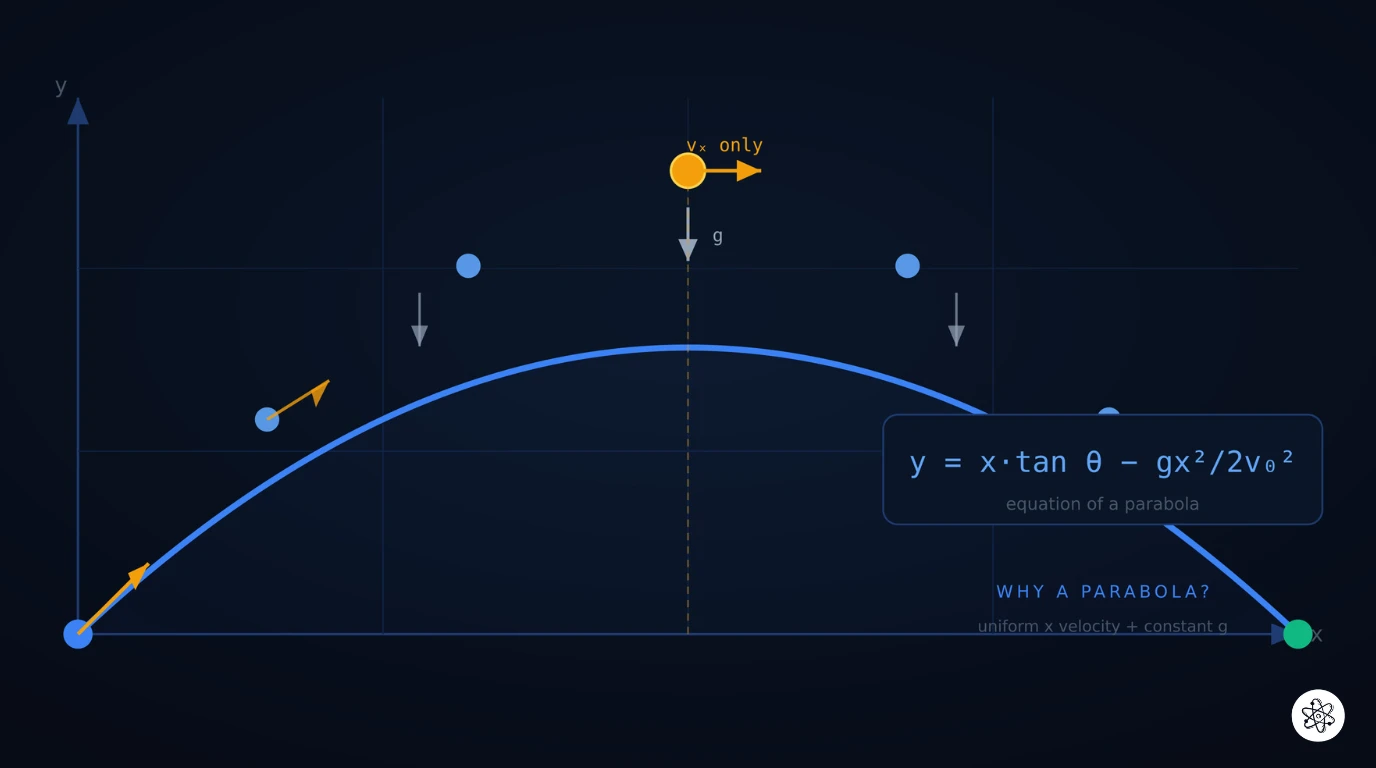
The critical point? These two motions don’t affect each other at all. The ball doesn’t slow down sideways because it’s falling. It doesn’t fall faster because it’s moving forward. They are completely independent.
This independence is not an assumption or simplification. It comes directly from Newton’s Second Law (F = ma). Since gravity only acts vertically, it only changes vertical motion. Horizontal motion stays untouched.
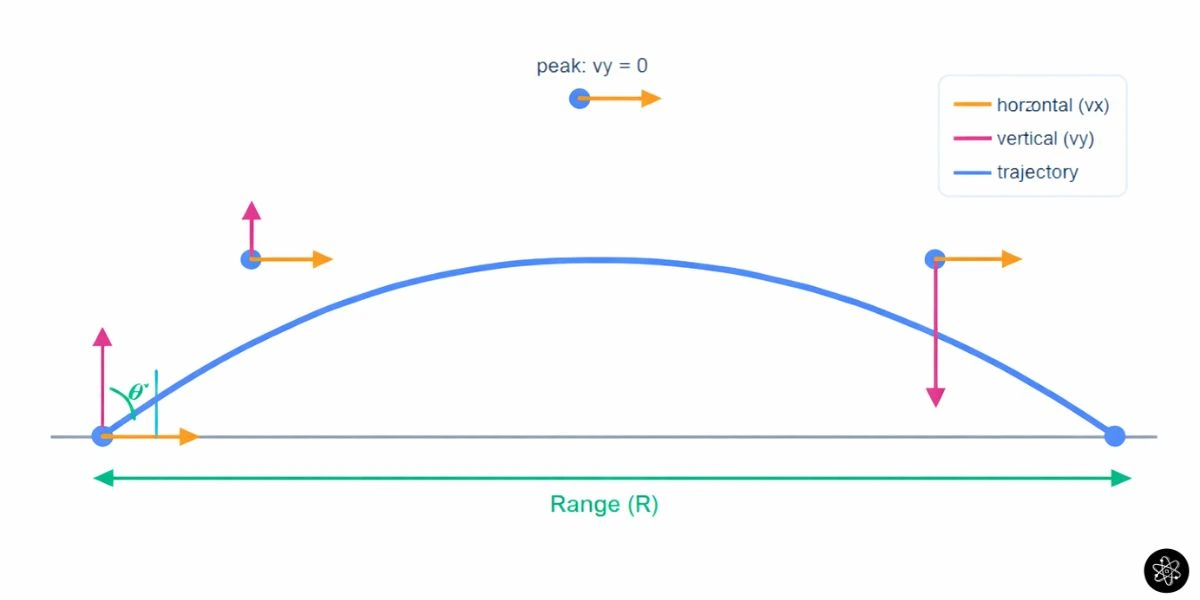
Diagram — Horizontal & Vertical Components of Projectile Motion
Think of It Like This
Imagine you’re on a perfectly smooth train moving at a constant speed. You toss a ball straight up inside the train. From your perspective, the ball goes straight up and comes straight down. But someone standing outside watching the train pass would see the ball trace a curved path — a parabola. The ball is doing two things at once: moving forward with the train (constant speed) and going up and down (accelerating due to gravity).
That combination — constant speed in one direction + constant acceleration in another — always produces a parabola. Always. Here’s why.
Why Those Two Motions Create a Parabola (Without Formulas First)
Let’s think about this step by step using just logic.
Horizontal position changes evenly with time. After 1 second, you’ve gone 10 meters. After 2 seconds, 20 meters. After 3 seconds, 30 meters. It’s a straight, proportional relationship: x grows like t (time).
Vertical position changes unevenly with time. Gravity makes the vertical distance grow faster and faster. After 1 second, you’ve fallen about 5 meters. After 2 seconds, 20 meters. After 3 seconds, 45 meters. It follows a squared relationship: y grows like t² (time squared).
Now here’s the key step. Since x grows like t, and y grows like t², then y grows like x². That relationship — y depending on x² — is the definition of a parabola.
Now the Math: Deriving the Parabolic Equation
No other shape is possible when you combine a constant-speed motion with a constant-acceleration motion. The parabola isn’t a coincidence. It’s a mathematical certainty.
Let’s put numbers to the idea. A projectile is launched from the ground with initial speed v₀ at an angle θ above the horizontal.
Step 1: Break the Initial Velocity Into Components
Vertical component: vᵧ = v₀ sin θ
Horizontal component: vₓ = v₀ cos θ
Step 2: Write Position Equations for Each Direction
Since horizontal acceleration is zero:
x = v₀ cos θ · t
Since vertical acceleration is −g (gravity pulling downward):
y = v₀ sin θ · t − ½gt²
From the horizontal equation, solve for t:
t = x / (v₀ cos θ)
Step 3: Eliminate Time
x(t) = vx · t = v₀ cos θ · t
Now substitute this into the vertical equation:
y = v₀ sin θ · [x / (v₀ cos θ)] − ½g · [x / (v₀ cos θ)]²
Simplify:
y = x tan θ − (g / 2v₀² cos² θ) · x²
This is the form y = bx + ax² — a quadratic equation in x. And a quadratic equation is the equation of a parabola.
That’s it. The parabola falls straight out of the math. There is no assumption or trick involved — just Newton’s laws and basic algebra.
What Decides the Shape of the Parabola?
Not all parabolas look the same. Some are tall and narrow, others are short and wide. Three things control the shape:
Initial speed (v₀): Throw harder, and the parabola stretches — both higher and farther. Double the speed, and the range increases by four times (because range depends on v₀²).
Launch angle (θ): This is where it gets interesting. Different angles create dramatically different parabolas from the same speed:
- Low angles (like 15° or 20°) create flat, stretched parabolas — low height, moderate range
- High angles (like 70° or 80°) create tall, narrow parabolas — great height, but shorter range
- 45° gives the maximum range — the sweet spot where height and distance balance perfectly
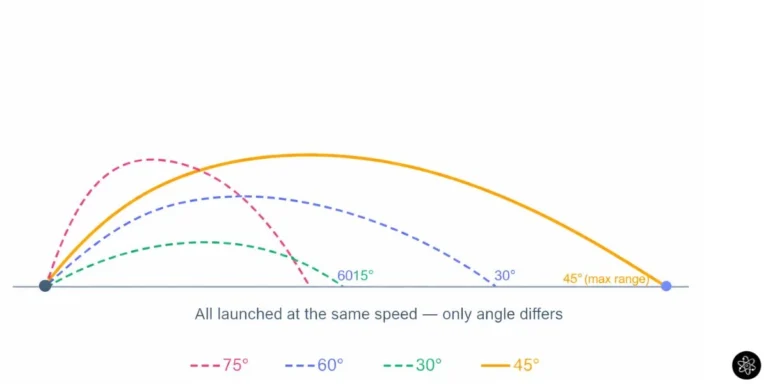
There’s also a beautiful symmetry here: complementary angles give the same range. A ball launched at 30° lands at the same distance as one launched at 60°. Same for 20° and 70°. The paths look completely different, but they cover the same horizontal distance.
Gravity (g): On the Moon, where g is about 1/6th of Earth’s, the same throw produces a much taller, wider parabola. Astronauts on the Moon could throw a ball six times farther than on Earth (with no air resistance in both cases).
The Three Key Formulas You Need
Once you have the parabolic equation, three important results follow:
Maximum Height (H)
H = v₀² sin² θ / (2g)
This is the highest point of the parabola. It depends on the vertical component of velocity only.
Time of Flight (T)
T = 2v₀ sin θ / g
The total time the projectile stays in the air. Notice it depends only on the vertical component and gravity — horizontal speed doesn’t matter.
Range (R)
R = v₀² sin(2θ) / g
The total horizontal distance covered. The sin(2θ) term is why 45° gives maximum range — because sin(90°) = 1, the largest possible value.
Important: These formulas only work when the launch and landing heights are the same (like throwing a ball on flat ground). If you throw from a height (like off a cliff), the equations get slightly different.
Visual Explanation of Projectile Motion
Real-World Examples That Click
A Basketball Free Throw
When a player shoots a free throw, the ball follows a parabolic arc from their hand to the hoop. The best shooters launch at about 50–55° (not 45°) because the ball is released from above the ground but must enter the hoop from above. The slight upward adjustment from 45° gives the ball a steeper entry angle into the rim, which means a bigger “window” to go in.
A Soccer Goal Kick
A goalkeeper’s long kick can travel 60+ meters. The ball launches at roughly 40–45° and follows a parabolic path — at least approximately. In reality, the spin and air resistance make the actual path deviate from a perfect parabola, but the parabolic model gives a solid first prediction.
Water From a Garden Hose
Tilt a garden hose upward and the stream of water traces a clear parabola. This is actually one of the easiest ways to “see” projectile motion in real life. Each tiny water droplet is a projectile, and together they outline the parabolic path beautifully.
Cannonballs in History
Before the physics was understood mathematically, artillerymen figured out through trial and error that 45° gave maximum range. Galileo was the first to prove it mathematically in the early 1600s, and Newton later explained why with his laws of motion.
Common Mistakes Students Make
Mistake 1: “The Object Moves in a Parabola Because Gravity Curves It”
This is vague and incomplete. Gravity doesn’t “curve” the path by bending it. Gravity pulls straight down at every point. The curve appears because gravity continuously adds downward velocity while horizontal velocity stays the same. The curving is a result, not a cause.
Mistake 2: “Horizontal Velocity Decreases During Flight”
No. In ideal projectile motion (no air resistance), horizontal velocity is constant from launch to landing. Many students intuitively feel the object must slow down sideways, but that only happens when air resistance is present.
Mistake 3: “At the Highest Point, Velocity Is Zero”
Only the vertical velocity is zero at the peak. The horizontal velocity is still there, unchanged. The object is still moving forward at the top — it just isn’t moving up or down for that instant.
Mistake 4: “45° Always Gives Maximum Range”
Only when launch and landing are at the same height. If you’re throwing from a balcony down to the ground, or shooting uphill, the optimal angle changes. In practice, factors like height of release and air resistance shift the ideal angle — often to something less than 45°.
Mistake 5: “The Path Is a Perfect Parabola in Real Life”
Almost never. Air resistance, wind, and spin all distort the path. A football, a bullet, a golf ball — none trace perfect parabolas. The parabolic model is an idealization that works best for heavy, slow objects over short distances. But it’s the essential starting point that every more accurate model builds upon.
Why Does This Matter Beyond Exams?
Understanding parabolic motion isn’t just about solving textbook problems. It’s the foundation for much bigger ideas.
Sports science uses these principles to optimize throwing angles, launch speeds, and trajectories for everything from javelin throws to basketball shots.
Engineering and ballistics use parabolic models as the first approximation for the path of any launched object — from water sprinklers to missile defense systems.
Space and orbital mechanics connect directly to projectile motion. Newton himself made this connection: if you throw a ball fast enough, the Earth curves away beneath it as fast as it falls. The ball never lands — it’s in orbit. A parabolic trajectory near Earth’s surface is actually a tiny piece of a much larger elliptical orbit. This single insight connects a classroom physics problem to how satellites and planets move.
Understanding energy becomes clearer through projectile motion. At launch, kinetic energy is at its maximum. At the peak, some kinetic energy has been converted to potential energy. At landing, it converts back. The total stays constant — a perfect example of conservation of mechanical energy.
Quick Summary
- A projectile moves in a parabola because it combines constant horizontal speed with constant vertical acceleration due to gravity.
- Horizontal position grows proportionally with time (x ∝ t), vertical position grows with time squared (y ∝ t²). Combining these gives y ∝ x² — a parabola.
- The shape of the parabola depends on launch speed, launch angle, and gravity.
- 45° gives maximum range on flat ground. Complementary angles (like 30° and 60°) give equal range.
- At the peak, only vertical velocity is zero. Horizontal velocity stays constant throughout.
- Real-world trajectories deviate from perfect parabolas due to air resistance, wind, and spin — but the parabolic model is the essential foundation.
- This concept connects to orbital mechanics, energy conservation, and the broader framework of Newtonian physics.
Frequently Asked Questions
Get physics insights delivered weekly
Join students and educators receiving expert explanations, study tips, and platform updates every Thursday.
Join others. No spam.

allphysicsfundamentals
Making physics accessible, interactive, and genuinely understandable for students at every level.
Learn
- All Articles
- Classical Mechanics
- Thermodynamics
- Waves & Optics
- Electromagnetism
- Modern Physics