projectile motion problems
If you are studying physics, projectile motion problems will come up a lot. The good news is they are not that hard once you get the basic idea. You just need to remember one thing: treat horizontal and vertical motion separately. Solve each one on its own, then use time to connect them.
This guide covers the most common types of projectile motion problems with clear, step-by-step solutions. No complicated words. Just simple steps that make sense.
What Is Projectile Motion?
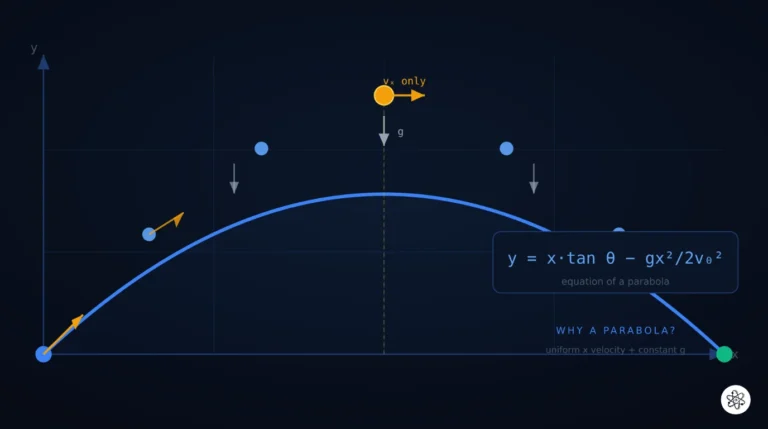
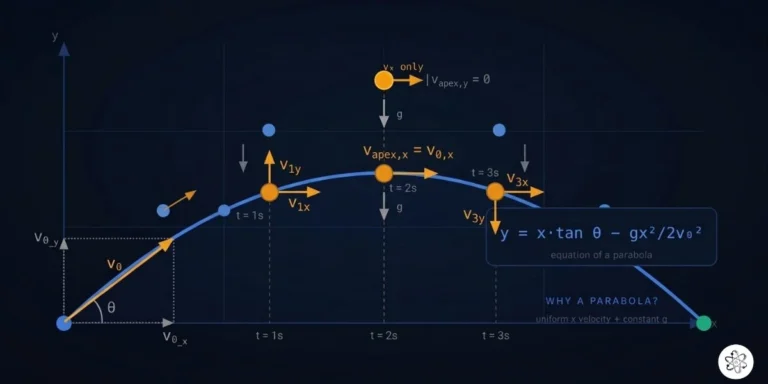
When you throw a ball or kick it into the air, it moves in two directions at the same time — forward (horizontal) and up or down (vertical).
Gravity only pulls things downward. It does not affect how fast something moves forward. So the horizontal speed stays the same the whole time the object is in the air. Only the vertical speed changes because gravity keeps pulling it down.
The Formulas You Need to solve projectile motion problems
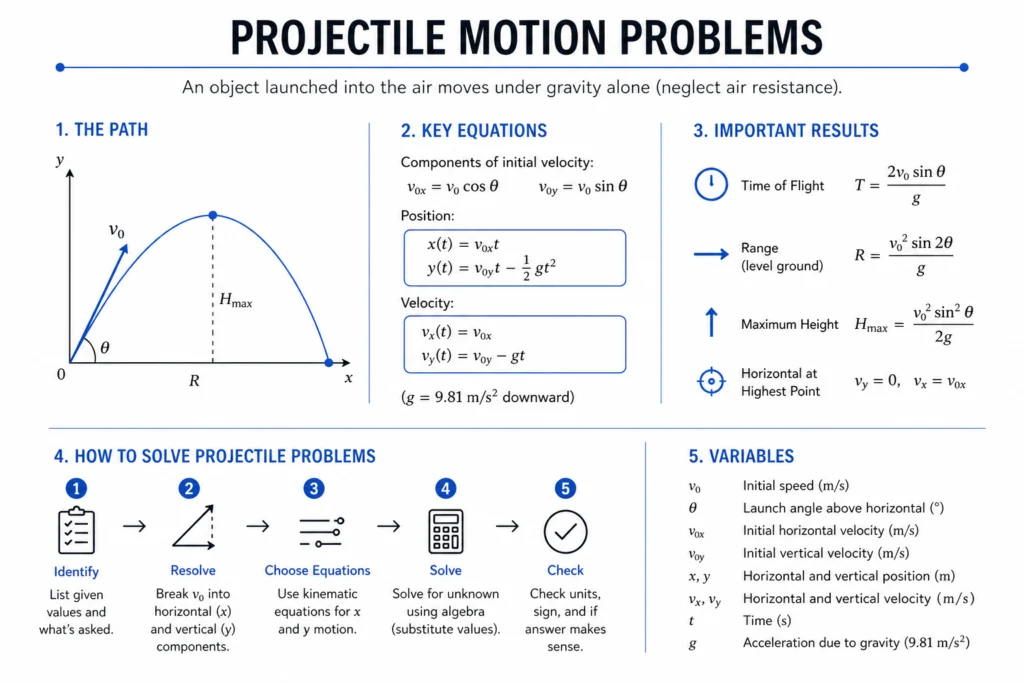
You only need a few formulas to solve most problems:
- Horizontal distance: x = vx × t
- Vertical position: y = vy × t − ½ × g × t²
- Vertical velocity at any time: vy = v₀ sinθ − g × t
- Max height: H = (v₀ sinθ)² / (2g)
- Total flight time: T = 2 × v₀ sinθ / g
- Range: R = v₀² × sin(2θ) / g
Where:
- v₀ = starting speed
- θ = launch angle
- g = 9.8 m/s² (gravity on Earth)
- t = time
Problem 1 — Ball Kicked at an Angle
A ball is kicked from the ground at 20 m/s at a 30° angle. Find the max height, total time in the air, and the range.
Step 1 — Split the velocity
- Horizontal speed: vx = 20 × cos(30°) = 17.32 m/s
- Vertical speed: vy = 20 × sin(30°) = 10 m/s
Step 2 — Max height
At the top, vertical speed = 0. H = (10)² / (2 × 9.8) = 100 / 19.6 = 5.1 meters
Step 3 — Total time in air
Time to reach top = 10 / 9.8 = 1.02 seconds Total time = 1.02 × 2 = 2.04 seconds
Step 4 — Range
Range = 17.32 × 2.04 = ≈ 35.3 meters
Problem 2 — Ball Rolled Off a Table
A ball rolls off a 1.5 m high table at 3 m/s horizontally. How long does it take to hit the ground? How far from the table does it land?
Since the ball moves horizontally off the table, its starting vertical speed is zero.
Time to fall: 1.5 = ½ × 9.8 × t² t² = 1.5 / 4.9 = 0.306 t = 0.55 seconds
Horizontal distance: x = 3 × 0.55 = 1.65 meters
Note: The mass of the ball does not matter here. A heavy ball and a light ball fall at the same rate.
Problem 3 — Finding the Launch Angle
A ball is launched at 15 m/s and must travel 20 meters. What angle is needed?
Use: R = v₀² × sin(2θ) / g
20 = (15)² × sin(2θ) / 9.8 sin(2θ) = 20 × 9.8 / 225 = 0.871 2θ = 60.5° θ ≈ 30.25°
There is also a second angle that works: 90° − 30.25° = 59.75°. Both angles give the same range but different flight paths. One goes high and slow, the other goes low and fast.
Problem 4 — Rock Thrown from a Cliff
A rock is thrown horizontally at 10 m/s from a 45 m cliff. Where does it land?
Time to fall: 45 = ½ × 9.8 × t² t² = 45 / 4.9 = 9.18 t = 3.03 seconds
Horizontal distance: x = 10 × 3.03 = 30.3 meters from the base of the cliff
Any time a problem says “thrown horizontally,” the starting vertical speed is zero. That makes the vertical part much simpler.
The 45° Rule
You may have heard that 45° gives the longest range. That is true — but only when the object lands at the same height it was launched from, and when there is no air resistance.
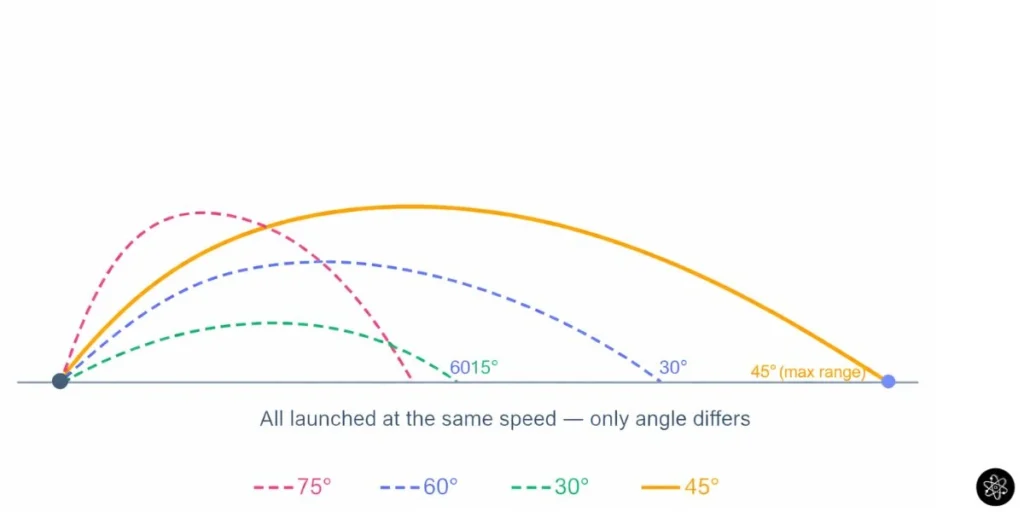
In real life it is different. A shot put athlete throws at about 38° because the ball starts above the ground. A long jumper leaves the ground at around 15–20° because of their running speed. So for real-world situations, 45° is not always the best angle. But for most physics exam problems, if nothing else is mentioned, 45° is the answer for maximum range.
Common Mistakes to Avoid
- Mixing horizontal and vertical equations — gravity only goes in the vertical part
- Forgetting to double the time — time to reach the peak is only half the total flight time
- Wrong sign for g — if up is positive, then g = −9.8 m/s²
- Forgetting the launch height — if the object starts above the ground, your vertical equation changes
- Calculator set to radians instead of degrees — always double check
Practice projectile motion problems
Try these yourself:
- A ball is thrown horizontally at 8 m/s from a 20 m building. How far does it land from the building?
- A soccer ball is kicked at 25 m/s at 40°. What is the maximum height?
- A projectile is fired at 50 m/s at 60°. What is the total range?
Answers:
- t = √(2×20/9.8) ≈ 2.02 s → Range = 8 × 2.02 ≈ 16.2 m
- vy = 25 sin(40°) ≈ 16.07 m/s → H = (16.07)² / 19.6 ≈ 13.2 m
- R = (50)² × sin(120°) / 9.8 ≈ 221 m
FAQs of projectile motion problems
What is the first step in solving projectile motion problems?
Split the starting velocity into horizontal and vertical parts using vx = v₀ cosθ and vy = v₀ sinθ. Then solve each direction separately.
Does the mass of the object matter?
No. When air resistance is ignored, all objects fall at the same rate no matter how heavy they are.
What angle gives the longest range?
45° gives the longest range when the launch and landing points are at the same height and there is no air resistance.
How do I find time in projectile motion?
Time comes from the vertical motion. For a symmetric launch use T = 2v₀ sinθ / g. For a horizontal launch from a height h use t = √(2h/g).
Can two different angles give the same range?
Yes. For example, 30° and 60° both give the same range. One path is higher, the other is flatter.
What value of g should I use?
Use 9.8 m/s² for Earth. Some textbooks use 10 m/s² to keep the math simple. For problems on other planets, use the gravity value given in the problem.
Frequently Asked Questions
Get physics insights delivered weekly
Join students and educators receiving expert explanations, study tips, and platform updates every Thursday.
Join others. No spam.

allphysicsfundamentals
Making physics accessible, interactive, and genuinely understandable for students at every level.