Newton’s Law of Universal Gravitation: The Force That Runs the Universe
Gravity is the one force you can’t escape. You feel it right now, holding you to your chair, pulling your coffee down into the mug, keeping the Moon locked in orbit overhead. And the wild thing is — a single equation describes all of it. From a falling apple to the spiral of entire galaxies, gravity follows the same rule everywhere.
Isaac Newton figured this out in 1687 and published it in his Principia Mathematica. Over three centuries later, his law of universal gravitation is still the go-to tool for everything from satellite launches to tidal predictions. It only breaks down in extreme situations — near black holes or at relativistic speeds — where Einstein’s general relativity takes over. For the other 99.99% of scenarios you’ll ever encounter, Newton’s equation is all you need.
The Equation: F = Gm₁m₂/r²(Newton’s Law of Universal Gravitation)
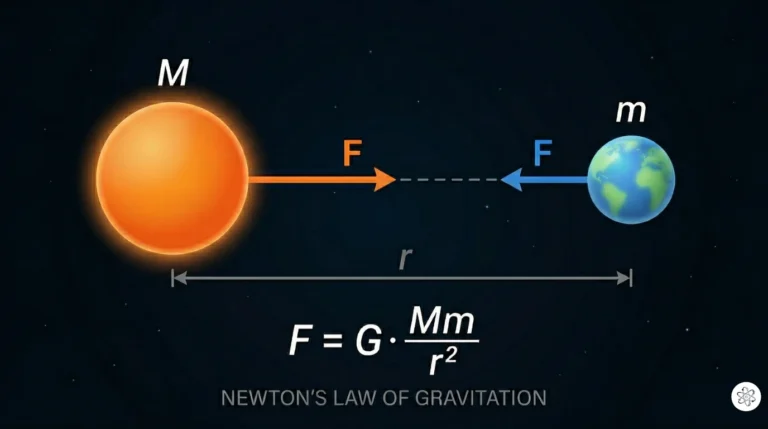
Newton’s law of universal gravitation says that every object with mass attracts every other object with mass. Not “some” objects. Not “heavy” objects. Every single one. The force between any two masses m₁ and m₂, separated by a distance r between their centers, is:
F = G × m₁ × m₂ / r²
Where G is the gravitational constant: approximately 6.674 × 10⁻¹¹ N·m²/kg².
That number is absurdly small. And that’s the whole reason you don’t feel gravitationally attracted to the person sitting next to you on the bus. Two 70 kg people standing 1 meter apart pull on each other with a force of roughly 3.3 × 10⁻⁷ newtons — about the weight of a grain of sand. You’d never notice it. But scale one of those masses up to the size of a planet, and suddenly gravity becomes the dominant force in your life.
Three things to notice about this equation
Gravity is always attractive. There’s no such thing as “negative gravity” or gravitational repulsion. Unlike electric charges, which can attract or repel depending on sign, mass only pulls. Two masses will always attract each other, no exceptions.
It’s an inverse-square law. Double the distance between two objects and the gravitational force drops to one quarter. Triple the distance, the force falls to one ninth. This rapid falloff means gravity weakens fast with distance — but it never actually reaches zero. Technically, every atom in your body is gravitationally pulling on every star in the observable universe right now. The force is just so ridiculously small at those distances that it doesn’t matter.
Both masses contribute equally. You pull on Earth with the exact same force that Earth pulls on you. That’s Newton’s third law in action. But because Earth’s mass is about 6 × 10²⁴ kg and yours is maybe 70 kg, Earth barely budges (its acceleration from your pull is something like 10⁻²² m/s²). You, on the other hand, accelerate at 9.8 m/s² toward the floor. Same force, wildly different accelerations.
Visual Explanation of Newton’s Law of Universal Gravitation
Gravitational force (F)
—
If distance doubled
—
Ratio
—
F = 6.674e-11 x 50 x 30 / 40² = …
How Was G Actually Measured?
Here’s something a lot of physics courses skip over: Newton never knew the value of G. He wrote down the law. He knew gravity was proportional to mass and inversely proportional to distance squared. But the actual number — the constant that tells you how strong gravity is — wasn’t measured until over a century after his death.
In 1798, Henry Cavendish used an incredibly delicate device called a torsion balance to measure the gravitational pull between lead spheres in his laboratory. Two small lead balls hung from a thin wire, and two massive 158 kg lead balls were positioned nearby. The gravitational attraction between the small and large balls twisted the wire by a tiny amount — and from that twist, Cavendish could calculate the force and work backward to find G.
Cavendish’s actual goal wasn’t to find G — he wanted to “weigh the Earth,” meaning determine its average density. But his result enabled the first calculation of G, and the value he got was within about 1% of today’s accepted number. Not bad for 1798.
And here’s a humbling detail: over 200 years and hundreds of experiments later, scientists only know G to about 4 or 5 significant figures. Compare that to something like the charge of an electron, which is known to 10+ digits. Gravity is the most familiar force in the universe, and yet its fundamental constant remains one of the hardest to pin down.
Weight vs. Mass — Why the Difference Matters
People use “weight” and “mass” interchangeably in everyday conversation. In physics, they’re completely different things.
Mass is a property of the object itself — how much matter it contains, how much it resists being accelerated. Your mass is the same whether you’re on Earth, on the Moon, or floating in deep space. It’s measured in kilograms.
Weight is the gravitational force a nearby body (usually a planet) exerts on you. It depends on both your mass and the local gravitational field strength:
W = mg
On Earth’s surface, g ≈ 9.8 m/s². On the Moon, g ≈ 1.6 m/s² (about one-sixth of Earth’s). So an astronaut with a mass of 80 kg weighs 784 N on Earth but only about 128 N on the Moon. Same person, same mass — completely different weight.
This matters because when you use Newton’s second law (F = ma), the m is always mass, not weight. Confuse the two and your calculations blow up. It also explains why bathroom scales give different readings at different altitudes — you’re very slightly lighter at the top of a mountain because you’re farther from Earth’s center, so g is slightly smaller.
Why Does a Bowling Ball Fall at the Same Rate as a Tennis Ball?
This is one of those facts that feels wrong the first time you hear it. Drop a bowling ball and a tennis ball from the same height (in a vacuum, so no air resistance), and they hit the ground at exactly the same time. Galileo figured this out centuries ago, and Apollo 15 astronaut David Scott demonstrated it on the Moon in 1971 by dropping a hammer and a feather simultaneously — they landed together.
Newton’s law explains why. The gravitational force on an object is F = mg — proportional to its mass. But the acceleration that force produces is a = F/m. The mass cancels:
a = mg / m = g
The mass drops right out. Every object, regardless of whether it weighs 1 gram or 1000 kg, accelerates at exactly the same rate under gravity — about 9.8 m/s² near Earth’s surface. Heavier objects experience more force, but they also have more inertia resisting that force, and the two effects cancel perfectly.
On Earth with air, things are different — a feather floats down slowly because air resistance pushes back hard relative to its weight. But that’s air resistance, not gravity. Gravity treats every mass equally.
Orbits: Falling Without Ever Landing
Here’s a way to think about orbits that might reshape how you see them: an orbiting object is falling. Constantly. It’s just moving sideways fast enough that the ground curves away beneath it at the same rate it falls toward it. The result is a continuous free fall around the planet — what we call an orbit.
For a circular orbit, the gravitational force provides the centripetal force needed to keep the object curving:
GMm/r² = mv²/r
Cancel m from both sides and solve for v:
v = √(GM/r)
This tells you the orbital speed needed for a circular orbit at distance r from the center of the planet. A few things jump out from this formula. First, the mass of the orbiting object doesn’t matter — a satellite and a space station need the same orbital speed at the same altitude. Second, higher orbits are slower. Sounds counterintuitive, but as r increases, v decreases.
At Earth’s surface (if you ignore the atmosphere), the needed speed is about 7.9 km/s — roughly 28,400 km/h. The ISS orbits at about 400 km altitude at 7.66 km/s. GPS satellites sit much higher, around 20,200 km, and cruise at about 3.9 km/s. Geostationary satellites at 35,786 km orbit at 3.07 km/s — slow enough that they take exactly 24 hours to complete one orbit, appearing to hover over a fixed point on Earth.
What about escape velocity?
If you speed up enough, you stop orbiting and leave the planet’s gravitational influence entirely. The minimum speed needed to do this is escape velocity:
v_escape = √(2GM/r)
For Earth’s surface, that’s about 11.2 km/s. Notice it’s just √2 times the circular orbital speed — you only need about 41% more speed to escape entirely versus orbit. This is why getting into orbit is the hard part of space travel. Once you’re up there, going anywhere else is relatively cheap in terms of energy.
Tidal Forces: Gravity’s Uneven Grip
If gravity were the same strength everywhere on Earth, we wouldn’t have tides. Tides happen because the Moon’s gravitational pull is slightly stronger on the side of Earth facing the Moon and slightly weaker on the far side. That difference in pull — the tidal force — stretches the oceans into a slight bulge on both sides.
The Sun also contributes to tides, but because it’s so much farther away, its tidal effect is about 46% as strong as the Moon’s. When the Sun, Moon, and Earth line up (during full and new moons), you get spring tides — the highest highs and lowest lows. When they’re at right angles, you get neap tides — the mildest.
Tidal forces aren’t just an ocean thing. They’re responsible for heating Jupiter’s moon Io (making it the most volcanically active body in the solar system), they’ve locked the Moon’s rotation so we always see the same face, and near a black hole, tidal forces become so extreme they can stretch objects into thin strands — a process whimsically called “spaghettification.”
Where Newton’s Gravity Breaks Down
Newton’s law is spectacularly accurate for everyday and planetary-scale physics. But there are situations where it gives the wrong answer.
The first hint came from Mercury. Its orbit doesn’t quite close — the point closest to the Sun (perihelion) shifts slightly each orbit. Most of this precession is explained by the gravitational pull of other planets, but there’s a leftover 43 arcseconds per century that Newton’s law can’t account for. Einstein’s general relativity explains it perfectly — gravity isn’t just a force, it’s the curvature of spacetime itself, and massive objects like the Sun warp spacetime in ways Newton didn’t predict.
Einstein’s theory also predicts that light bends when passing near massive objects (gravitational lensing), that time runs slower in stronger gravitational fields (gravitational time dilation), and that accelerating masses produce ripples in spacetime (gravitational waves, first detected directly in 2015 by LIGO). None of these effects appear in Newton’s framework. But unless you’re dealing with black holes, neutron stars, or GPS-level timing precision, Newton’s law gives you everything you need.
Frequently Asked Questions
What is Newton’s law of universal gravitation?
It states that every object with mass attracts every other object with mass. The force is proportional to the product of the two masses and inversely proportional to the square of the distance between their centers: F = Gm₁m₂/r². G is the gravitational constant, approximately 6.674 × 10⁻¹¹ N·m²/kg².
What is the difference between weight and mass?
Mass is how much matter an object contains — it doesn’t change regardless of location. Weight is the gravitational force on that object, calculated as W = mg. Your mass stays 80 kg whether you’re on Earth or the Moon, but your weight changes because g is different on each body.
Why do heavy and light objects fall at the same speed?
Because the gravitational force on an object is proportional to its mass (F = mg), but so is the resistance to acceleration (F = ma). The mass cancels out: a = g. Every object accelerates at the same rate regardless of mass. In air, lighter objects may fall slower due to air resistance — but that’s drag, not gravity.
Who measured the gravitational constant G?
Henry Cavendish first measured it in 1798 using a torsion balance that detected the faint gravitational pull between lead spheres. His result was within about 1% of today’s accepted value. Remarkably, G is still one of the least precisely known fundamental constants in physics — scientists have pinned it down to only about 4-5 significant figures.
How fast do you need to go to orbit Earth?
At Earth’s surface, about 7.9 km/s (roughly 28,400 km/h). At higher altitudes, the required speed is lower — the ISS at 400 km needs 7.66 km/s, while GPS satellites at 20,200 km need only about 3.9 km/s. To leave Earth’s gravitational pull entirely.
Frequently Asked Questions
Get physics insights delivered weekly
Join students and educators receiving expert explanations, study tips, and platform updates every Thursday.
Join others. No spam.
allphysicsfundamentals
Making physics accessible, interactive, and genuinely understandable for students at every level.
Learn
- All Articles
- Classical Mechanics
- Thermodynamics
- Waves & Optics
- Electromagnetism
- Modern Physics