Special Relativity Explained: Time, Space, and E = mc²
Why Einstein Had to Rethink Everything
By the late 1800s, physics had a serious problem. James Clerk Maxwell’s equations for electromagnetism had been a triumph of 19th-century science. They unified electricity, magnetism, and light into a single elegant framework and predicted that light travels through space at a specific speed, approximately 3 x 10^8 meters per second. But those equations raised an uncomfortable question that nobody could answer satisfactorily. Speed relative to what exactly?
In Newtonian physics, which had dominated scientific thinking for over two centuries, speeds were always added together straightforwardly. If you throw a ball forward at 20 meters per second from a train moving at 30 meters per second, someone standing beside the track sees the ball moving at 50 meters per second. Velocities simply add. So if light travels at a fixed speed according to Maxwell’s equations, it should travel faster relative to an observer moving toward the light source and slower relative to one moving away, just like the ball on the train.
But experiments kept saying otherwise. The most famous was the Michelson-Morley experiment of 1887, in which Albert Michelson and Edward Morley used an extraordinarily sensitive interferometer to measure whether the speed of light changed depending on the direction it was traveling relative to Earth’s motion through space. The answer was definitive and deeply puzzling. It did not change at all. The speed of light was the same in every direction regardless of Earth’s motion. Every attempt to detect a difference failed.
For nearly two decades, this result sat like a splinter in the foot of physics. Various physicists proposed various explanations, some of them quite elaborate, but none were fully satisfactory. Then, in 1905, a 26-year-old patent clerk in Bern, Switzerland, named Albert Einstein published a paper that cut through the confusion with extraordinary clarity. Instead of trying to explain away the constancy of light speed as some mysterious coincidence, Einstein simply accepted it as a fundamental fact of nature and asked what the universe would have to look like if it were true. The answer he derived changed our understanding of space, time, mass, and energy forever.
The Two Postulates of Special Relativity
Einstein built his entire theory on just two postulates, two fundamental assumptions that he took as given and from which everything else followed logically.
The first postulate is the principle of relativity. The laws of physics are the same in all inertial reference frames. An inertial reference frame is simply one that is not accelerating, one that is either stationary or moving at constant velocity. What this postulate says is that there is no physical experiment you can perform inside a closed laboratory that will tell you whether you are stationary or moving at constant velocity. The physics looks the same either way. A ball thrown straight up in a smoothly moving train falls straight back down, just as it would if the train were sitting still in the station. There is no preferred state of rest in the universe.
The second postulate is the constancy of the speed of light. The speed of light in a vacuum is the same for all observers regardless of the motion of the light source or the motion of the observer. This is the strange one. This is the one that breaks with Newtonian intuition completely. It does not matter if you are running toward a flashlight or running away from it. You will always measure light arriving at the same speed, c = 3 x 10^8 meters per second. Always. No exceptions.
These two postulates sound simple enough. But when you follow their logical consequences rigorously and mathematically, the results are astonishing. Time is not absolute. Space is not absolute. Mass and energy are the same thing. Nothing with mass can reach the speed of light. All of these follow inevitably from accepting those two starting points.
Time Dilation: Moving Clocks Run Slow
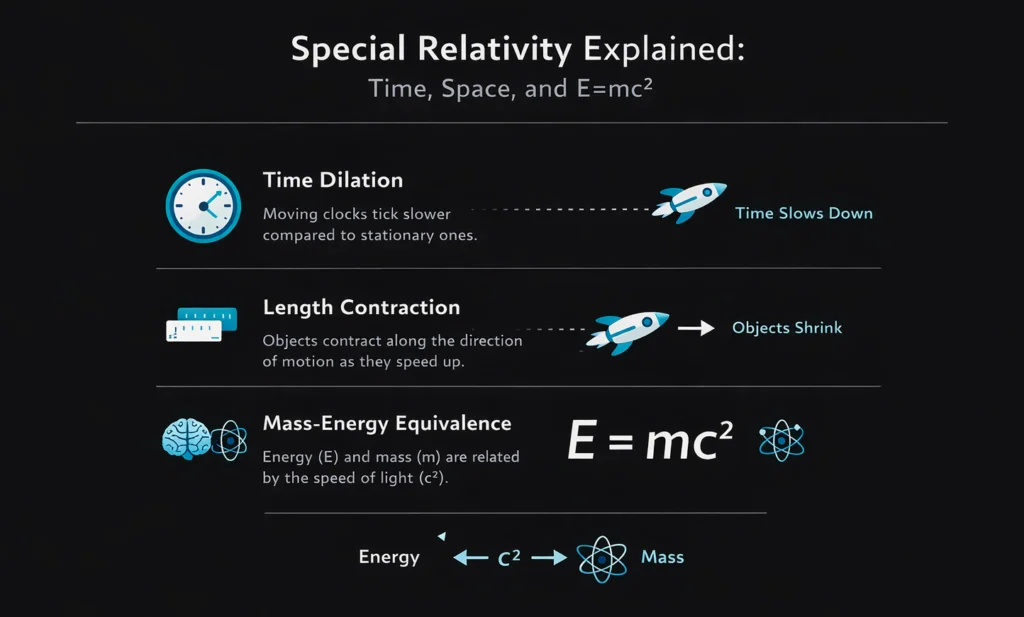
One of the most startling consequences of special relativity is that time does not pass at the same rate for everyone. An observer who is moving relative to you experiences time more slowly than you do. The faster they move relative to you, the more slowly their clock ticks from your perspective. This effect is called time dilation.
The mathematical relationship is:
t’ = t / sqrt(1 minus v2/c2)
Where t is the time measured by the moving observer on their own clock, t’ is the time measured for the same event by the stationary observer, v is the relative velocity between them, and c is the speed of light. The factor sqrt(1 minus v2/c2) is called the Lorentz factor, and it is always less than or equal to one.
At everyday speeds, v is so much smaller than c that v2/c2 is essentially zero, making the Lorentz factor essentially one, and the time dilation effect is completely unmeasurable. This is why we never notice it in daily life. But as v approaches c the effect becomes dramatic. At 50% the speed of light, a moving clock ticks at about 87% the rate of a stationary one. At 90% the speed of light, it ticks at only about 44% the rate. At 99% the speed of light, it ticks at just 14% the rate. At exactly c the Lorentz factor would be zero, meaning time would stop entirely, but as we will discuss, nothing with mass can actually reach c.
Time dilation is not a theoretical curiosity or a trick of perception. It is physically real and has been confirmed by numerous experiments. Unstable subatomic particles called muons are created in the upper atmosphere when cosmic rays strike air molecules. These muons travel toward Earth’s surface at about 98% the speed of light. Based on their measured lifetime at rest in the laboratory, they should decay long before reaching the surface. But they do reach the surface in large numbers because, from our perspective, their internal clocks are running slow due to time dilation, giving them much more time to complete the journey before decaying.
The effect is also practically important. GPS satellites orbit Earth at speeds of about 14,000 kilometers per hour and at high altitude where gravity is weaker. Both special relativity (because they are moving) and general relativity (because they are in weaker gravity) affect the rate of their onboard atomic clocks. Without continuous relativistic corrections applied to the GPS, positioning errors would accumulate at a rate of several kilometers per day, making GPS completely useless for navigation.
Length Contraction: Moving Objects Shrink
Time is not the only thing that changes for moving objects. Space does too. An object moving relative to you appears shorter in the direction of motion than it would if it were at rest. This effect is called length contraction.
The formula is:
L = L0 x sqrt(1 minus v2/c2)
Where L0 is the proper length of the object, meaning its length measured when it is at rest, and L is the contracted length measured by the stationary observer. The same Lorentz factor appears again. At 90% the speed of light, an object appears contracted to about 44% of its rest length in the direction of travel. At 99% the speed of light, it contracts to about 14% of its rest length.
It is important to understand that length contraction is not an optical illusion and is not the result of the object being physically squashed by its motion. From the perspective of the stationary observer, the object genuinely occupies less space in the direction of motion. From the perspective of someone riding with the moving object, their own length is perfectly normal, but the distances ahead of and behind them in the direction of travel appear contracted. Both perspectives are equally valid. This is the relativity of simultaneity at work, one of the deeper conceptual aspects of special relativity.
The Relativity of Simultaneity
One of the most profound and counterintuitive aspects of special relativity is that events which appear simultaneous to one observer may not be simultaneous to another observer moving relative to the first. This is not a matter of perception or signal delay. It is a fundamental feature of spacetime.
Imagine a long train moving at high speed. Lightning strikes both ends of the train simultaneously, according to an observer standing beside the track at the midpoint between the two strike locations. But an observer riding in the middle of the train will see the lightning strike at the front of the train before the lightning strike at the back, because they are moving toward the light coming from the front strike and away from the light coming from the back strike.
Both observers are correct within their own reference frames. There is no absolute answer to the question of whether the strikes happened simultaneously. Simultaneity is relative, not absolute. This result follows directly from the two postulates and from the mathematics of the Lorentz transformation, the set of equations that describe how measurements of space and time transform between different inertial reference frames.
Mass-Energy Equivalence: E = mc²
Perhaps the most famous equation in all of science emerged from special relativity. Einstein showed that mass and energy are not separate things but two aspects of the same underlying physical reality, related by:
E = mc2
Where E is energy in joules, m is mass in kilograms, and c is the speed of light in meters per second, approximately 3 x 10^8 m/s. Because c2 is such an enormous number, 9 x 10^16 m2/s2, even a tiny amount of mass contains a staggering amount of energy.
One kilogram of matter, if it could be completely converted to energy, would release 9 x 10^16 joules. That is roughly equivalent to 21 megatons of TNT, or about 1500 times the energy released by the atomic bomb dropped on Hiroshima. The sun converts approximately 4 million tonnes of mass to energy every single second through nuclear fusion in its core, and has been doing so for about 4.6 billion years.
The equation E = mc2 is actually a special case of the more complete relativistic energy equation:
E2 = (mc2)2 + (pc)2
Where p is the momentum of the object. For an object at rest, p = 0, and this reduces to E = mc2. For a massless particle like a photon, m = 0, and it reduces to E = pc, meaning photons carry energy purely through their momentum.
Nuclear fission and nuclear fusion both work by converting a small fraction of mass to energy according to E = mc2. In nuclear fission, a heavy nucleus like uranium-235 splits into smaller fragments. The total mass of the fragments is slightly less than the original nucleus. That tiny mass difference, typically about 0.1% of the original mass, is converted entirely to energy in the form of kinetic energy of the fragments and gamma radiation. Nuclear fusion, which powers the sun and hydrogen bombs, works similarly but by combining light nuclei like hydrogen isotopes into heavier ones, releasing even more energy per unit mass than fission.
Why Nothing Can Travel Faster Than Light
One of the most important and most frequently asked consequences of special relativity is why nothing can travel faster than the speed of light. The answer comes directly from the mathematics of how kinetic energy behaves at relativistic speeds.
In Newtonian physics, the kinetic energy of a moving object is simply one-half times mass times velocity squared: KE = (1/2)mv2. To double the speed, you just apply four times the energy. There is no limit in principle to how fast an object can go if you keep applying energy.
In special relativity, the situation is completely different. The relativistic kinetic energy of a moving object is:
KE = mc2 x (1 / sqrt(1 minus v2/c2) minus 1)
As v approaches c, the term 1 / sqrt(1 minus v2/c2) approaches infinity. This means the kinetic energy required to accelerate an object to exactly the speed of light would be infinite. No finite amount of energy can get a massive object to c. You can always add more energy and the object will go faster, but it will approach c asymptotically, getting closer and closer but never actually reaching it.
This is not a technological limitation that better rockets or particle accelerators might someday overcome. It is a fundamental feature of spacetime itself. The speed of light is an absolute universal speed limit for anything with mass. Only massless particles like photons, which have no rest mass, travel at exactly c. Everything with mass must travel at less than c, always.
Particle accelerators like the Large Hadron Collider at CERN can accelerate protons to 99.9999991% the speed of light, but they can never reach 100%. The protons at that speed have a kinetic energy about 6500 times their rest mass energy, requiring enormous amounts of energy to achieve even tiny incremental increases in speed.
Spacetime: Unifying Space and Time
One of the deepest insights of special relativity, developed mathematically by Hermann Minkowski shortly after Einstein published his theory, is that space and time are not separate, independent things. They are aspects of a single four-dimensional continuum called spacetime. Every event in the universe occurs at a specific location in both space and time, and different observers moving relative to each other will disagree about how much of the separation between events is spatial and how much is temporal. But they will all agree on a quantity called the spacetime interval, which combines spatial and temporal separations in a specific way that remains the same for all inertial observers.
This unification of space and time into spacetime is not just a mathematical convenience. It reflects the actual structure of physical reality. It means that what one observer sees as a purely spatial separation, another observer might see as partly spatial and partly temporal. Space and time mix when you change reference frames, in a way precisely described by the Lorentz transformation equations.
Frequently Asked Questions
What is special relativity in simple terms?
Special relativity is Einstein’s 1905 theory that the laws of physics are the same for all non-accelerating observers, and that the speed of light is constant for all observers regardless of their motion. These two simple principles lead to the remarkable conclusions that time passes more slowly for moving objects, moving objects are shorter in the direction of motion, and mass and energy are interconvertible through E = mc2.
What is time dilation?
Time dilation is the phenomenon where a clock that is moving relative to an observer ticks more slowly than a stationary clock, as measured by that observer. The faster the motion, the greater the time dilation. It has been experimentally confirmed many times using atomic clocks on aircraft, in satellites, and by observing the extended lifetimes of fast-moving subatomic particles.
What does E=mc2 actually mean?
It means that mass and energy are two forms of the same thing and can be converted into each other. The conversion factor is c2, the square of the speed of light, which is an enormous number. This means even a tiny amount of mass contains a vast amount of energy. This equivalence is the physical principle behind nuclear power and nuclear weapons, and it is what powers the sun.
What is length contraction?
Length contraction is the phenomenon where an object moving relative to an observer appears shorter in the direction of motion than it would if it were at rest. Like time dilation, it follows mathematically from the two postulates of special relativity and has been confirmed experimentally.
Why can nothing travel faster than light?
Accelerating any object with mass to the speed of light would require an infinite amount of energy, because the relativistic kinetic energy increases without bound as speed approaches c. This is not a technological barrier but a fundamental feature of the universe. Only massless particles like photons can travel at exactly c.
Does special relativity mean everything is relative?
Not quite. Special relativity says that measurements of space and time are relative and depend on the observer’s motion. But the laws of physics themselves are the same for all observers, and the spacetime interval between events is the same for all inertial observers. Some things are relative, and some things are absolute. The speed of light, in particular, is the same for everyone, which is what started the whole theory in the first place.
Frequently Asked Questions
Get physics insights delivered weekly
Join students and educators receiving expert explanations, study tips, and platform updates every Thursday.
Join others. No spam.

allphysicsfundamentals
Making physics accessible, interactive, and genuinely understandable for students at every level.
Learn