The Photoelectric Effect: How Light Proved It Was a Particle
A Simple Experiment That Changed Physics Forever
In science, the most important discoveries are sometimes hiding in plain sight. The photoelectric effect is one of those discoveries. The basic observation is straightforward enough. Shine light on a metal surface and under certain conditions electrons get ejected from that surface. Simple. Unremarkable at first glance. But when physicists looked carefully at exactly how and when those electrons were ejected, they found results so completely at odds with everything classical physics predicted that the entire framework of how we understand light had to be rebuilt from scratch.
The photoelectric effect was first noticed by Heinrich Hertz in 1887, the same physicist who first experimentally confirmed the existence of electromagnetic waves. He observed that a spark would jump more easily between two electrodes when ultraviolet light was shining on them. He did not fully understand why and did not pursue it deeply. It was Philipp Lenard who studied the effect in systematic detail in the early 1900s, carefully measuring the energies and numbers of ejected electrons under different conditions of light intensity and frequency. What he found was deeply puzzling and completely inexplicable using the classical wave theory of light that everyone accepted at the time.
The full explanation came in 1905 from Albert Einstein, in one of four extraordinary papers he published that year, a year sometimes called his miracle year. His explanation of the photoelectric effect was so radical and so correct that it is what earned him the Nobel Prize in Physics in 1921, not his theories of relativity which are what most people associate with his name. The committee specifically cited his discovery of the law of the photoelectric effect as the reason for the award.
What Classical Physics Predicted
To understand why Einstein’s explanation was so revolutionary you first need to understand what classical physics expected to happen and why those expectations were so thoroughly wrong.
By 1900 it was well established that light is an electromagnetic wave. Maxwell’s equations described it beautifully and predictions based on the wave theory of light were confirmed experimentally in countless ways. Waves carry energy in a continuous, spread out fashion. The energy of a wave depends on its amplitude, which for light corresponds to its brightness or intensity. A brighter light wave has more energy. A dimmer light wave has less energy.
Based on this wave picture, here is what classical physics predicted would happen when light shines on a metal surface. The energy of the light wave would be absorbed continuously and gradually by the electrons in the metal surface. A brighter light would deliver more energy per second and should therefore eject electrons more quickly and with more energy. A dimmer light would deliver less energy per second and might need to shine for a while before building up enough energy to eject any electrons at all, but given enough time it should still work. The frequency or color of the light should not matter much. What should matter is the total energy delivered, which depends on brightness and time.
This is what classical physics predicted. Here is what actually happens instead, as Lenard carefully documented.
Below a certain threshold frequency of light, no electrons are ejected from the metal surface no matter how bright the light is and no matter how long you shine it. You can point the most powerful light source imaginable at the metal surface, but if its frequency is below the threshold, not a single electron comes out. Ever.
Above the threshold frequency, electrons are ejected immediately the moment light hits the surface, even if the light is extremely dim. There is no waiting period while energy builds up. The ejection is essentially instantaneous.
The kinetic energy of the ejected electrons depends entirely on the frequency of the light, not on its intensity. Higher frequency light ejects electrons with more kinetic energy. Lower frequency light ejects electrons with less kinetic energy. Changing the brightness of the light changes only the number of electrons ejected per second, not the energy of each individual electron.
Each of these three observations is completely impossible to explain using classical wave theory. If light energy is delivered continuously and gradually, why does frequency matter so much and intensity so little? Why is there an instantaneous response rather than a buildup time? Why does brightness affect number but not energy? Classical physics had no answers. The wave theory of light simply could not account for these results.
Einstein’s Radical Explanation: Light Comes in Packets
In 1905 Einstein proposed a solution that was brilliant in its simplicity and radical in its implications. He suggested that light does not deliver energy continuously like a wave. Instead, light energy comes in discrete indivisible packets, each carrying a specific fixed amount of energy. He called these packets quanta of light, and we now call them photons.
The energy of each individual photon is determined entirely by the frequency of the light, according to a relationship that Max Planck had introduced five years earlier in a different context:
E = h x f
Where E is the energy of one photon in joules, h is Planck’s constant which equals 6.626 x 10^-34 joule seconds, and f is the frequency of the light in hertz. Higher frequency light means higher energy photons. Lower frequency light means lower energy photons. The brightness of the light, its intensity, determines only how many photons arrive per second, not the energy of each individual photon.
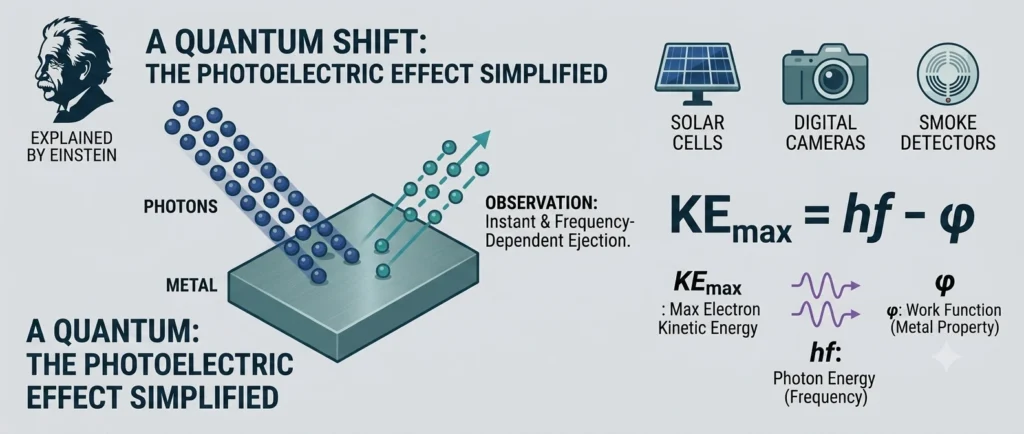
Now the photoelectric effect makes complete sense. An electron in the metal needs a minimum amount of energy to escape from the surface. This minimum energy is called the work function of the metal, represented by the Greek letter phi, and it is different for different metals. When a photon strikes the metal surface, it interacts with a single electron and transfers all of its energy to that electron in one go. The interaction is not gradual. It is instantaneous and complete.
If the photon’s energy is less than the work function, meaning hf is less than phi, then the photon simply does not have enough energy to liberate the electron. The electron absorbs the energy but cannot escape. No matter how many such photons arrive, no matter how bright the light, each one individually lacks the energy needed. So no electrons are ejected. This explains the threshold frequency perfectly.
If the photon’s energy equals or exceeds the work function, the electron absorbs the photon’s energy, uses some of it to escape the metal surface, and the remainder becomes kinetic energy of the now-free electron. The ejection is instantaneous because the energy transfer from photon to electron is instantaneous. This explains why even very dim light above the threshold frequency causes immediate ejection.
The Photoelectric Equation
Einstein expressed all of this in a single elegant equation that precisely describes the energy balance of the photoelectric effect:
KE maximum = hf minus phi
Where KE maximum is the maximum kinetic energy of the ejected electrons in joules, hf is the energy of the incoming photon, and phi is the work function of the metal. The maximum kinetic energy is the energy left over after the electron has used enough energy to escape the surface. Some electrons are deeper in the metal and lose more energy escaping, so they come out with less kinetic energy. The ones right at the surface come out with the maximum kinetic energy given by this equation.
If hf is less than phi the result is negative, which physically means no electrons are ejected. The threshold frequency f0 is the frequency at which hf0 equals phi exactly, meaning the photon has just barely enough energy to free an electron with zero kinetic energy left over.
The equation makes several testable predictions. The maximum kinetic energy of ejected electrons should increase linearly with the frequency of light. The slope of that linear relationship should equal Planck’s constant h. There should be a sharp cutoff threshold frequency below which no ejection occurs. None of these features depend on light intensity at all.
Robert Millikan, an American physicist, set out to disprove Einstein’s equation. He found the whole idea of light quanta deeply objectionable and philosophically unsatisfying. He spent about ten years conducting extraordinarily careful and precise measurements of the photoelectric effect under various conditions. At the end of that decade of effort he had to admit that Einstein’s equation was correct in every detail. His measurements confirmed the linear relationship between photon frequency and electron kinetic energy, confirmed the existence of the threshold frequency, and allowed him to measure Planck’s constant with remarkable accuracy. Millikan won the Nobel Prize in Physics in 1923 partly for this work, which had been intended to refute Einstein but ended up providing some of the strongest confirmation of his theory.
What the Photoelectric Effect Proved About Light
Before Einstein’s explanation, physicists had strong evidence that light behaves as a wave. Young’s double slit experiment showed interference patterns. Maxwell’s equations described light as an electromagnetic wave. Hertz had detected radio waves experimentally. The wave picture of light seemed secure and complete.
After Einstein’s explanation of the photoelectric effect, it became clear that light also has particle-like properties. It delivers energy in discrete localized packets. A single photon interacts with a single electron. The energy of that interaction is determined by frequency, not by the spread-out amplitude of a wave.
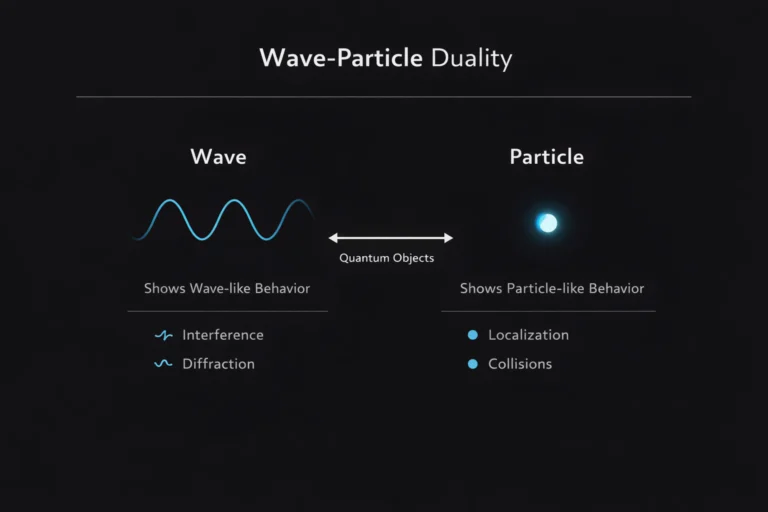
This did not mean the wave theory was wrong. Light genuinely does produce interference patterns and diffraction, which are wave phenomena. Light genuinely does also deliver energy in discrete packets, which is a particle phenomenon. Light is both, depending on what kind of experiment you perform to study it. This is wave-particle duality, one of the central mysteries and defining features of quantum mechanics.
The photoelectric effect was the first solid experimental evidence that electromagnetic energy is quantized, that it comes in discrete chunks rather than flowing continuously. This quantization of energy is the foundation on which all of quantum mechanics is built. Without the photoelectric effect forcing physicists to take energy quantization seriously, the development of quantum mechanics would have been delayed significantly.
The Work Function and Different Metals
Different metals have different work functions, meaning they require different minimum photon energies to eject electrons. Cesium has one of the lowest work functions at about 2.1 eV, which means visible light photons have enough energy to eject electrons from cesium. This is why cesium is commonly used in photoelectric devices. Platinum has a much higher work function at about 5.7 eV, requiring ultraviolet light to eject electrons. Gold, copper, and silver fall somewhere in between.
The work function depends on how tightly the metal holds onto its electrons, which is determined by the electronic structure of the metal. Alkali metals like cesium, sodium, and potassium tend to have low work functions because they have loosely held outer electrons. Transition metals and noble metals tend to have higher work functions.
Knowing the work function of a material allows you to calculate exactly what frequency of light is needed to eject electrons from it, which is valuable information for designing photoelectric devices.
Real World Applications of the Photoelectric Effect
The photoelectric effect is not just a piece of physics history. It is the operating principle behind a wide range of technologies that we use every day.
Solar cells and photovoltaic panels convert sunlight directly into electricity using the photoelectric effect. Photons from the sun strike a semiconductor material, typically silicon, and knock electrons loose. These free electrons are then directed through a circuit to produce an electric current. The efficiency of solar cells depends on how well the semiconductor material absorbs photons and converts their energy to useful electrical current.
Digital cameras use image sensors based on the photoelectric effect. CCD and CMOS sensors are arrays of millions of tiny light-sensitive elements called pixels. Each pixel contains a photodetector that releases electrons when struck by photons. The number of electrons released is proportional to the number of photons that hit that pixel, which corresponds to the brightness of the light at that point in the image. The camera electronics then read out these electron counts to reconstruct the image.
Photomultiplier tubes are extremely sensitive light detectors used in scientific instruments, medical scanners, and particle physics experiments. A single photon strikes a photosensitive surface and ejects one electron. That electron is then accelerated and strikes another surface ejecting several more electrons. This cascade repeats many times, amplifying the original single photon signal into a measurable electrical pulse. Photomultiplier tubes can detect individual photons with high reliability.
Photoelectric smoke detectors use a light source and a detector in a chamber. Smoke particles entering the chamber scatter light onto the detector, triggering the alarm. Some smoke detectors use the ionization of air by radiation rather than the photoelectric effect, but photoelectric detectors are particularly good at detecting slow smoldering fires.
Automatic door sensors, light meters in cameras, barcode scanners, and many types of scientific instruments all rely on the photoelectric conversion of light into electrical signals.
Frequently Asked Questions
What is the photoelectric effect?
The photoelectric effect is the emission of electrons from a material when light of sufficient frequency shines on it. It showed that light delivers energy in discrete packets called photons rather than as a continuous wave, and it became one of the foundations of quantum mechanics.
Why did Einstein win the Nobel Prize for explaining the photoelectric effect rather than for relativity?
Einstein’s explanation of the photoelectric effect provided direct experimental evidence for the quantization of light energy, a truly fundamental discovery about the nature of electromagnetic radiation. Relativity, while enormously important, was at the time considered more theoretical and harder to directly verify experimentally. The Nobel committee awarded the prize specifically for the discovery of the law of the photoelectric effect.
What is the work function?
The work function is the minimum energy required to remove an electron from the surface of a particular material. It is specific to each material and depends on how tightly the material holds its electrons. If a photon’s energy is less than the work function, no electron is ejected regardless of light intensity or exposure time.
What is the threshold frequency?
The threshold frequency is the minimum frequency of light needed to eject electrons from a particular metal surface. Below this frequency no ejection occurs no matter how bright the light. Above this frequency ejection occurs immediately even in very dim light. The threshold frequency equals the work function divided by Planck’s constant.
How does the photoelectric effect relate to solar panels?
Solar panels work by using photons from sunlight to knock electrons loose in a semiconductor material, creating an electric current. This is a direct application of the photoelectric effect. The efficiency of a solar panel depends on how effectively its semiconductor material absorbs photons and converts their energy to electrical current rather than heat.
Why does intensity affect the number of electrons but not their energy?
In Einstein’s photon model, intensity corresponds to the number of photons arriving per second. Each photon interacts with exactly one electron and transfers all its energy to that electron. So more photons mean more electrons ejected, but each individual interaction transfers the same amount of energy determined by the photon’s frequency, not by how many photons there are.
Articles from same category
- Wave-Particle Duality:
- Quantum Mechanics Basics
- Special Relativity
- The Uncertainty Principle
- The Photoelectric Effect
Frequently Asked Questions
Get physics insights delivered weekly
Join students and educators receiving expert explanations, study tips, and platform updates every Thursday.
Join others. No spam.

allphysicsfundamentals
Making physics accessible, interactive, and genuinely understandable for students at every level.