Newton’s Second Law (F = ma): The One Equation That Runs Everything
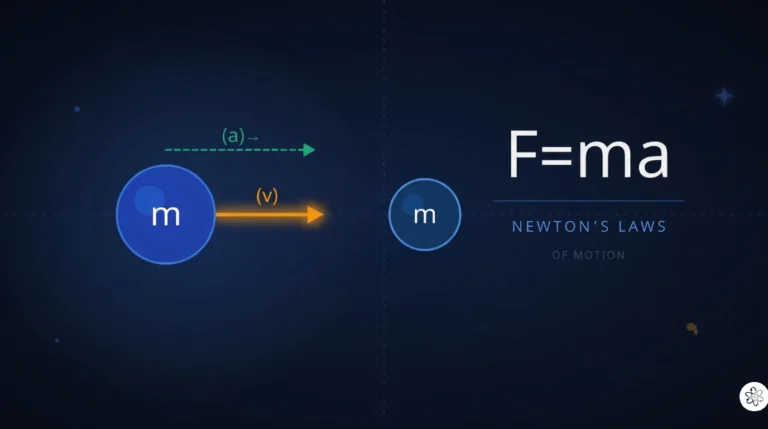
If physics had a greatest hit, it’d be F = ma. Three letters, one equation, and it runs basically everything — from the arc of a thrown ball to the orbit of the Moon, from the crash testing of a car to the thrust calculation of a rocket engine. Newton’s second law is the single most-used equation in all of classical mechanics, and it’s the one you’ll reach for more than any other in a physics course.
But it’s also more subtle than it looks. Most students can plug in numbers. Fewer really understand what the equation is saying about the universe. Let’s fix that.
The Equation: Fnet = ma(Newton’s Second Law)
Newton’s second law says that the net force on an object equals its mass times its acceleration:
Fnet = ma
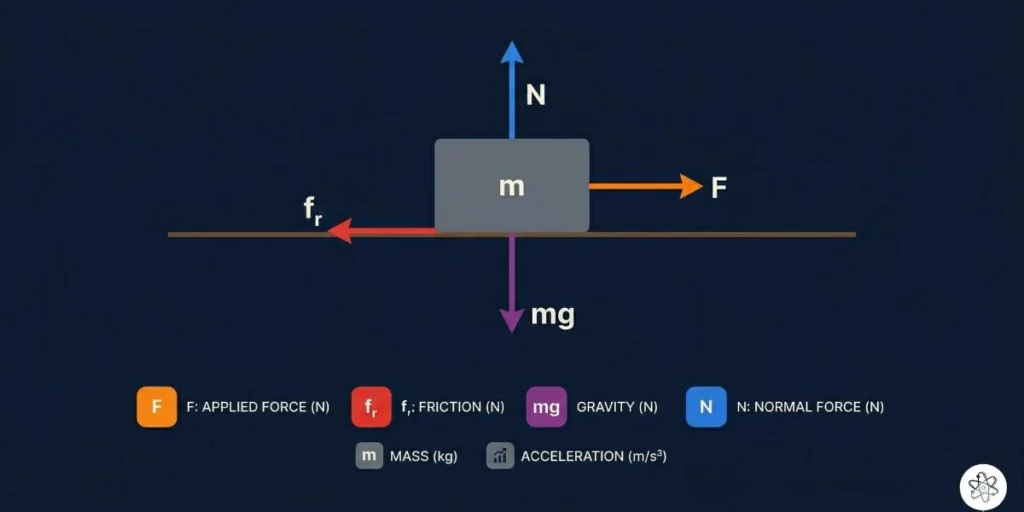
Each piece matters. Fnet is the vector sum of every force acting on the object — gravity, friction, tension, normal force, applied push, air resistance, everything. Not just the biggest force. Not just the one you’re thinking about. The total. Add them all up as vectors, and the result is the net force.
m is the mass — a measure of how much the object resists being accelerated. More mass, harder to speed up or slow down.
a is the acceleration — how fast the velocity changes, in both magnitude and direction.
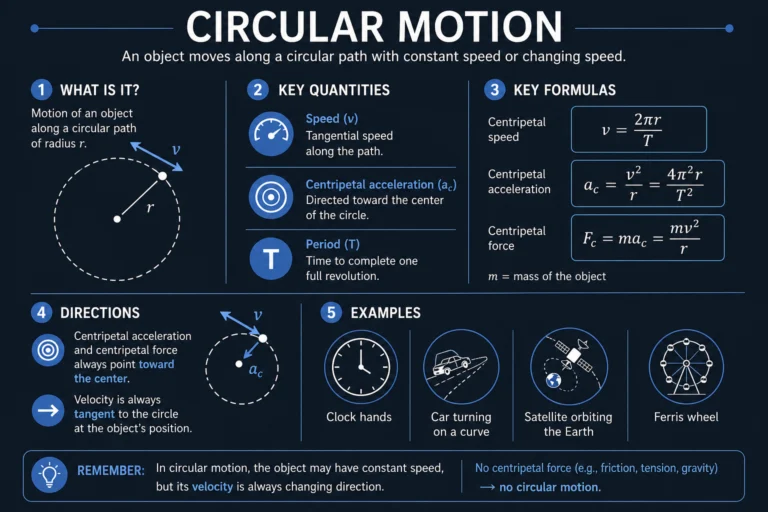
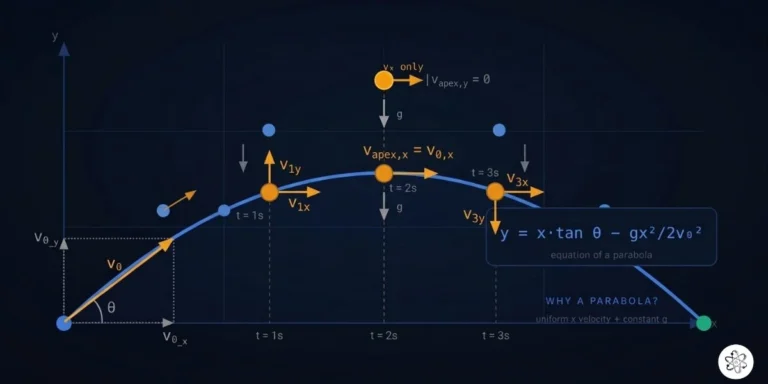
And because it’s a vector equation, it holds independently in every direction. In 2D problems, you split it into two equations: ΣFx = max and ΣFy = may. This decomposition is what makes projectile motion, inclined planes, and circular motion problems solvable.
The Insight Most People Miss: Force Causes Acceleration, Not Speed
This is the single biggest misconception in introductory physics, and it’s the reason F = ma trips up so many students.
Apply a constant force to a box on a frictionless floor. The box doesn’t move at constant speed. It accelerates — it gets faster and faster and faster for as long as you keep pushing. Force doesn’t produce velocity. Force produces a change in velocity. That change is acceleration.
Now flip it around. A car cruising at 100 km/h on a flat highway — is there a net force propelling it forward? No. The engine provides a forward thrust, but air resistance and rolling friction push backward by exactly the same amount. The forces cancel. Net force is zero. Acceleration is zero. Speed is constant. That’s Newton’s first law (inertia), and it’s really just the special case of the second law when Fnet = 0.
Once this clicks — force causes acceleration, not velocity — the rest of mechanics starts making sense in a way it didn’t before.
What Mass Actually Does
Rearrange the equation to a = F/m and something jumps out: for the same force, a heavier object accelerates less. Double the mass, halve the acceleration. That’s why pushing a shopping cart is easy but pushing a loaded truck is a completely different experience — even though the physics is identical, the truck’s enormous mass means any force you can apply produces negligible acceleration.
The mass in F = ma is technically inertial mass — the measure of how much an object resists changes to its motion. There’s also gravitational mass, which determines how strongly gravity pulls on the object. One of the deepest facts in physics — and a cornerstone of Einstein’s general relativity — is that these two types of mass appear to be exactly identical. This has been tested to extraordinary precision (about 1 part in 10¹³), and no difference has ever been found.
That equivalence is why all objects fall at the same rate in a vacuum. The gravitational force on a heavier object is stronger (more gravitational mass), but the object also resists acceleration more (more inertial mass). The two effects cancel perfectly: a = F/m = mg/m = g. Mass drops out. Everything falls at 9.8 m/s². Galileo noticed this empirically. Newton’s second law explains why.
Newton Didn’t Actually Write F = ma
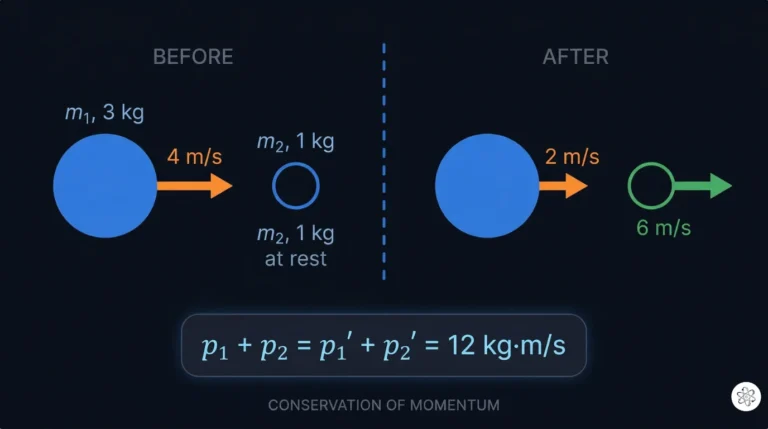
Here’s a piece of history most textbooks gloss over. When Newton published his second law in 1687 in the Principia Mathematica, he didn’t write F = ma. He wrote it in terms of momentum: the net force on an object equals the rate of change of its momentum.
F = dp/dt = d(mv)/dt
When mass is constant (which it is for most everyday problems), d(mv)/dt = m(dv/dt) = ma. So F = ma is the constant-mass version of Newton’s more general statement.
But the momentum form is more fundamental. It works even when mass changes — like a rocket burning fuel and getting lighter, or a raindrop gaining mass as it falls through a cloud. In those cases, F = ma gives the wrong answer, but F = dp/dt still works perfectly. The modern algebraic notation “F = ma” was formalized later, largely by Leonhard Euler, but the underlying physics is all Newton.
Free-Body Diagrams: The Key to Using F = ma
The most common mistake when applying Newton’s second law isn’t math — it’s forgetting a force or including a force that doesn’t belong. The fix is the free-body diagram (FBD): a simple sketch showing your object and every external force acting on it.
Rules for a correct FBD: draw only forces acting on your chosen object. Don’t include forces the object exerts on other things — those belong on other objects’ FBDs. Label every force (gravity, normal, friction, tension, applied). Then add them up as vectors, set ΣF = ma in each direction, and solve.
Nearly every mechanics problem in an introductory course reduces to: (1) draw FBD, (2) sum forces in each direction, (3) set equal to ma, (4) solve. Master that sequence and you can handle blocks on ramps, pulley systems, elevator problems, and circular motion — all with the same equation.
Worked Example: Block on a Frictionless Ramp
A 5 kg block sits on a frictionless ramp angled at 30° to the horizontal. What’s its acceleration down the ramp?
Draw the FBD: gravity (mg = 49 N straight down) and normal force (perpendicular to the ramp surface). No friction.
Choose axes: parallel and perpendicular to the ramp. The component of gravity along the ramp is mg sin 30° = 49 × 0.5 = 24.5 N. The normal force balances the perpendicular component, so no acceleration in that direction.
Apply F = ma along the ramp: 24.5 = 5 × a → a = 4.9 m/s²
Notice the mass cancels if you do it symbolically: a = g sin θ = 9.8 × sin 30° = 4.9 m/s². The acceleration doesn’t depend on mass — just the angle and g. A 5 kg block and a 500 kg block slide at the same rate on the same frictionless ramp.
The Connection to Energy and Work
F = ma doesn’t exist in isolation. Apply it over a distance and you get the work-energy theorem:
W = ΔKE = ½mv² − ½mv₀²
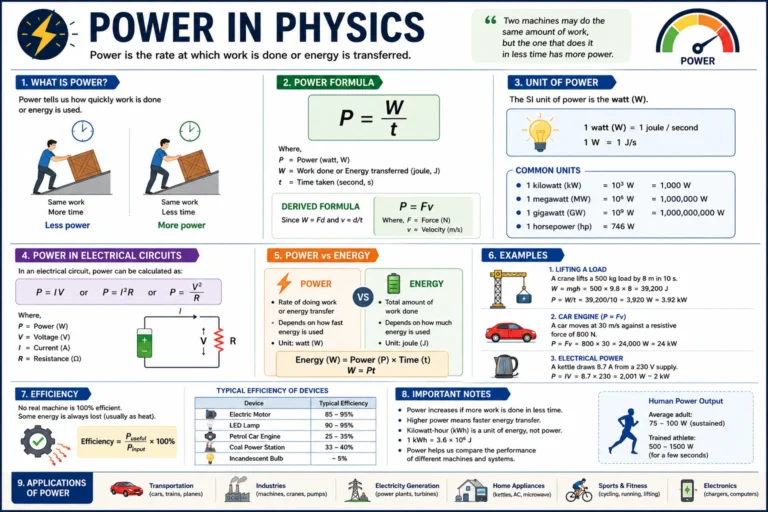
The net work done on an object equals the change in its kinetic energy. This follows directly from integrating F = ma over displacement. In many problems, the energy approach is faster — you skip the time variable entirely and go straight from forces to speeds. But both methods give identical answers because they’re derived from the same underlying law.
Energy methods are especially powerful for curved paths (roller coasters, pendulums, ski jumps) where applying F = ma along a changing direction would require calculus. Conservation of energy handles these in two lines.
Common Mistakes (and How to Avoid Them)
Using one force instead of net force. If gravity pulls down at 50 N and the normal force pushes up at 50 N, the net force is zero — not 50 N. F = ma uses the sum of all forces, not the biggest individual one.
Forgetting that acceleration and net force share a direction. If an object is slowing down, the net force points opposite to the direction of motion. A braking car has a backward net force (friction) and backward acceleration. Deceleration is just acceleration in reverse — there’s no special physics for slowing down.
Confusing mass and weight. Mass (kg) is a property of the object — it’s the same everywhere. Weight (N) is the gravitational force on that object: W = mg. On Earth, a 10 kg object weighs about 98 N. On the Moon, the same 10 kg object weighs about 16 N. The mass didn’t change. The gravitational field did.
Applying F = ma to a system when you need it for one object. If two blocks are connected by a string, you can apply F = ma to the whole system (to find acceleration) and then to one block alone (to find tension). Mixing system and individual equations in the same line produces nonsense.
Where F = ma Shows Up in the Real World
Automotive engineering — crash tests are F = ma problems. The force on a passenger depends on mass and deceleration. Crumple zones and airbags extend the stopping time, reducing acceleration and therefore force (via the impulse-momentum theorem, which flows directly from F = ma).
Aerospace — NASA uses F = ma (in its momentum form) to calculate thrust requirements, fuel burn rates, and orbital trajectories. Every rocket launch is a real-time application of Newton’s second law with changing mass.
Structural engineering — every load calculation for a bridge, building, or dam starts with identifying forces and applying equilibrium conditions (Fnet = 0, the static case of F = ma).
Sports biomechanics — a sprinter’s acceleration off the blocks, a pitcher’s arm delivering a fastball, the force of a tennis racket on a ball — all governed by F = ma. Coaches use force plates that literally measure the F in real time.
Medical devices — accelerometers in pacemakers, impact sensors in helmets, force measurements in prosthetics — all rely on the relationship between force, mass, and acceleration.
Frequently Asked Questions
What does F = ma(Newton’s Second Law) mean?
The net force on an object equals its mass times its acceleration. Force causes acceleration — the greater the force, the greater the acceleration. The greater the mass, the smaller the acceleration for the same force. It’s the foundation of classical mechanics.
Is Newton’s Second Law a definition or a law of nature?
It’s a law of nature — an experimental fact about how the universe works. Newton didn’t define force as mass times acceleration. He discovered through observation that acceleration is proportional to net force and inversely proportional to mass. That’s a statement about physics, not about definitions.
Why do I use net force, not just one force?
Because multiple forces usually act on an object simultaneously — gravity, friction, normal force, tension, applied forces. The object responds to their combined effect (the vector sum), not to any individual force. If two equal forces push in opposite directions, they cancel and the object doesn’t accelerate.
Does F = ma work when mass changes?
Not directly. F = ma is the constant-mass version. The more general form is F = dp/dt (force equals rate of change of momentum). For rockets, raindrops, or any system where mass changes over time, you need the momentum form. For everything else, F = ma works perfectly.
What’s the difference between mass and weight?
Mass (kg) measures how much an object resists acceleration — it’s the same everywhere in the universe. Weight (N) is the gravitational force on an object: W = mg. Your mass is 70 kg whether you’re on Earth, the Moon, or floating in space. Your weight changes depending on the local gravitational field.
Frequently Asked Questions
Get physics insights delivered weekly
Join students and educators receiving expert explanations, study tips, and platform updates every Thursday.
Join others. No spam.
allphysicsfundamentals
Making physics accessible, interactive, and genuinely understandable for students at every level.
Learn
- All Articles
- Classical Mechanics
- Thermodynamics
- Waves & Optics
- Electromagnetism
- Modern Physics